
 Worksheets
26104 power point 2 quiz
Total questions: 30
Worksheet time: 15mins
Which law is applied to various types of circuits in Session Two?
Newton's law
Ohm's law
Kirchhoff's law
Coulomb's law

What is the first step to find the voltage across individual resistors in a circuit?
Calculate the total resistance in the circuit.
Use Ohm's Law directly on each resistor.
Measure the current through each resistor.
Add up all the voltages in the circuit.
Which equation is used to find the individual voltage drops after calculating the total resistance?
E = IR
V=IR2
P = IV
R = V/I
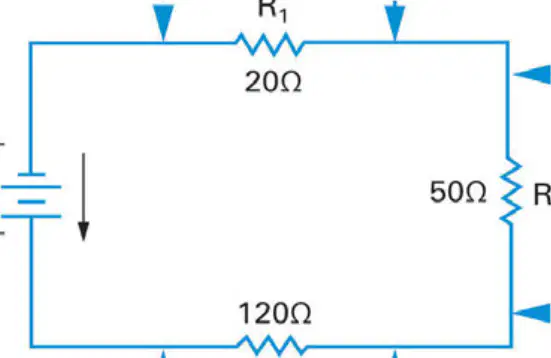
In the given circuit diagram, what is the resistance value of R1?
20Ω
50Ω
120Ω
95Ω

According to the diagram, which component is used to measure voltage?
Voltmeter
Ammeter
Ohmmeter
Thermometer
In a parallel circuit, what is the total current equal to?
The sum of the branch currents
The difference of the branch currents
The product of the branch currents
The average of the branch currents
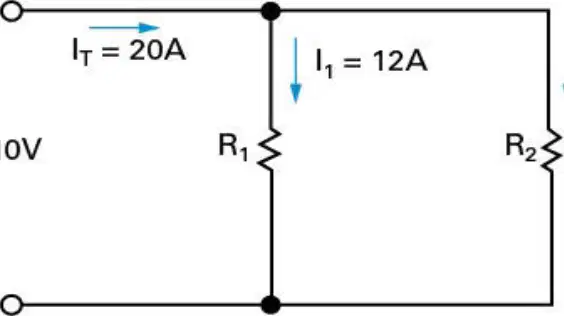
What is the total current (I_T) in the circuit?
20A
12A
8A
15A

How is the current in branch R_2 (I_2) calculated?
I_2 = I_T + I_1
I_2 = I_T - I_1
I_2 = I_1 - I_T
I_2 = I_T * I_1
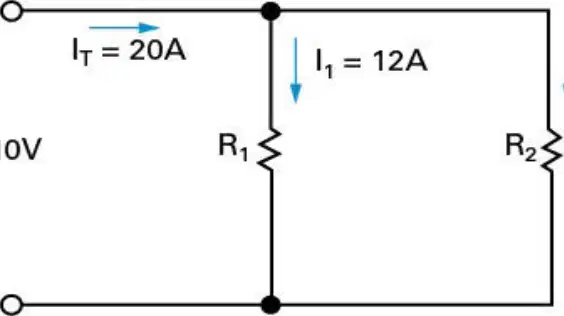
What is the value of the unknown current I_2?
20A
12A
8A
15A
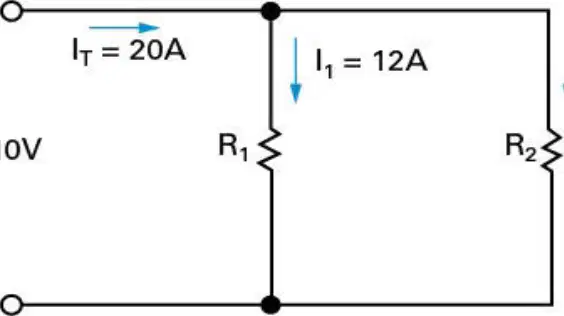
Which equation represents the relationship between I_T, I_1, and I_2?
I_T = I_1 * I_2
I_T = I_1 / I_2
I_T = I_1 + I_2
I_T = I_1 - I_2

What is the total current (IT) in the circuit?
35A
20A
15A
55A

What is the total voltage (E_T) in the given series-parallel circuit?
1.5V
3.0V
0.75V
2.0V
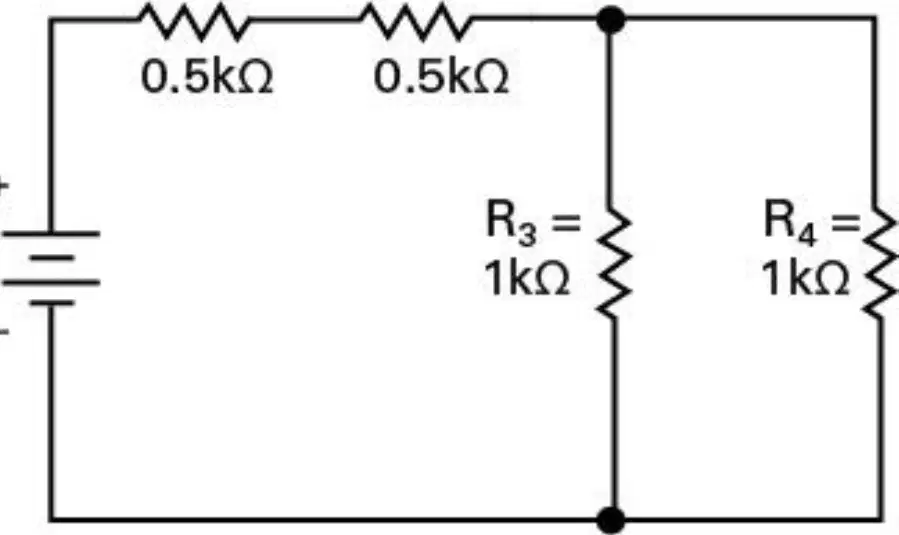
What is the resistance value of R3 in the circuit?
0.5kΩ
1kΩ
1.5kΩ
2kΩ

Which resistors are in series in the given circuit?
R1 and R2
R3 and R4
R1 and R3
R2 and R4
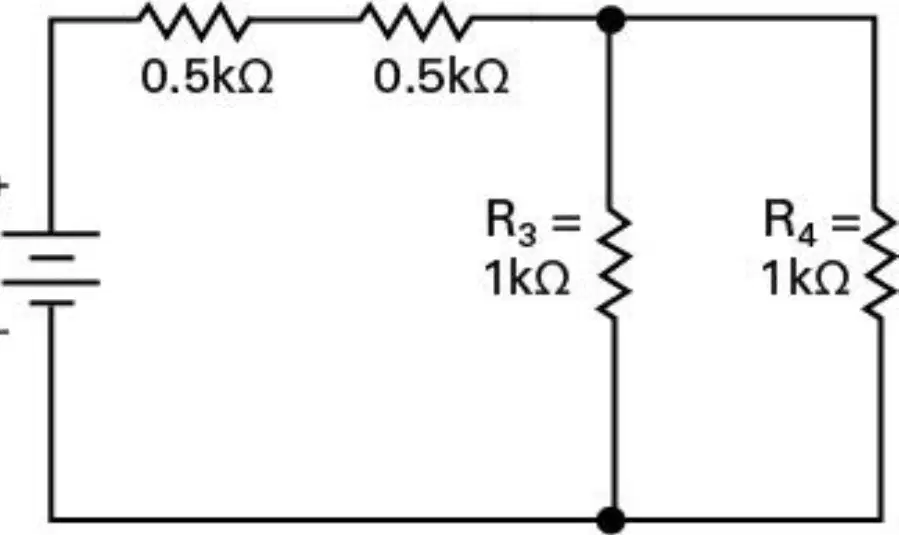
Which resistors are in parallel in the given circuit?
R1 and R2
R3 and R4
R1 and R3
R2 and R4
What is the formula for finding the series resistance of two resistors, R1 and R2?
R1 + R2
R1 × R2
R1 / R2
R1 - R2
If R1 is 0.5 kΩ and R2 is 0.5 kΩ, what is the total series resistance?
1 kΩ
0.5 kΩ
2 kΩ
0.25 kΩ
What method can be used to calculate the resistance of R3 plus R4?
General reciprocal formula
Subtraction method
Division method
Multiplication method

What is the total voltage (E_T) in the simplified series-parallel circuit?
1.5V
2.0V
1.0V
0.5V
What is the resistance value of R1+2 in the circuit?
1kΩ
0.5kΩ
2kΩ
1.5kΩ
What is the resistance value of R3+4 in the circuit?
0.5kΩ
1kΩ
1.5kΩ
2kΩ
What formula is used to calculate individual voltage drops in a circuit?
E = I + R
E = I - R
E = I × R
E = I / R
If the total current (IT) is 1mA and the resistance (R1) is 0.5kΩ, what is the voltage drop (E1)?
0.5V
1.0V
0.25V
2.0V
What is the resistance value used in the calculation of E2?
1kΩ
0.5kΩ
2kΩ
0.25kΩ
What is the current value used in the calculation of E1 and E2?
2mA
0.5mA
1mA
1.5mA

Diagram showing the formula E = I × R and calculations for E1 and E2.
E = I + R
E = I - R
E = I × R
E = I / R

Kirchoff's First Law states
the sum of the currents entering any junction in an electric circuit must equal the sum of the currents leaving that junction
the sum of the charges entering any junction in an electric circuit must equal the sum of the charges leaving that junction
the sum of the emfs entering any junction in an electric circuit must equal the sum of the pds leaving that junction
none of these
Kirchhoff's current law states that _____.
only Ohm’s law can be used to solve for unknown circuit values
the total line current must be less than the sum of the branch currents
the total current entering a point must equal the total current leaving a point
the line current is always twice the sum of the branch currents


