
 Worksheets
Enzymes and Biological Processes Quiz
Total questions: 28
Worksheet time: 14mins
What are enzymes primarily made of?
Nucleic acids
Lipids
Proteins
Carbohydrates
What is the primary function of enzymes in biological reactions?
To change the products
To speed up reactions
To act as a reactant
To slow down reactions
Which model explains enzyme specificity?
Fluid mosaic model
Lock and key model
Bohr model
Induced fit model
What would happen to digestion without enzymes?
It would take 2-3 weeks to digest a meal
It would be faster
It would not occur
It would take 1-2 hours
Enzymes are necessary for which type of reactions?
Metabolic reactions
Nuclear reactions
Combustion reactions
Photosynthesis
What is the role of enzymes in metabolic reactions?
To inhibit reactions
To act as a substrate
To provide energy
To maintain reaction speeds
What is the term for the molecule that an enzyme acts upon?
Product
Substrate
Catalyst
Inhibitor
What happens to enzymes after a reaction?
They are used up
They are changed
They remain unchanged
They become inactive
Which of the following is NOT a characteristic of enzymes?
They speed up reactions
They are used up in reactions
They are biological catalysts
They are proteins
What is the effect of enzymes on the rate of chemical reactions?
They stop the reaction
They increase the rate
They have no effect
They decrease the rate
What is the complementary shape to an enzyme called?
Active site
Substrate
Inhibitor
Product
What is the result of an enzyme-substrate reaction?
A new enzyme
A new substrate
An inhibitor
A product
Which of the following is a property of enzymes?
They are proteins
They are nucleic acids
They are lipids
They are carbohydrates
What is the role of enzymes in digestion?
To speed up digestion
To slow down digestion
To act as a food source
To provide nutrients
Which of the following best describes enzymes?
They are energy sources
They are inorganic catalysts
They are biological catalysts
They are chemical inhibitors
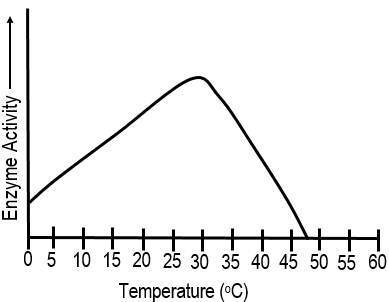
Based on the graph, what temperature does this enzyme work best?
15 C
40 C
30 C

Letter C...
active site
enzymes
substrate
products
Which is the strongest acid?
ph of 1
ph of 4
ph of 7
ph of 9

What is the optimum ph for Enyme A?
6.5
7.0
7.5
8.0

What is the optimum ph for this enzyme to work?
0
6
7
10

Looking at the graph shown, what is the optimum temperature for this particular enzyme to work?
10 degrees
40 degrees
63 degrees
30 degrees

In this diagram a disaccharide molecule is broken apart by adding a water molecule which results in two monosaccharide molecules . What type of chemical reaction is this?
Hydrolysis
Dehydration synthesis
Synthesis Reaction

What is labeled D in this diagram?
Product
Enzyme
Subrate
Enzyme-Substrate complex

An enzyme inhibitor prevents an enzyme from working because it-
eats the substrate
destroys the substrate
eats the enzyme
changes the shape of the enzyme

What is number 1 labeled in this diagram?
Product
Enzyme
Substrate
Enzyme-substrate complex

What is the object labeled Y?
Enzyme
Enzyme-Substrate complex
Substrate
Product
Which of the following is NOT an example of an enzyme?
Lactose
Lactase
Pretease
Lipase
Which of the following is the term that describes the alteration or change of the shape of an enzyme to the point where it is no longer functional?
Denature
Discard
Displace
Denounce

