
 Worksheets
Jacksonian Democracy and Tariff of Abomination 1828
Total questions: 43
Worksheet time: 35mins
Which group was disenfranchised by Jackson's policy of expanding democracy?
Native Americans
Women
African Americans
Landowners
What was Jackson's stance on the Bank of the United States?
He supported it.
He opposed it.
He was neutral.
He wanted to expand it.
The purpose of the Indian Removal Act signed by Jackson in 1830 was to:
Relocate Native American tribes to lands west of the Mississippi River
Grant citizenship to Native Americans
Establish reservations within existing states
Promote trade between Native Americans and settlers
Who proposed the theory of nullification in response to the Tariff of Abomination 1828?
John C. Calhoun
Andrew Jackson
Henry Clay
Daniel Webster
Under Jacksonian Democracy, who can vote in the United States?
Women gain the right to vote
African Americans gain the right to vote
Nearly all white males
All males living in the US, regardless of race
The right to vote is called -- (2)
tariff
nullification
suffrage
franchise
Why did Jackson veto the bank bill?
it was unconstitutional and it favored the rich
it was led by Henry Clay
he just loved vetoing bills
the bank was failing
Why did Jackson oppose the Bank of the United States?
He thought its president was inexperienced and poorly educated.
He thought it loaned too much money to farmers and workers.
He thought it was unconstitutional and that it favored the rich.
He thought it benefited western business owners over those in the east.
The nullification crisis occurred when...
the Supreme Court declared the tariff laws null and void.
Congress refused Jackson's request to repeal the tariff laws.
South Carolina threatened to secede if the tariff laws were enforced.
Jackson threatened to make South Carolina leave the Union by force.
What is an action that cancels federal law to which a state objects?
nationalism
tariff
spoils system
nullification
The nullification confrontation of 1832- 1833 between President Andrew Jackson and South Carolina Senator John C. Calhoun concerned
Jackson's attempts to abolish slavery in the South
Calhoun's claim that a state has the power to ignore federal laws
the constitutionality of the second Bank of the U.S.
whether slavery would be allowed in western territories
The nullification crisis occurred when
the Supreme Court declared the tariff laws null and void.
Congress refused Jackson's request to repeal the tariff laws.
South Carolina threatened to secede if the tariff laws were enforced.
Jackson threatened to make South Carolina leave the Union by force.
The concept of nullification became an issue during Jackson's presidency when
South Carolina nullified congressional tariff bills
Southern representatives to the Electoral College switched their votes in the 1824 election
Virginia nullified congressional legislation concerning slavery
South Carolina nullified congressional legislation concerning the removal of Native Americans
What was the Nullification Crisis about?
The right of states to secede from the Union
The enforcement of federal tariffs by the state of South Carolina
The ability of states to declare federal laws unconstitutional
The dispute over the renewal of the Bank of the United States
“I consider, then, the power to annul a law of the United States, assumed by one State, incompatible with the existence of the Union, contradicted expressly by the letter of the Constitution, unauthorized by its spirit, inconsistent with every principle on which it was founded, and destruction of the great object for which it was formed…” Andrew Jackson, 1832
What issue is this about?
Indian Removal Act
Nullification Crisis
Westward Expansion
Suffrage
The tariff passed by Congress in 1828, which angered Southerners, was the (a) .
Tariff of Abominations
Industrial Tariff
Jackson Tariff
Cause and Effect: Andrew Jackson refused to uphold the decision of Worcester v. Georgia, which led to
Headright System
Land Lotteries
Manifest Destiny
Trail of Tears
A major reason for President Andrew Jackson’s policy toward the Cherokee Nation was to
provide Native American Indians with better farmland
enforce the United States Supreme Court decision in Worcester v. Georgia (1832)
obtain land from Native American Indians for white settlers
gain the political support of Native American Indians
(v.) to give up, surrender; to hand over to another
bargain
cede
nullify
plurality
a law that ended the U.S. government's earlier policy of respecting the rights of Native Americans to remain on their land
Indian Removal Act
Trail of Tears
Tariff of Abomination
Jacksonian Democracy
the route the Cherokees and other Native Americans took during their forced migration from the southeast United States to Oklahoma
inflation
Trail of Tears
doctrine of nullification
treason
Which of the following was not part of Henry Clay's American System?
National Bank
states' rights
Protective Tariffs
federal subsidies for infrastructure
Which of Henry Clay's American System did the West want?
National Bank
Protective Tariffs
mining rights
Federal subsidies for improvements to the infrastructure
sued the state of Georgia and the main tribe on the Trail of Tears
Cherokee nation
Andrew Jackson
Nicholas Biddle
Henry Clay
the term used by southerners to refer to the Tariff of 1828 because it stirred feelings of disgust and hatred
Indian Removal Act
Trail of Tears
Tariff of Abomination
Jacksonian Democracy
the route the Cherokees and other Native Americans took during their forced migration from the southeast United States to Oklahoma
inflation
Trail of Tears
doctrine of nullification
treason
to formally reject a decision or proposal made by a legislature
veto
agrarian
spoils system
secession
the practice of rewarding political backers with government jobs
veto
assimilate
spoils system
secession
related to agriculture or farming
truce
agrarian
corruption
secession
. to adopt the culture or way of life of the nation in which one currently lives
treason
truce
corruption
assimilate
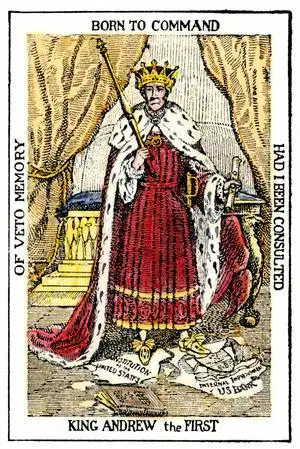
President Jackson is portrayed in this political cartoon as a king because -
He ended the Presidency and started a monarchy
He refused to follow checks and balances as President
He regained citizenship in England
He allowed Parliament to reinstitute laws against Americans
Which of the following are TRUE about the Nullification crisis? (Pick 2)
Southern states wanted to end the tariff!
Tariffs supported southern farmers and hurt northern factories!
Northerners wanted to secede from the USA!
Tariffs supported Northern factories but hurt southern farmers!
What political party was President Jackson a part of?
Federalist
Republican
Democratic
Whig
Why did Andrew Jackson close the National Bank?
The bank favored the poor!
The bank favored the new manifest destiny lands!
The bank favored the elite!
The bank favored the Supreme Court!
Nullify means -
accept
cancel
amend
refuse
Southern states argued for states rights against the tariff! What amendment gives states rights?
7th
8th
9th
10th

The proclamation excerpted above was issued during which of these historical events?
Shay's Rebellion
The War of 1812
The Nullification Crisis
The Civil War
What was President Jackson's response to the nullification crisis?
He admitted that the Union was a "compact" of the states
He offered to raise tariffs to keep South Carolina in the Union
He conceded South Carolina's right to secede
He threatened to use force against South Carolina if it did not repeal its nullification policies

Which of the following correctly completes this graphic organizer?
President Jackson annexes land west of the Mississippi River.
President Jackson ignores a Supreme Court ruling.
President Jackson introduces a bill to Congress.
President Jackson vetoes an act passed by Congress.
What is the Spoils System?
President chooses enemies into government positions
President chooses friends for government positions
John Calhoun stood up against President Jackson due to the tariff! Calhoun is from the state of -
North Carolina
North Dakota
South Virginia
South Carolina
President Jackson signed the Force Bill and threatened military action to make southern states pay the -
National Bank
Navy and Air Force
Protective Tariff
What was the primary purpose of the Tariff of 1828?
To increase international trade
To support Southern agricultural exports
To protect American manufacturers from foreign competition
To decrease taxes on imported goods

