
Font size
 Worksheets
CH8: Earth's Origin
Total questions: 45
Worksheet time: 25mins
What formed from a huge cloud of gases and particles pulled together by gravity?
A star
A planet
A black hole
A galaxy
Fill in the blank: Earth remained a mass of liquid rock for ________ of years.
millions
thousands
billions
hundreds
What are examples of dynamism in the dynamic geosphere?
Volcanic eruptions and earthquakes
Photosynthesis and respiration
Evaporation and condensation
Magnetism and electricity
Fill in the blank: Weathering, erosion, and deposition break down rock, move sediment, and form ________ rock.
sedimentary
igneous
metamorphic
volcanic
Geologists use relative dating to place rocks in chronological order by:
using radiometric dating techniques.
comparing the age of rock layers with fossils.
analyzing the chemical composition of rocks.
observing the position of rock layers.
Fill in the blank: The geologic time scale is based on relative and absolute dating. The divisions are ________, ________, and ________.
The divisions are eons, eras, and periods.
The divisions are epochs, ages, and phases.
The divisions are centuries, decades, and years.
The divisions are cycles, stages, and intervals.
Scientists hypothesize about early Earth that it was:
a barren wasteland with no atmosphere
a lush paradise with abundant life
a molten mass with volcanic activity
a frozen ice world
The theory of plate tectonics is:
a scientific theory explaining the movement of the Earth's lithosphere.
a theory about the formation of stars.
a hypothesis about the extinction of dinosaurs.
a concept related to the water cycle.
Earth's thin, solid, outer skin is called the ____
crust
mantle
core
atmosphere
A mostly solid shell that stretches from the crust to a depth of 2900 kilometers is called the ____.
mantle
core
crust
lithosphere
The incredibly hot layer of Earth below the mantle is called the ____.
core
crust
lithosphere
asthenosphere
The theory of plate tectonics explains the movement of which of the following?
Continental and oceanic plates
Atmospheric layers
Ocean currents
Mountain ranges
What processes change rock?
Weathering and erosion
Photosynthesis
Condensation
Evaporation
What is the definition of plate tectonics?
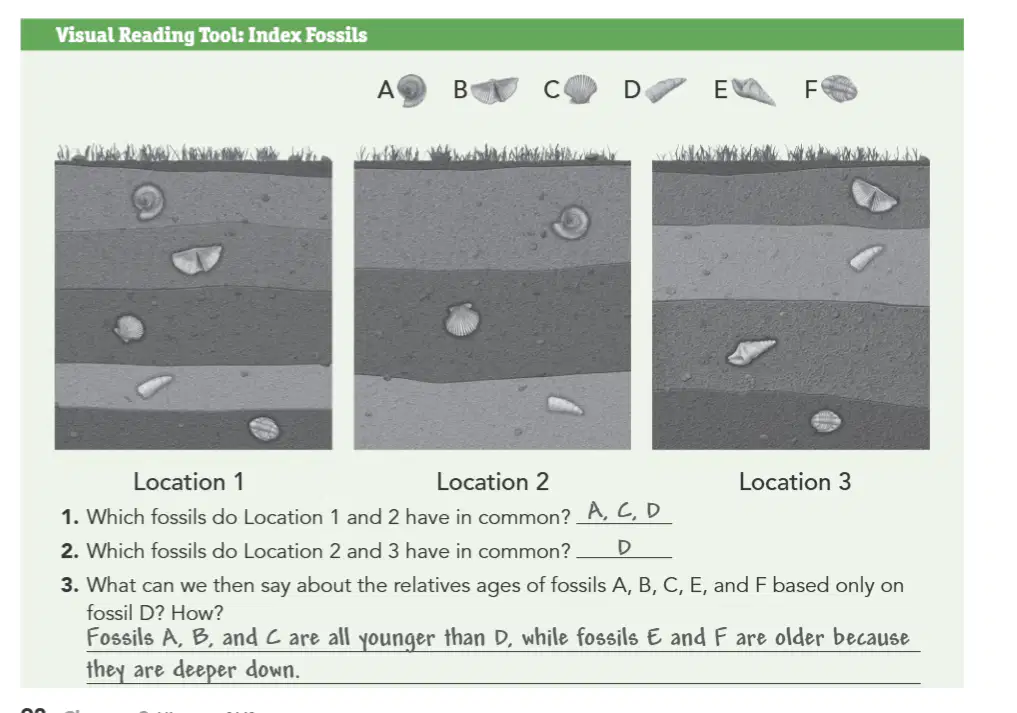
Which fossils do Location 1 and 2 have in common?
A
C
D

What can we then say about the relative ages of fossils A, B, C, E, and F based only on fossil D? How?
Fossils A, B, and C are all younger than D, while fossils E and F are older because they are deeper down.
Fossils A, B, C, E, and F are all older than D.
Fossils A, B, C, E, and F are all younger than D.
Fossils A and B are older than D, while C, E, and F are younger.
What is a half-life? A half-life is the time required for half of the radioactive atoms in a sample to decay. True or False?
True
False
What is the geologic time scale?
The geologic time scale is a timeline of Earth’s history. It is based on both relative and absolute dating. The major divisions of the geologic time scale are eons, eras, and periods.
The geologic time scale is a method to measure the distance between planets.
The geologic time scale is a calendar used by geologists to predict future earthquakes.
The geologic time scale is a chart that shows the different types of rocks found on Earth.
The geologic time scale was established by:
studying rock layers and index fossils
analyzing climate patterns
observing animal behavior
measuring ocean currents
The sequence of events in the Miller-Urey Experiment is described in the text as:
A series of chemical reactions simulating early Earth conditions.
A demonstration of the theory of evolution.
A study of the effects of climate change.
An analysis of the human genome.
Summarize the RNA World Hypothesis based on the information provided.
The RNA World Hypothesis suggests that early life forms relied on RNA for both genetic information and catalytic functions.
The RNA World Hypothesis proposes that DNA was the first genetic material, followed by RNA and proteins.
The RNA World Hypothesis states that proteins were the first molecules to store genetic information.
The RNA World Hypothesis claims that life originated from simple inorganic molecules without any genetic material.
The role of the biosphere as a force in planetary evolution is described in the text as:
a significant influence on climate and atmospheric conditions
a minor factor in geological processes
irrelevant to the development of life
a temporary phase in Earth's history
What do scientists know about the earliest eukaryotes according to the text?
Scientists know that the earliest eukaryotes were single-celled organisms.
Scientists know that the earliest eukaryotes were multi-celled organisms.
Scientists know that the earliest eukaryotes were plants.
Scientists know that the earliest eukaryotes were animals.
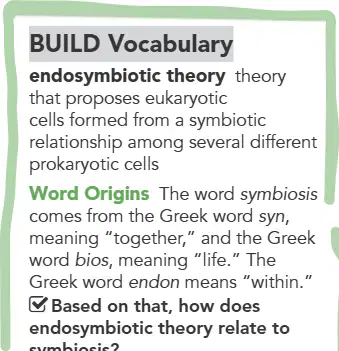
The endosymbiotic theory is explained as:
A theory that explains the origin of eukaryotic cells from prokaryotic organisms.
A theory that describes the process of photosynthesis in plants.
A theory that outlines the principles of natural selection.
A theory that details the structure of the DNA molecule.
Scientists hypothesize about the origin of life.
It began in deep-sea hydrothermal vents.
It was created by extraterrestrial beings.
It started from a single-celled organism.
It originated from a chemical reaction in the ocean.
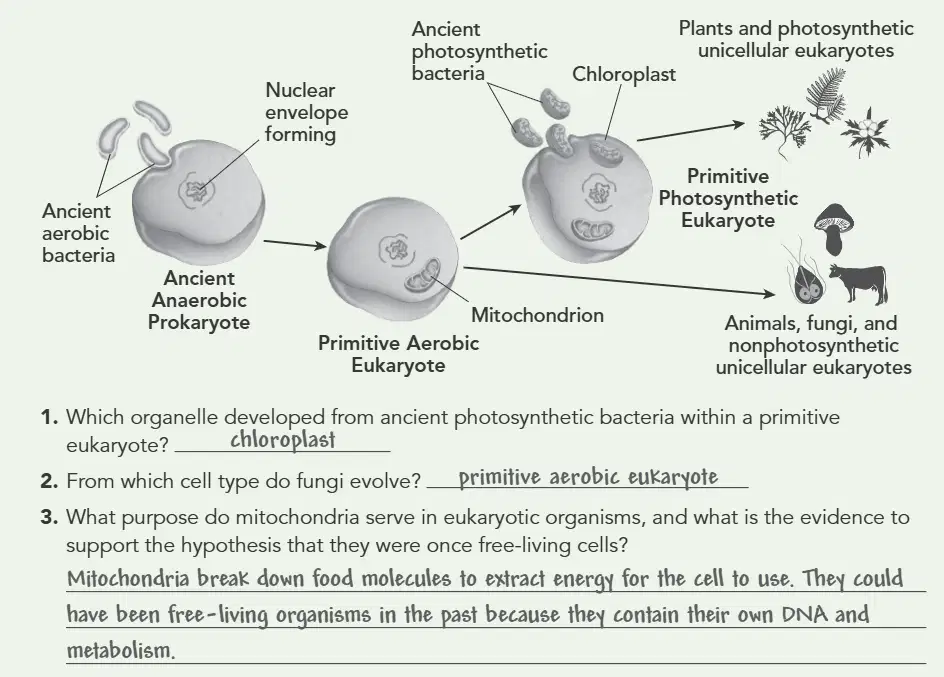
Which organelle developed from ancient photosynthetic bacteria within a primitive eukaryote?
chloroplast
mitochondria
nucleus
ribosome
From which cell type do fungi evolve?
primitive aerobic eukaryote
prokaryotic cell
anaerobic eukaryote
photosynthetic eukaryote
Mitochondria serve a specific purpose in eukaryotic organisms. What is this purpose, and what evidence supports the hypothesis that they were once free-living cells?
Energy production; presence of their own DNA and double membrane
Protein synthesis; lack of ribosomes
Photosynthesis; presence of chlorophyll
Cell division; ability to replicate independently
What do fossils reveal about ancient life?
Fossils reveal the diet and behavior of ancient life.
Fossils reveal the climate and environment of ancient life.
Fossils reveal the evolution and extinction of ancient life.
Fossils reveal the size and shape of ancient life.
When environmental conditions change, individuals that have favorable adaptations are able to ______ and pass down their advantageous traits.
survive
migrate
hibernate
perish
Fill in the blank: When two species evolve in response to or with each other, it is called ______.
co-evolution
symbiosis
mutation
natural selection
Climate change has affected the history of life by:
causing mass extinctions and altering habitats
having no significant impact
improving biodiversity
stabilizing global temperatures
What patterns can be observed in the fossil record?
Evolutionary changes over time
Random distribution of species
No discernible patterns
Only marine life fossils
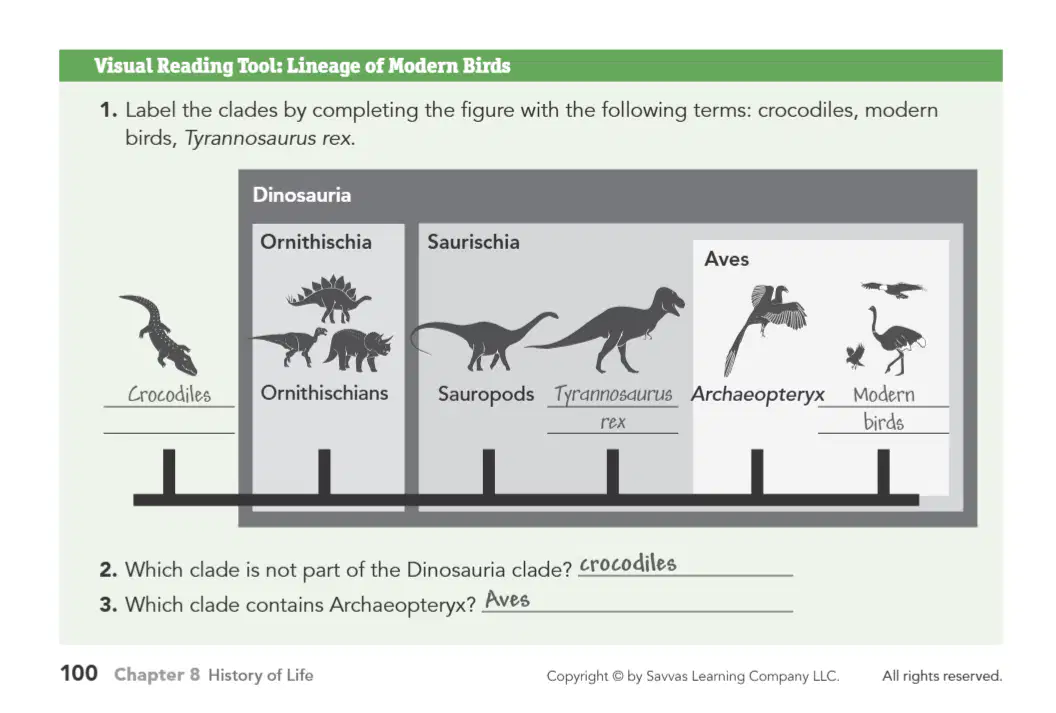
Which clade is not part of the Dinosauria clade?
Crocodiles
Ornithischians
Sauropods
Aves
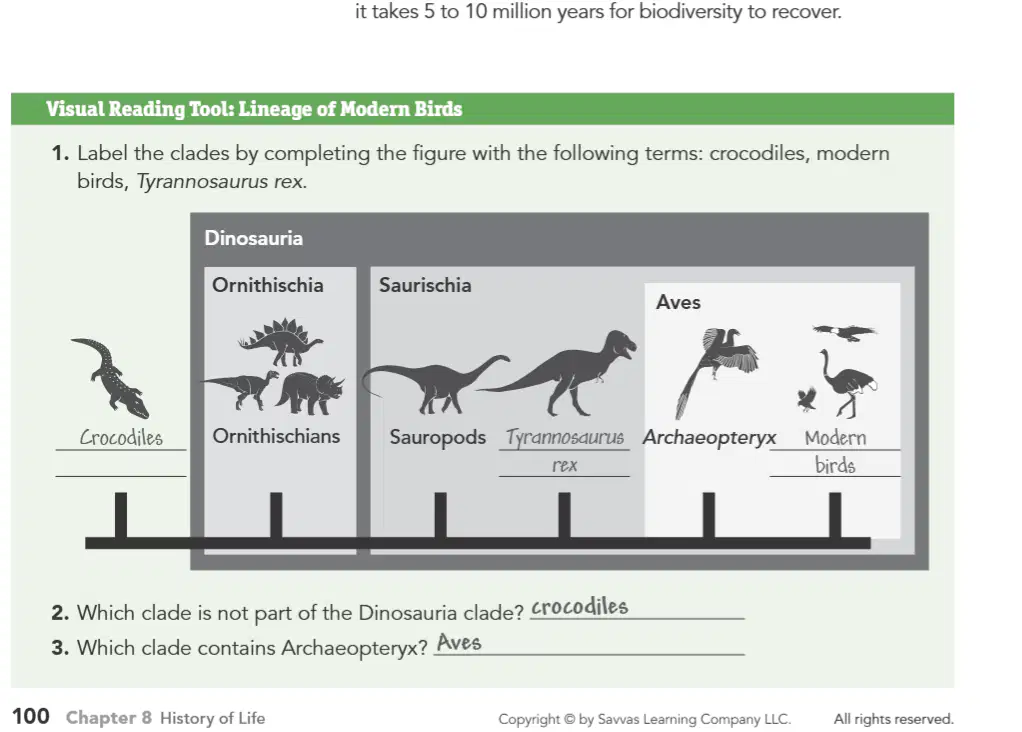
Which clade contains Archaeopteryx?
Crocodiles
Ornithischians
Sauropods
Aves
What does 'extinct' mean?
Having no living members.
Being in danger of disappearing.
Thriving in large numbers.
Recently discovered.
What is 'background extinction'?
Extinction caused by the slow and steady process of natural selection.
Extinction caused by catastrophic events.
Extinction due to human activities.
Extinction of species in a specific habitat.
What is 'mass extinction'?
An event during which many species become extinct during a relatively short period of time.
A process of gradual adaptation of species to their environment.
A phenomenon where a single species dominates an ecosystem.
A natural event that leads to the formation of new species.
How fast does evolution take place?
Instantly
Over a few years
Over millions of years
It varies significantly
What is the definition of convergent evolution?
A) Evolution of a species by gradual accumulation of small genetic changes over long periods of time
B) Evolution in which long, stable periods are interrupted by brief periods of more rapid change
C) Process by which a single species or a small group of species evolves into several different forms
D) Evolution of similar characteristics in unrelated organisms
What is the definition of coevolution?
A) Evolution of a species by gradual accumulation of small genetic changes over long periods of time
B) Evolution in which long, stable periods are interrupted by brief periods of more rapid change
C) Process by which a single species or a small group of species evolves into several different forms
D) Process by which two species evolve in response to changes in each other over time
Two species evolve in response to each other over time
A. convergent evolution
B. coevolution
C. adaptive radiation
Determining a fossil’s age by its placement with other fossils within rock layers is called
the geologic time scale
radiometric dating
relative dating
Have changes in climate occurred in the past? Give examples.
Yes, changes in climate have occurred in the past, such as the Ice Age.
No, climate has remained constant throughout history.
Climate changes are only a recent phenomenon due to human activity.
Climate changes have occurred only in the last century.
A mass extinction is defined by what criteria, and what are the immediate effects on biodiversity?
A significant and rapid decrease in biodiversity, leading to the loss of many species.
A gradual change in climate affecting only a few species.
An increase in biodiversity due to new species emerging.
A slow and steady evolution of species over millions of years.

