
 Worksheets
Domain Vocabulary: Chapters 1–3
Total questions: 65
Worksheet time: 33mins
To be an example of _______.
exemplify
illustrate
demonstrate
represent
Relating to a style of European art popular in the seventeenth and eighteenth centuries _______.
Baroque
Renaissance
Gothic
Neoclassical
Describing the sun as the center of the universe _______.
heliocentric
geocentric
astrological
mythological
The act of cutting something into parts in order to study it _______.
dissection
analysis
surgery
examination
The removal or reduction of certain punishments for sin, linked to a special act of penance _______.
indulgence
absolution
confession
penance
An idea or opinion _______.
thesis
hypothesis
notion
concept
Describing Earth as the center of the universe _______.
geocentric
heliocentric
astronomic
cosmologic
A person who goes against the accepted teachings of a religion _______.
heretic
believer
follower
devotee
A person who challenges existing ideas in an institution _______.
reformer
conformist
follower
traditionalist
The head of government of the city of Venice _______.
doge
mayor
president
governor
Based on reason and logic _______
rational
irrational
emotional
intuitive
The study of religious faith, practice, and experience _______.
theology
biology
psychology
sociology
A removal from a group or place in a sudden or violent way _______.
purge
insert
attach
connect
The idea that a person’s salvation has already been decided by God _______.
predestination
free will
reincarnation
karma
A person who gives money or other support to someone, such as an artist _______.
patron
beneficiary
client
sponsor
A school where advanced learning is taught _______.
university
college
high school
academy
A method of looking at information and evidence through questioning and doubt _______.
skepticism
certainty
faith
acceptance
An art technique used to make something that is flat appear to have depth, in addition to height and width _______.
perspective
shading
coloring
outlining
A building where a community of monks lives, worships, and works together _______
monastery
library
museum
church
Use the word bank to complete the crossword puzzle: A type of wall painting made on wet plaster _______.
fresco
mosaic
graffiti
tapestry
A branch of mathematics that studies the measurements and relationships between lines, angles, surfaces, and shapes _______.
geometry
algebra
calculus
trigonometry
Use the word bank to complete the crossword puzzle: Relating to the literature, art, architecture, or ideas of the ancient Greek and Roman world _______.
classical
modern
medieval
baroque
A system of buying now and paying later based on a person’s honesty and ability to pay _______.
credit
cash
barter
loan
Use the word bank to complete the crossword puzzle: The head of the Roman Catholic Church _______.
pope
bishop
cardinal
priest
Not religious or faith based _______.
secular
religious
spiritual
devout
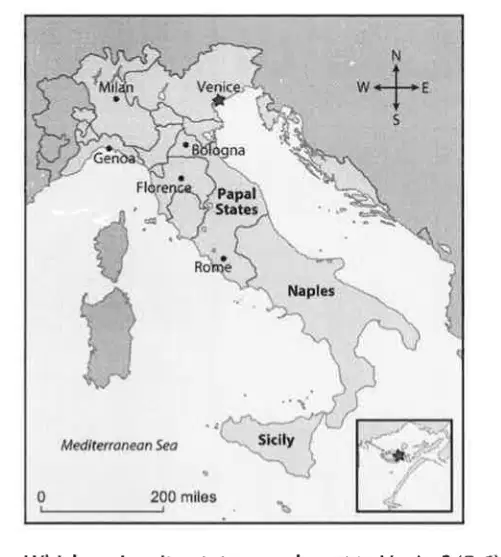
Which major city-state was closest to Venice? (5.6)
Sicily
Rome
Sardinia
Bologna
Which statement best explains a reason why the Renaissance flourished in Italy? (5.12)
Rulers in Italy rejected the teachings of the Church.
Humanism was banned in most of Europe.
Holy Roman Emperors encouraged new ideas.
Wealthy citizens and the Church supported artists and architects.
Which are humanist ideals? Select the two correct answers. (5.12)
understanding the spiritual world
striving for eternal salvation
allowing humans to shape religious rules
celebrating the human experience
recognizing the potential within each person
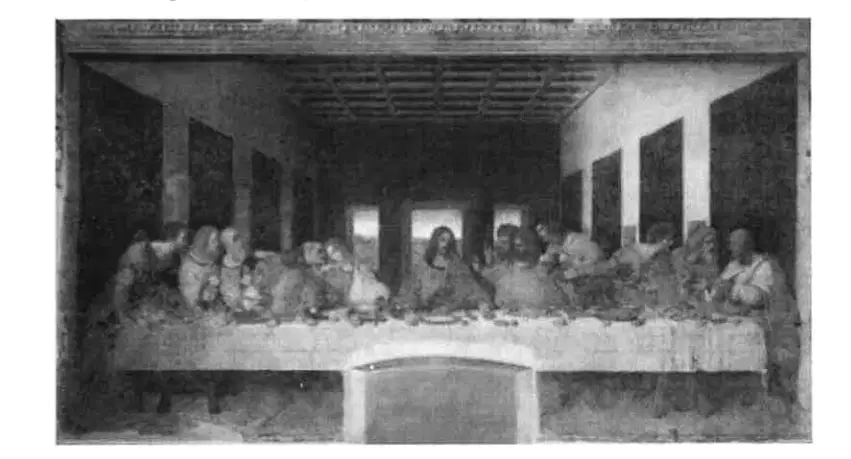
Who created this painting? (5.2.a, 5.12, 5.12.c)
Leonardo da Vinci
Filippo Brunelleschi
Leon Battista Alberti
Michelangelo Buonarroti
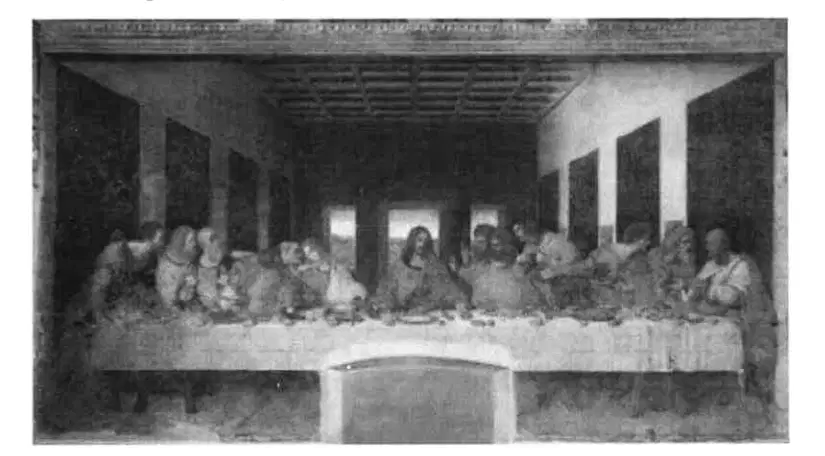
What technique was used to create the illusion of depth in this painting?
fresco
plaster
movable type
linear perspective
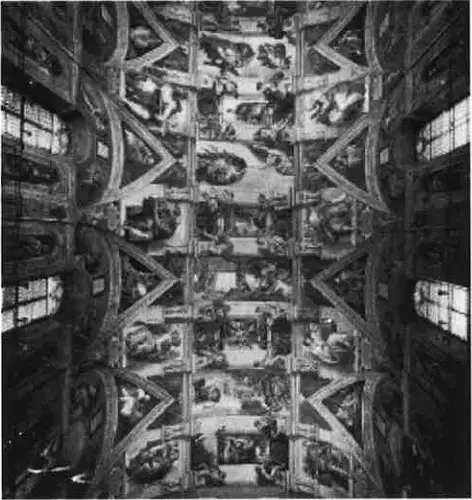
What type of images are painted on the ceiling in this work of art?
images depicting world events
images depicting Renaissance events
images depicting biblical events
images depicting Roman events
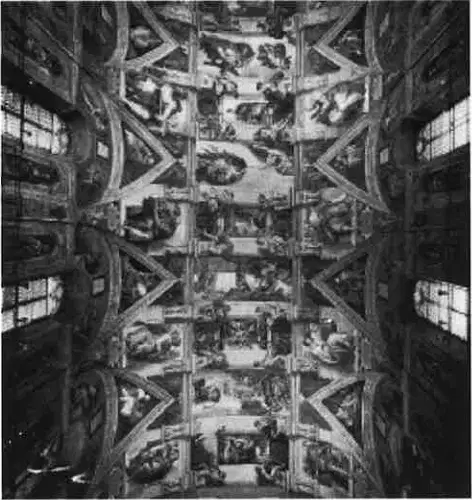
Where is this work of art located?
the Medici family’s home in Florence
the Sistine Chapel, built as a private chapel for the pope in Rome
the Cathedral of Santa Maria del Fiore in Florence
the pope’s residence in Avignon, France
In what ways did Gutenberg’s printing press influence the Protestant Reformation? Select the two correct answers.
Pamphlets and books spreading Protestant ideas were cheaper to make.
Printed texts were easier to hide from Church authorities.
Printed books encouraged the growth of literacy.
Printing presses were easy to construct and maintain.
The specialized knowledge needed to use a press encouraged people to question the Church.
Which phrase from the passage describes what a citizen needs to have in order to become a prince? (5.2.a)
crime or intolerable violence
worth or entirely on fortune
cunning assisted by fortune
oppression of the great
One factor that influenced the Renaissance was:
The invention of the printing press
The fall of the Roman Empire
The Industrial Revolution
The discovery of electricity
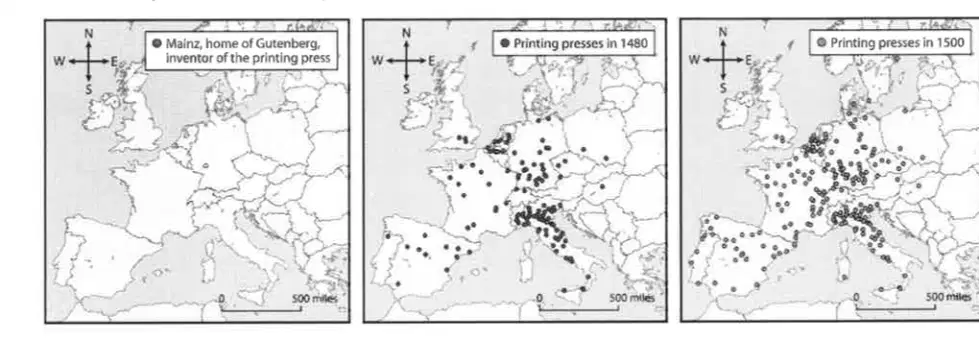
What spread because of the development shown on the map? (5.6, 5.7, 5.12.d)
trade
ideas
slavery
disease
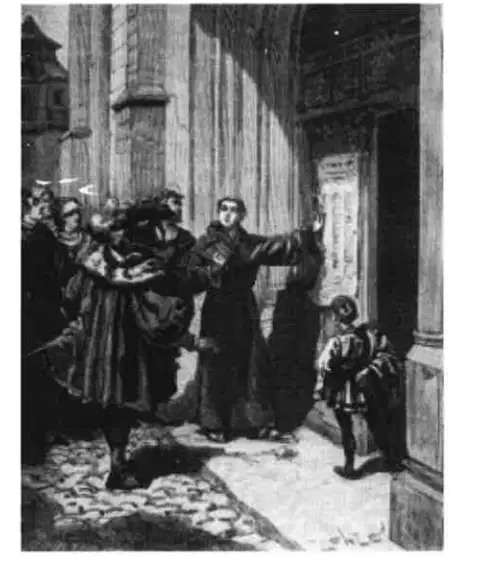
What prompted Martin Luther to take the action shown in the image?
He was against the pope’s return to Rome.
He wanted to share his theory of predestination.
He disagreed with the Church’s sale of indulgences.
He thought only clergy should teach Church doctrine.
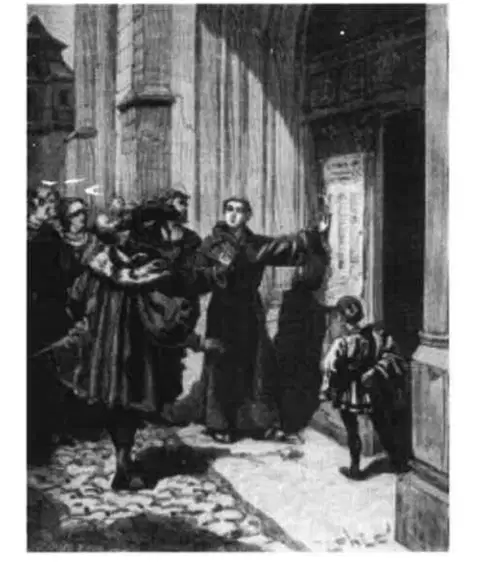
What was an effect of Luther’s action shown in the image?
The Church split into the Catholic Church and the Protestant Church.
The Catholic Church lowered the prices of indulgences.
Spain purged all non-Catholics from the country.
Martin Luther was executed for being a heretic.
On which theological ideas did Luther and John Calvin agree? Select the two correct answers. (5.8, 5.12)
A person can be saved by faith alone.
A person does not need religion to be saved.
A person’s fate is decided by God ahead of time.
A person’s actions do not determine the goodness of their soul.
A person needs only the Bible, not guidance from religious leaders.
What was one outcome of the Treaty of Westphalia? (5.3)
Protestantism became the official European religion.
The Holy Roman Empire expanded its territory.
Countries were allowed to govern themselves
Continent-wide rules for governance were set.
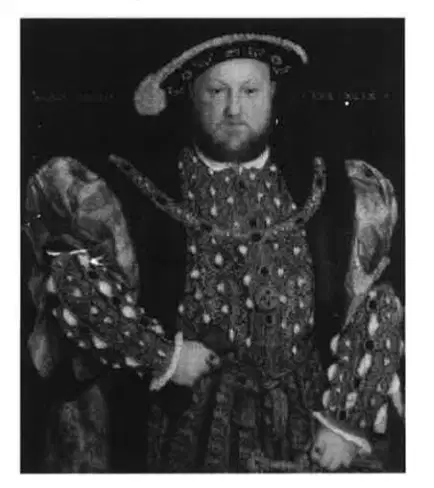
Why did the person in the image leave the Catholic Church? (5.3, 5.12)
He did not support the sale of indulgences.
He thought clergy were unnecessary for worship.
His new wife was a follower of Lutheran doctrine.
The pope would not allow him to divorce his wife.
What did supporters of the Counter-Reformation want the Catholic Church to do in response to the Reformation? Select the three correct answers. (5.8, 5.12, 5.12.e)
allow people to leave the Church if they wanted
provide better education for priests
establish new schools and universities
fight corruption within the Church
adopt translated versions of the Bible
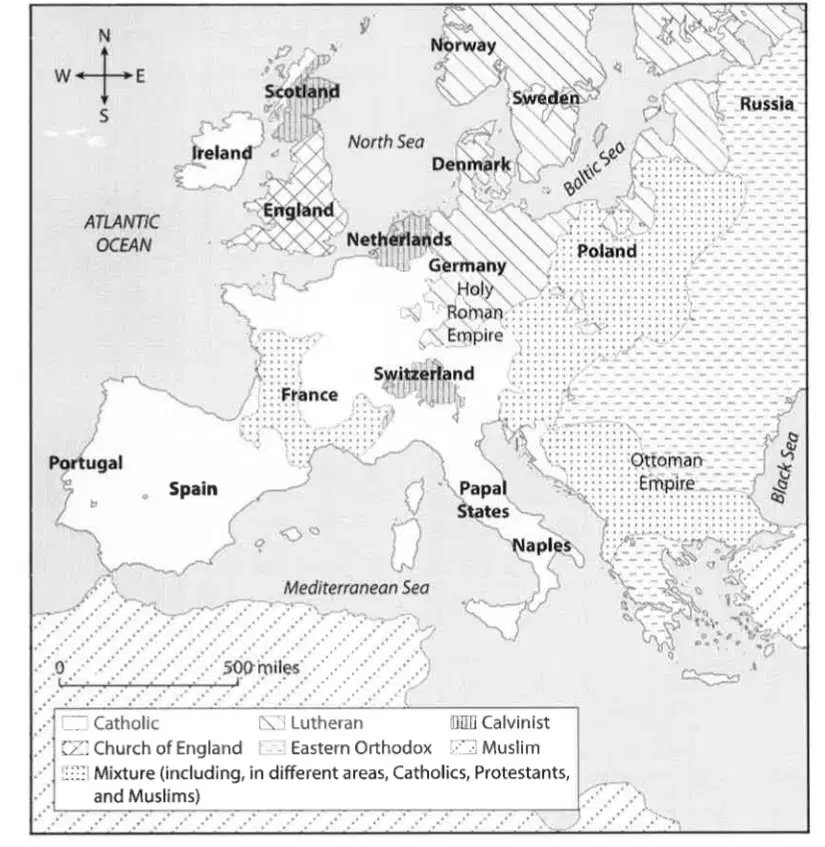
What was the dominant religion of Spain in the mid-1500s?
Islam
Calvinism
Catholic
Lutheran
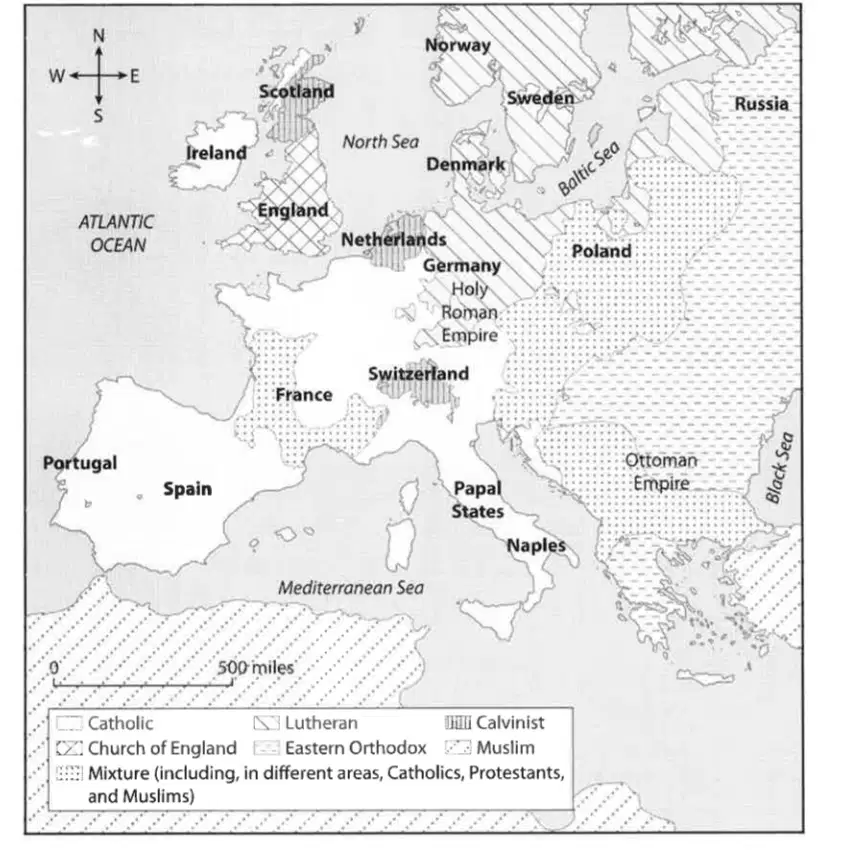
Which country was primarily a Calvinist country? (5.6, 5.8)
Netherlands
Germany
Denmark
Spain
Which thesis describes the consequence for purchasing an indulgence?
#21
#27
#28
#32
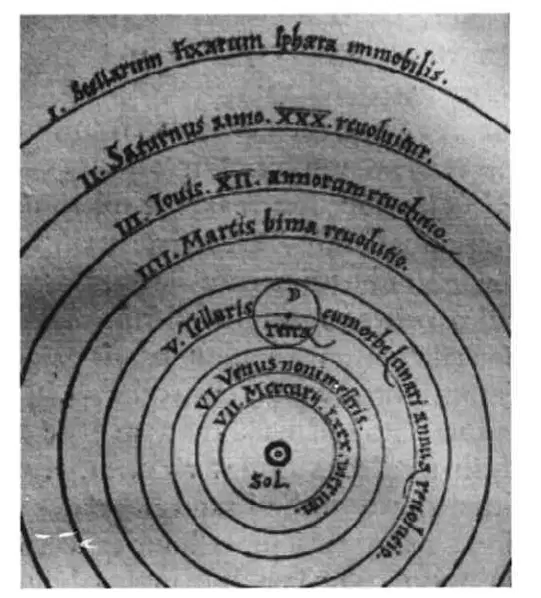
Which idea is explained by this diagram? (5.12.f)
the origin of life
the distance to Rome
the anatomy of a human
the theory developed by Copernicus
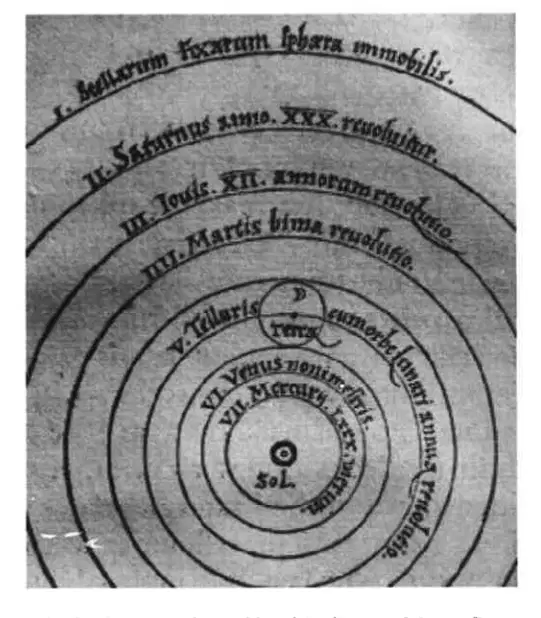
What does the circle at the center of the diagram represent? (5.12.f)
the sun
Earth
the moon
the Milky Way
Which statement best explains why the Roman Catholic Church rejected Galileo’s scientific discoveries? (5.12.f)
Church leaders feared that Galileo’s discoveries would make people convert to other religions.
Church leaders feared the rise of new technology.
Church leaders felt that Galileo’s discoveries went against the Bible’s teachings.
Church leaders were concerned that Galileo was becoming too powerful.
Which phrases best describe Renaissance ideas that influenced the Scientific Revolution? Select the two correct answers. (5.12)
encouraging curiosity
focusing on spirituality
maintaining traditions
defending rights
exploring new lands
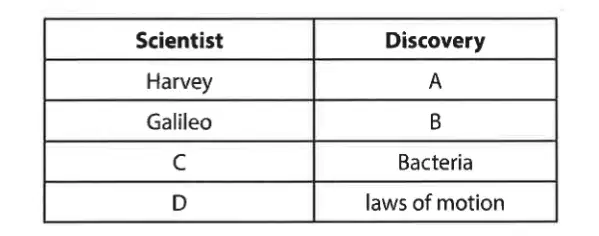
Which discovery belongs in Box A? (5.12)
how to heal wounds faster
how muscles are structured
how blood pumps through the body
how oxygen moves around the body
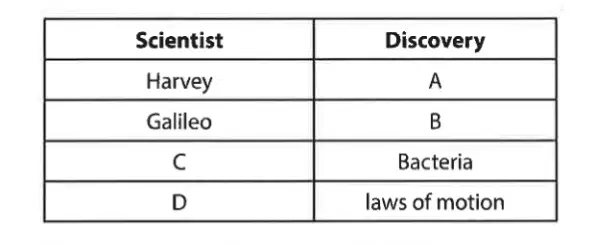
Which discoveries could go in Box B? Select the two correct answers. (5.12.g)
Jupiter’s moons
the existence of gravity
the compound microscope
the invention of movable type
Earth’s moon’s mountains and valleys
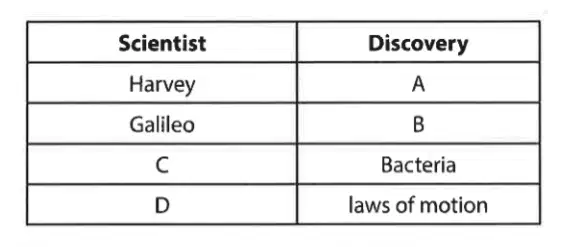
Who belongs in Box D? (5.12)
Tycho Brahe
Isaac Newton
Francis Bacon
René Descartes
Which phrases best describe parts of Francis Bacon’s scientific method? Select the two correct answers. (5.12)
relying on traditional ideas
using math to understand the universe
observing things in nature
using science to solve real-life problems
making predictions without observation
How did Isaac Newton develop his scientific method? (5.12)
He combined the ideas of Descartes and Bacon.
He used the existing methods of Galileo and Copernicus.
He created a method based on instinct and repeatable tests.
He followed the Church’s teachings about the presence of God in all things.
Use the following passage from “Excerpt from Galileo’s Letter to Grand Duchess Christina of Tuscany (1615)” to answer the question. “To command professors of astronomy that they must themselves see to confuting [arguing against] their own observations and demonstrations is to ask the impossible, for it is not only to command them not to see what they do see, and not understand what they do understand, but to seek for and to find the contrary. . . . . . . it is not in the power of any creature to make them to be true or false, otherwise than as, in fact, they are.” Which statement summarizes Galileo’s argument? (5.2.a, 5.12.g)
a) “You cannot ask a scientist to teach something they know to be false.”
b) “We don’t see or understand impossible things, so we can’t teach them.”
c) “Things that can be observed and demonstrated are true; everything else is false.”
d) “Humans cannot change facts, so there’s no use in trying to change how we teach them.”
which of these statements about the printing press is most accurate?
Books became less important in everyday life.
Books and documents became more expensive for the average person.
It helped scientific and religious ideas spread quicker.
The church was now able to control all information released to the people.
Which of these best explains the impact of Gutenberg's invention on the church?
Only Catholic approved books were printed and distributed to the people.
It was difficult and expensive to ship books, so only the bible was able to be purchased.
The church effectively banned all of Gutenberg's presses, preventing new ideas from being spread.
It reduced the Church's ability to control information, leading to conflicts with scientists.
Which of these best explains why Martin Luther was considered a heretic by the church?
His paintings showed the Church in a negative light.
He used the church in order to make money for his business.
His belief in polytheism led to arguments with Catholic bishops.
He spoke out against the Church making money from selling indulgences.
which of these best explains Martin Luther's message?
Luther taught that angels in the bible should be treated as gods.
Luther taught that people should not give money in return for God’s forgiveness.
Luther explained to others the church cannot survive without financial support from his business.
Luther felt that his paintings were an important way of teaching others about the problems of the Church.
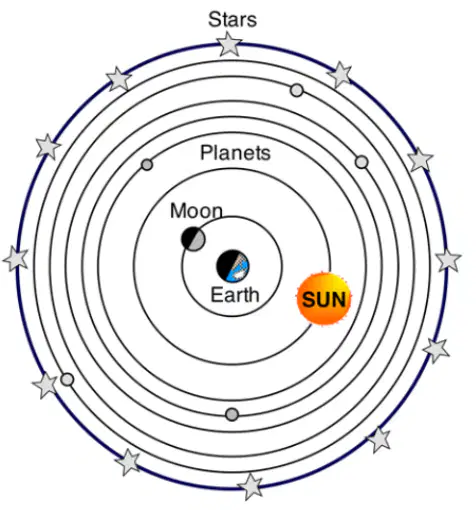
Which of the following best describes the model found in the image?
Geocentric
Theocentric
Heliocentric
Biocentric
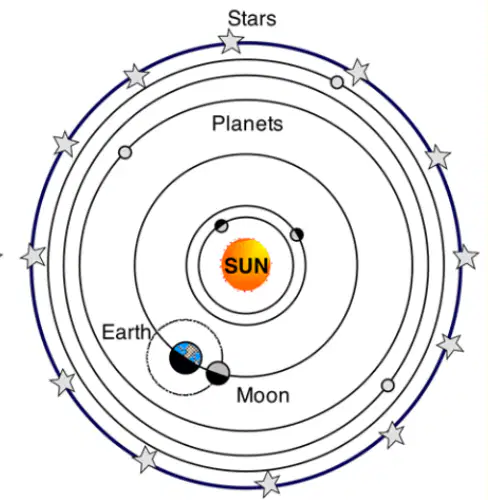
Which of the following best describes the model found in the image?
Geocentric
Theocentric
Heliocentric
Biocentric
Which of these best summarizes the accomplishments of the Scientific Revolution?
The Church improved its methods in spreading its services to the rich and the poor.
There were new advances in medicines as the black plague continued to infect livestock.
The new scientific theories helped people revert back to previous belief systems from before the Renaissance.
There were many new scientific inventions and discoveries in the areas of astronomy and studying the human body.
Which of these best explains Copernicus’ contribution to the Scientific Revolution?
He supported a heliocentric view where the sun was at the center of the universe.
He supported a geocentric view where the Earth is at the center of the universe.
He used his wealth to support many painters and sculptors in the church.
He spent his career debating Galileo who supported the idea that the Earth was the center of the universe.
Which of the following best describes the reaction of the Catholic Church to Galileo's ideas?
The Church agreed with his ideas completely.
The Church strongly opposed his model of the universe.
The Church eagerly adapted the Bible to support the new heliocentric model.
The Church began new funding for scientists to support these new theories.
Which of these most accurately describes Galileo’s contributions to the Scientific Revolution?
He debated many political leaders of the time to abolish slavery.
He was an artist who painted many famous works like the Mona Lisa.
He was part of the clergy and worked to promote the bible and its teachings.
He improved many scientific tools, like the telescope, while supporting other new scientific theories.

