
 Worksheets
TCAP Review
Total questions: 100
Worksheet time: 53mins
How did hunter-gatherers make tools?
They used fire to shape metal pieces.
They hit flint on other stones to break off pieces.
They rubbed two pieces of wood together to sharpen them.
They used artifacts to bend and sharpen wood.
Why are hunter-gatherers considered nomadic?
They practiced large-scale farming.
They lived in small family groups.
They moved from place to place in search of food.
They used fire to stay warm.
What types of shelter did hunter-gatherers use?
Temporary shelters made of wood and stone.
Natural shelters live caves and rock overhangs.
Permanent shelters made of clay and plant materials.
Permanent shelters like villages.
Temporary shelters made of animal skins and plant materials.
When did early humans start building permanent settlements?
when they started farming
when they started using basic hunting weapons
when they started using fire
when they started using tools
Which factors contributed to the Agricultural Revolution? (2)
The earth cooled and there were fewer animals.
They earth warmed and plants grew more readily.
People discovered how to make tools.
People discovered how to use fire.
People discovered how to domesticate animals.
After the Agricultural Revolution, people started to use materials such as _______ to make shelters.
mud bricks
animal skins
cotton and wool
caves and rock overhangs
Which of these examples describes a barter economy?
A weaver buys food from a farmer.
A weaver asks a farmer to share the food he grew.
A weaver and a farmer trade cloth for food.
A weaver grows enough food to feed his family.
Which characteristic of a civilization was used as a way to organize communities based on class and profession?
Culture
Government
Military
Social Structure
Which of the following are advancements made by Sumerians to transport agricultural goods more quickly? (2)
chariot
plow
wheel
pottery
sail
How did the Sumerians use slave labor?
to fertilize poor soil
to experiment with metallurgy
to cultivate field and crops
to invent the wheel

Based on this chart, how are monarchies and empires different?
Empires are created by conquering different cultures, while monarchies rule a single culture.
Monarchies are made by uniting ethic minorities, while empires are made up of one group of people.
Empires are not culturally diverse, while monarchies are made up of several cultures.
Monarchies are divided across several diverse regions, while empires are located in one central location.
Power lies with one person
Rule is hereditary.
Actions are not restricted by written law.
What type of government is described in this chart?
Anarchy
Democracy
Monarchy
Oligarchy

According to this excerpt, how did religion impact the culture of Mesopotamian civilizations?
Mesopotamians believes in a single deity that no impact on daily life.
Mesopotamians created new city-states to honor their many deities.
Mesopotamians were controlled by religious leaders who claimed to be living deities.
Mesopotamians believed in multiple deities that influenced different elements of daily life.
Why did Mesopotamians give offerings in their religious temples? (2)
They wanted to develop a system of measurement.
They wanted to be the first empire.
They wanted to be rewarded with peace and plentiful crops.
They wanted to create a new writing system.
They were fearful that a natural disaster or personal disaster could result if they did not.
What was the purpose of the Ziggurat in Mesopotamia?
They used it as a home for slave labor.
They used it for religious worship.
They used it for the king's home.
They used it as a place of safety in case of invasion.
Why is the Epic of Gilgamesh an important Sumerian achievement?
It is the oldest religious temple.
It is the oldest writing system.
It is the oldest system of measurement.
It is the oldest written long poem.
Why is the Code of Hammurabi significant to the history of Mesopotamia?
It was the first declaration of war.
It was the first set of written laws.
It was the first religious text.
It was the first example of government taxation.
What were common roles for slaves in Ancient Egypt? (2)
working in labor camps
leading governments
selling goods
assisting the wealthy
studying medicine
According to Ancient Egyptian society, why were pharaohs given the power to rule?
It was believed that pharaohs were representatives of the artisan class.
It was believed that pharaohs were living gods.
Pharaohs were selected by the wealthy elite.
Pharaohs were elected by the common people.
Why were wealthy Ancient Egyptians mummified after death?
They believed that aniaml spirits could live within their bodies.
They believed that death was temporary.
They believed that death caused new diseases.
They believed that their bodies could be used in the afterlife.
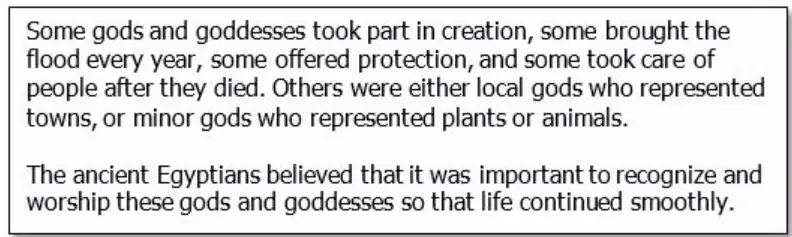
According to the reading, what is true about Egyptian religion?
The Egyptians practiced polytheism in their civilization.
The Egyptians believed gods lived alongside humans in society.
The Egyptians practiced monotheism in their civilization.
The Egyptians did not place an importance on religion.
How did the discovery of King Tut's tomb contribute to the study of Ancient Egypt?
It provided detailed evidence of Ancient Egyptian educational techniques.
It provided examples of written laws in Ancient Egypt.
It provided an opportunity to study the roles of enslaved people in Ancient Egypt.
It provided detailed evidence of Ancient Egyptian burial practices.

Which historical figure completes this chart?
Cleopatra
Moses
Ramses II
King Tut
How did the economic policies of Queen Hatshepsut help Ancient Egypt?
by establishing trade relationships with many foreign countries
by establishing many powerful businesses in the region
by establishing a new system of currency
by establishing several banks
Which were invented in Ancient Egypt? (3)
gunpowder
hieroglyphics
papyrus
pyramid
silk
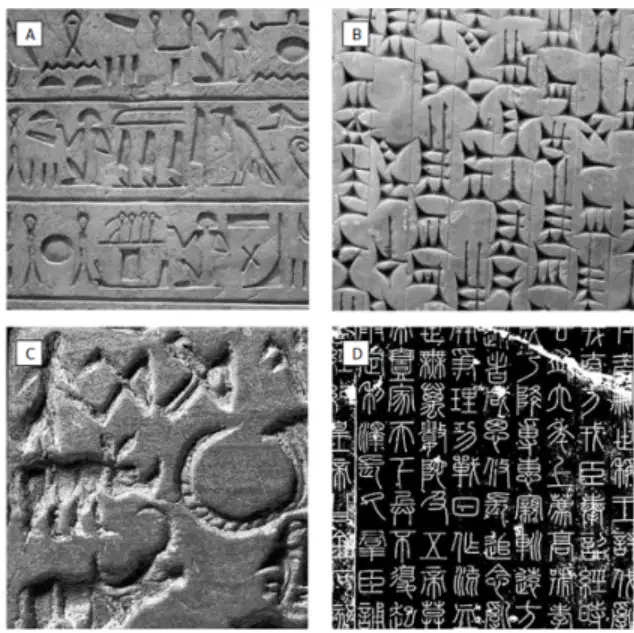
Which of these writing samples came from ancient Egypt?
A
B
C
D
What was the purpose of the Sphinx at Giza?
It is an extremely large structure that was built to honor the pharaohs.
It is the first known structure to be built with wood.
It is the first known structure to include a sewer.
It is a defensive structure that was built to protect the local population.
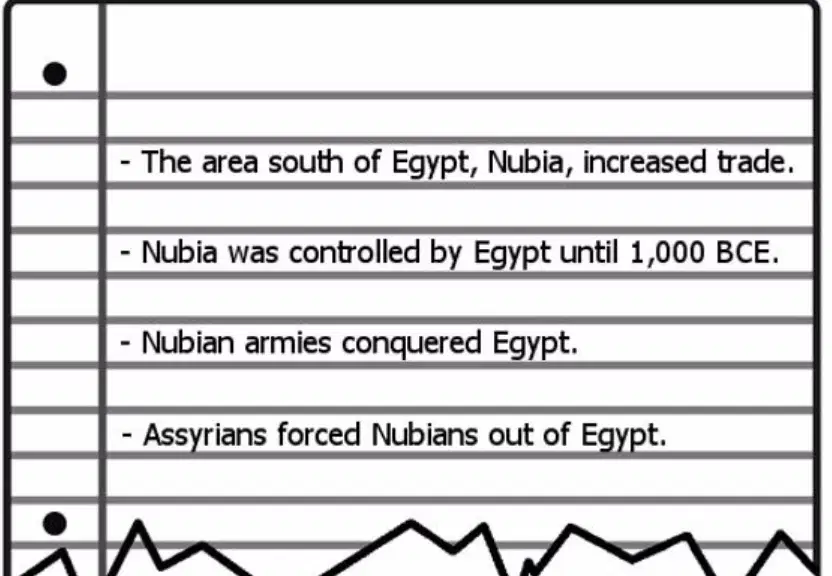
Which ancient Nubian civilization is most closely associated to the events in these notes?
Assyria
Kush
Mesopotamia
Sumer
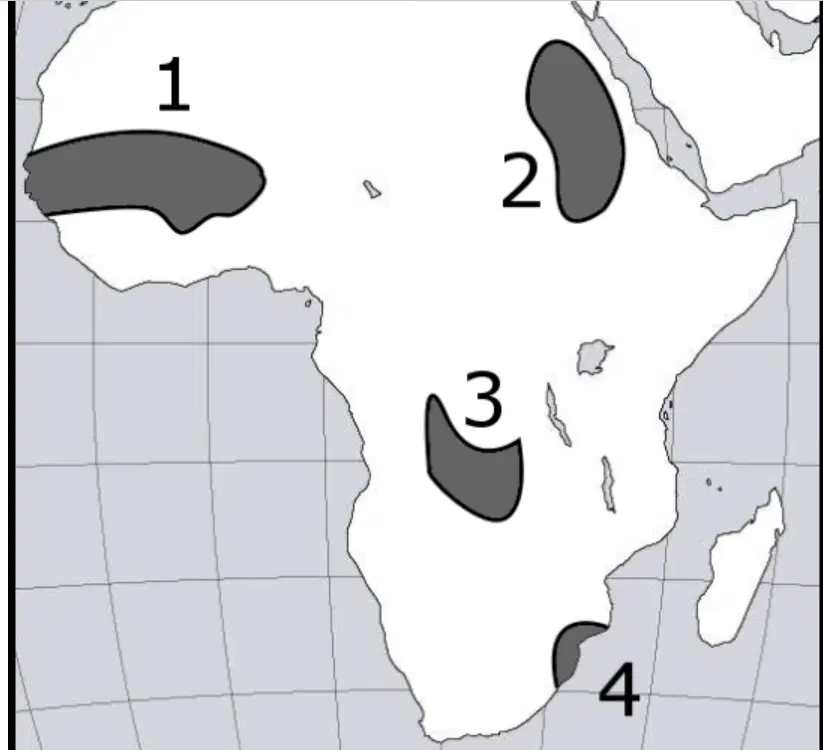
Which darkly shaded area identifies the land controlled by the Kush civilization?
1
2
3
4
Which statement describes the relationship between Egypt and Kush?
Nubia conquered Egypt but maintained and adopted its culture.
Trade was discouraged between Nubia and Egypt.
Pharaohs from Egypt ruled Kush for almost a century.
The Egyptians allied with the Assyrians to take back lands being ruled by Kush.
Which statement accurately describes the location of the Jordan River?
The Jordan River flows through Turkey
The Jordan River is located in northern Egypt
The Jordan River is north of the Dead Sea in Israel
The Jordan River forms the border between Europe and Asia

Which events completes this timeline?
Israelites explored Asia.
Israelites introduced trade to Africa.
Israelites left Egypt to settle in Canaan.
Israelites took control of Egypt.

According to the Torah, this quote inspired which historical event?
the settlement of Israelites in Canaan
the conquest of Israel by the Egyptians
the freeing of the Israelites by the Babylonians
the Sumerian evacuation of Israel
How was the religion of the Israelites different from all other religions at the time of its creation?
It was the first written religion.
It was monotheistic.
It was the first religion to contain laws.
It was polytheistic .
According to the Jewish religion, why did Abraham lead the Hebrews out of Mesopotamia?
The Sumerians had enslaved the Hebrews.
Drought forced the Hebrews to look for new farmland.
God had promised the land of Canaan to the Hebrews.
War forced the Hebrews to retreat into the Arabian Desert.
Why is Moses an important figure in Ancient Israeli history?
He preached the earliest forms of Christianity.
He increased trade with Europe.
He developed early Israeli laws and was given the Ten Commandments.
He led an Israeli army into Egypt to free Jewish slaves.

The events in this chart all happened as a result of the rule of which historical figure?
Aristotle
Shi Huang
Pericles
King Solomon
What was one major impact of King David's rule of Israel?
He made Judaism the official religion of Israel.
He established democracy in Israel.
He enforced the Ten Commandments as the law of Israel.
He established Jerusalem as the capital of Israel.
Which historical figure was the first Hebrew king of Israel?
Abraham
Jesus
Moses
Saul
How did the growth of the Persian Empire in 530 BCE impact the Jewish people?
It prevented Judaism from being practiced in Israel.
It allowed the Jews to return to Israel.
It forced the Jews into slavery in Babylon.
It allowed Judaism to become the main religion of the Middle East.
Which event caused the division of Israel into separate kingdoms of Israel and Judah?
the death of King Solomon
the Hebrew exodus from Egypt
the Hebrew alliance with Egypt
the writing of the Torah
Ancient Indian civilization developed along which river?
Euphrates River
Indus River
Nile River
Yellow River
Which geographical features create the borders of India? (2)
Arctic Ocean
Caucasus Mountains
Himalayan Mountains
Indian Ocean
Pacific Ocean
Which geographical feature creates annual periods of heavy rainfall in parts of India?
Euphrates River
Jordan River
monsoon winds
tsunamis
Which statement about Harappan culture is true?
It developed temporary shelters.
It used bricks to build permanent structures.
It created buildings made from mud and grass.
It depended on regional trade to gain resources.
Why is the Harappan civilization significant to Indian history?
It allowed Buddhism to spread outside of India.
It prevented international trade in India.
It was the first permanent agricultural civilization in India.
It was the first monotheistic civilization in India.
Brahmin = _______
priests
untouchables
kings/warriors
laborers
merchants/artisans
Dalits = _________
priests
untouchables
kings/warriors
laborers
merchants/artisans
How did the Indian caste system reflect the Hindu concept of reincarnation?
People were born into their caste based on the actions of their past lives.
People in the lowest castes were given access to the afterlife.
Castes were designed to help create equality within society.
Castes prevented traditional powers from controlling society.
How did Hinduism develop?
It started as a Mauryan religion, and the Harappans adopted it.
It developed as a blend of ancient Aryan traditions and beliefs.
It developed as a blend of Sumerian traditions and customs.
It developed as a blend of Sumerian traditions and customs.
Which term describes the release from the cycle of rebirth in Hinduism?
exodus
fasting
moksha
pilgrimage
The words "Vedas" and "Upanishads" belong to which religion?
Buddhism
Hinduism
Judaism
Taoism
How did Siddhartha Gautama have a lasting impact on Asian cultures?
He wrote the Vedas.
He established the Silk Road.
He created Buddhism.
He ended isolationism.
Which teaching is a central belief in the practice of Buddhism?
There is only one true god.
One can be saved by offering sacrifices.
Members must make annual pilgrimages.
Achieving enlightenment ends the cycle of suffering and rebirth.
Which geographical features are located in China? (2)
Atlantic Ocran
Gobi Desert
Mediterranean Sea
Nile River
Yellow River
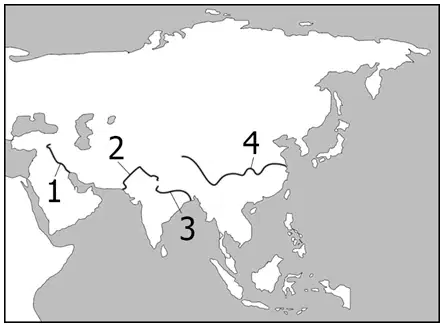
Which number correctly identifies the location of the Yangtze River?
1
2
3
4
How did the geography effect the development of Ancient China?
Ancient China was connected to other early civilizations by rivers, plateaus, and plains.
Ancient China was isolated from other early civilizations by mountain ranges, deserts, and vast oceans.
Ancient China was isolated from other early civilizations by rivers, plateaus, and plains.
Ancient China was connected to other early civilizations by mountain ranges, deserts, and a vast ocean.
Which geographical characteristics in the Yellow River Valley led to the first permanent Chinese settlement? (3)
The loess silt was ideal for growing crops.
The flat terrain and lack of trees helped farmers easily plow the soil.
The warm temperatures year-round were good for growing crops.
The cool, dry winters and warm, rainy summers were good for growing crops.
The river provided water for drinking, bathing, and watering crops.
Why was governing especially difficult for leaders of early Chinese civilizations?
China did not have enough natural resources and food supplies to serve its large population.
Religions were unable to unite the different populations of China.
Many wars prevented any one city from becoming the capital of China.
China was very large and divided by geographic features like deserts and mountains.
What is the name of the ideology that gives absolute power to their leader and enforces harsh punishments and strict laws?
Confucianism
Monarchy
Legalism
Feudalism
How did the mandate of heaven make governing the large land of ancient China easier?
It discouraged people from accepting feudalism because the gods wanted everyone to be equal.
It discouraged people from overthrowing a ruler because the gods would be against the new ruler.
It encouraged people to accept the ruler because the ruler was chosen by the gods.
It encouraged people to accept Chinese culture because the gods thought it was the best culture.
How did the Warring States period impact Chinese society?
It was a period of political and social instability.
It was a period of economic grwoth.
It was a period of peace and growth.
It was a period of religious freedom.
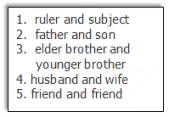
This outline depicts the social order associated with which set of beliefs?
Legalism
Confucianism
Judaism
Christianity
How did Confucius want to address the political and cultural problems that were prevalent in China during his lifetime?
He developed a philosophy that emphasized cultural diffusion and openness.
He developed a philosophy that emphasized a selfish and evil human nature.
He developed a philosophy that emphasized the absolute power of the ruler.
He developed a philosophy that emphasized order, kinship, and hierarchy.
What teachings did The Analects contain?
the teachings of the Qin Dynasty
the teachings of the Zhou Dynasty
the teaching of Confucianism
the teachings of Legalism
A mountainous kingdom located in northwestern China, after the Warring States Period. This kingdom unified China and was the third dynasty in China.
Qin Dynasty
Shang Dynasty
Han Dynasty
Zhou Dynasty
How did Shi Huangdi enforce his control over a widespread territory in China?
He used the philosophy of Legalism which gave absolute power to the king and encouraged strict laws and harsh punishments.
He used the philosophy of Legalism which required a ruler to be fair and care for all the people as if they were his family.
He used the philosophy of Confucianism which focused on order in relationships and respect and honor for their superiors.
He used the philosophy of Confucianism which discouraged trust in the people who served in the government.
The Qin dynasty was significant because it was the first ______ in Chinese history.
Republic
Monarchy
Empire
How did the Han Dynasty leaders react to the philosophy of Confucianism?
They rejected the philosophy of Confucianism, and this rejection led to political and economic success.
They implemented the philosophy of Confucianism, and this implementation led to political and economic problems.
They implemented the philosophy of Confucianism, and this implementation led to political and economic success.
They rejected the philosophy of Confucianism, and this rejection led to political and economic problems.
What idea developed by the Chinese is still practiced today as a way to ensure that government employees are qualified for their positions?
requiring candidates to attend college and get degrees in government
requiring candidates to complete internships before applying for a job
requiring candidates to undergo background checks
requiring candidates to pass civil service exams
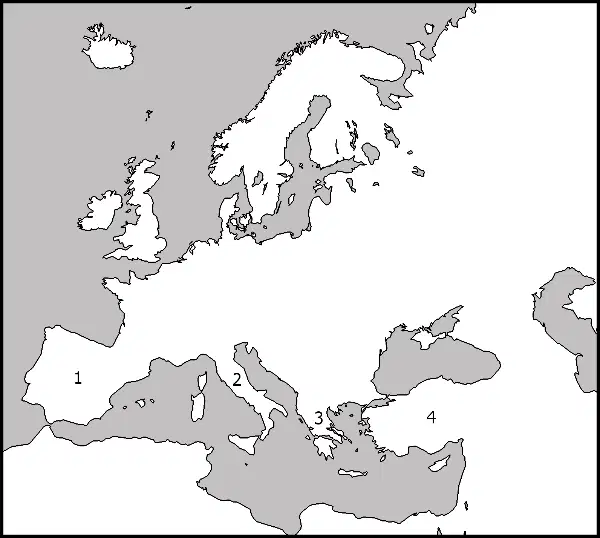
Which number correctly identifies the location of Ancient Greece?
1
2
3
4
What was one way that the Athenian government limited the voting rights of its citizens?
Athens only allowed women to vote.
Athens allowed its king to overrule all elections.
Athens allowed all free people to vote.
Athens only allowed free male citizens to vote.
How did the concept of the polis impact Greek city-states?
It restricted the economy by preventing trade with foreign civilizations.
It increased the territory controlled by city-states by creating mandatory military service.
It decreased the influence of religion in city-states by making it illegal to enforce religious laws.
It led to the development and expansion of democratic rights.
Citizens working together to make a change or difference = ?
People who are vested with rights, duties, and privileges = ?
community-wide code of conduct = ?
civic participation
citizenship
rule of law
rule of law
citizenship
civic participation
rule of law
civic participation
citizenship
citizenship
civic participation
rule of law
1. form of government where the political power is isolated within a small number of people
2. form of government where all citizens are able to vote on all political issues
1: direct democracy; 2: oligarchy
1: empire; 2: monarchy
1: monarchy; 2: empire
1. oligarchy; 2: direct democracy
1.Had slaves
2.Women were not allowed to vote
3.Assembly had a lot of power
4.Government was a direct democracy
5.Government was an oligarchy
6.Women could own property and go into the public without an escort
7.Boys were educated in math, reading, writing, music, drama, and military practice
8.Had a great navy due to its location on the coast
9.Located on the Peloponnesian Peninsula
Which of these describe ONLY ATHENS?
3, 4, 7, 8
1, 2, 5, 6
2, 4, 6, 8
1, 3, 5, 7
-All males join the military
-Women have more rights than other women in Greece
-Strong emphasis on physical training
Which city-state is described by this list?
Athens
Sparta
Rome
Troy
Why were there many different gods in the Ancient Greek religion?
The Greeks believed that people became gods when they died.
The Greeks believed that one god would be too busy to influence their daily lives.
The Greeks believed that each god controlled a specific aspect of life.
The Greeks believed that the gods were chosen from the best humans.
Which statement about Greek gods can be made?
Greek gods didn't interact with humans.
Greek gods were violent.
Greek gods took human form.
Greek gods controlled the elements.
Which option below best summarizes how Greece was able to defeat Persia in the Persian Wars?
The Greek city-states had superior weapons.
The Greek city-states outnumbered the Persians.
The Greek city-states fought harder for their homeland.
The Greek city-states cooperated with each other to defend their homeland.
Which major event led to the creation of the Delian League?
The Greek Nation divided into separate kingdoms.
Persia remained a common threat.
The Greek nation was conquered by the Persians.
The Romans remained a common threat.
What is a valid conclusion on why Greek city-states entered into the Peloponnesian War?
there is a power-struggle between two alliances
they were jealous of another city-state's culture
expansion of the empire into new regions
allegiance to the Persian empire
How did the Peloponnesian Wars have a negative impact on Ancient Greece?
They left Ancient Greece vulnerable to invasion from Macedonia
They prevented Ancient Greece from adopting democratic governments
They allowed Ancient Greece to create colonies throughout the Mediterranean Sea
They isolated Ancient Greece from the outside world
-direct democracy
-public debate
-limited citizenship
-developed over centuries
These are all characteristics of what?
Contributions of Spartan Society
Developments of the Delian League
Features of Athenian Democracy
Inventions of the Hellenic Period
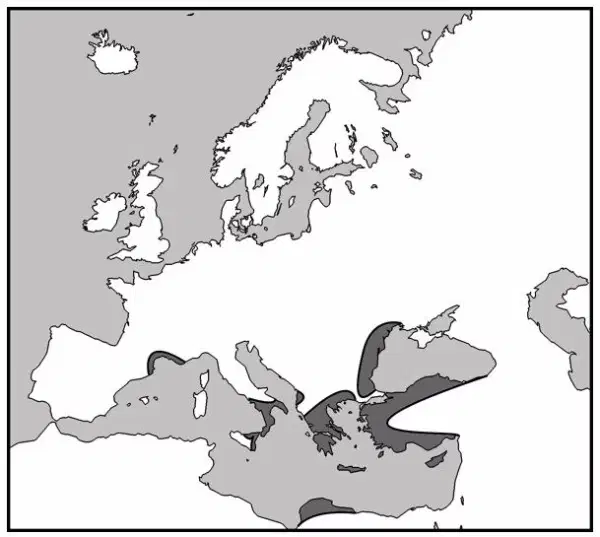
Based on the map, what was one of the solutions to the Ancient Greeks' lack of resources and space?
to create alliances with other regions of Europe and Australia
to form an empire including parts of Italy and Asia Minor
to conquer much of Syria and Egypt
to colonize along the coast of the Mediterranean Sea
How did the Alps mnts. impact the safety of the Roman Empire?
The Alps Mountains were short and flat, leaving Rome open for invasion.
The Alps Mountains provided rich soil and great lands for farming.
The Alps Mountains were active volcanoes that damaged cities.
The Alps Mountains provided a natural barrier against invasion.
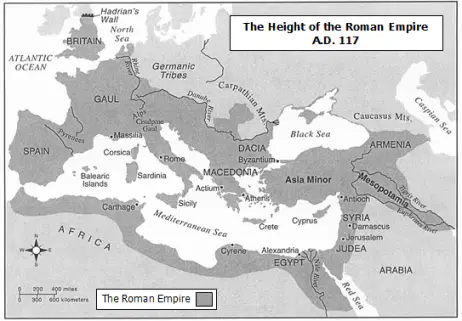
Based on this map, which statement is most accurate about the expansion of the Roman Empire?
Rome was only able to expand by sending armies over land.
Rome's central location in the Mediterranean made it possible to expand in all directions.
Rome avoided trying to conquer nations in Africa such as Carthage.
Rome's conquest only provided access to ports in the Mediterranean Sea.

According to this chart, which statement is true?
The Roman Republic was very different from the US government
The US government was influenced by the Roman Republic.
The US government is a dictatorship.
The Roman Republic did not give representation to common people
Why did the early Roman government incorporate various forms of checks and balances into the government?
to prevent any one group or body from having too much power
to provide for a healthy and stable economy that promoted individual wealth
to ensure that the government operated in the best interests of the elite
to promote involvement in the government by all classes of citizens

Based on these quotes, which statement about Roman law and the Twelves Tables is true?
Women were given more rights than men in Ancient Rome.
Women and men were treated equally in Ancient Rome.
Men were given more rights than women in Ancient Rome.
Men and women of different classes practiced different laws in Ancient Rome.
What was the purpose of the tribunes, assemblies, and consuls in the Roman Republic?
to control the military and decide when to go to war
to serve as spiritual leaders to the people
to represent the interests of various groups of people
to hear criminal cases and decide a punishment
How did Julius Caesar gain unlimited power as a dictator?
The people of Rome voted to make him dictator for life.
The leaders of religious groups announced that he was chosen by the gods.
He declared himself dictator for life during a period of military conflict.
He was born into the royal family of Rome.
How were the Roman Republic and the Roman empire different?
The Republic was democratic while the Empire was ruled by a dictator.
The Republic was ruled by a dictator while the Empire was democratic.
The Republic made peace with its neighbors while the Empire waged war.
The Republic waged war on its neighbors while the Empire made peace.
How did the expansion of the Roman Empire and the Pax Romana impact Europe?
It created a period of war and famine.
It created a period of peace and prosperity.
It decreased diversity in the region.
It decreased the education in the region.
Ancient Rome is best known for which architectural advancements? (3)
aqueduct
arch
dome
pillar
steel
Which statement best reflects the importance of the Ancient Roman structures?
Roman structures were built so well that many remain today.
Roman structures served as examples of poor architectural planning.
Roman structures were destroyed by a war with the Goths and Vandals.
Romans structures showed strong ties to Ancient Egyptian designs.
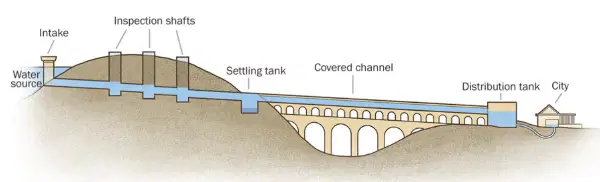
How did this invention impact Roman society?
Defensive barriers protected cities.
Water power increased business.
Freshwater was brought to the cities.
Sewage was dumped outside of the cities.
How did ancient Greek religion influence the religion of early Rome?
The early Roman religion featured gods who shared many characteristics with Greek gods.
Both the Greek religion and the early Roman religion were monotheistic.
Both the Greek religion and the early Roman religion were heavily influenced by the Bible.
The early Roman religion was borrowed from the Etruscans.
What was the role of gods in traditional Roman religion?
Gods were created from nature spirits.
Gods had human qualities and controlled specific aspects of life.
Gods lived within human beings who lived in Rome.
Gods were the reincarnated spirits of ancient Roman leaders.
What impact did the development of paved roads have on the ancient Roman civilization?
Roads decreased contact with the outside world.
Roads limited the amount of Roman exploration.
Roads led to increased invasion and war.
Roads led to increased trade and wealth.

