
 Worksheets
Unit 3 - Energy and Work Vocab
Total questions: 28
Worksheet time: 18mins
Us
Kinetic Energy
Gravitational Potential Energy
Elastic or Spring Potential Energy
Thermal Energy
Chemical Energy
Q
Kinetic Energy
Gravitational Potential Energy
Elastic or Spring Potential Energy
Thermal Energy
Chemical Energy
K
Kinetic Energy
Gravitational Potential Energy
Elastic or Spring Potential Energy
Thermal Energy
Chemical Energy
Ug
Kinetic Energy
Gravitational Potential Energy
Elastic or Spring Potential Energy
Thermal Energy
Chemical Energy
Ug
Kinetic Energy
Gravitational Potential Energy
Elastic or Spring Potential Energy
Thermal Energy
Chemical Energy
The energy of a moving body.
(a)
K = ½ × m × v2
(a)
Energy stored when an object is raised above the ground
(a)
Ug = m × g × h
(a)
-------- measure of energy transfer that occurs when an object is moved over a distance by an external force at least part of which is applied in the direction of the displacement.
(a)
Work = FNET × d × cos (Θ)
(a)
Work is not possible when....
Constant net force
The force must cause the displacement
Non-Constant Force
Force both causes displacement and doesn't
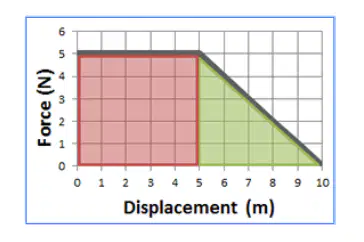
The amount of work can be calculated by calculating the area ---- and Force vs. Displacement graph
(a)
When pulling something at an incline, is the force less?
Yes, the force is less because the friction is becoming less.
Yes, the total force is multiplied by a fraction of the total force
No, its impossible as a force applied in any way has no different effect
On a displacement v force graph, what is the area under curve represent?
Work
Force
Displacement
Velocity
Friction
When energy passes from one object or place to another without changing form.
Energy Transfer
Energy Transformation
Energy Conservation
The total amount of energy in an isolated system remains constant, although it may change forms (transform!).
Energy Transfer
Energy Transformation
Energy Conservation
The total amount of energy in an isolated system remains constant, although it may change forms (transform!).
Energy Transfer
Energy Transformation
Energy Conservation
When energy changes from one to another
Energy Transfer
Energy Transformation
Energy Conservation
In a close system, what goes in must come out in a energy conservation system!
As the angle increases, the force
increases
decrease
remains constant
As the angle increases, the work
increases
decrease
remains constant
What is a closed system in physics?
What is a open system in physics?
What is a isolated system in physics?
What is this equation represent?
K=21Iw2
What is this equation?
ΔUg=mgΔy
What is this equation is ΔUs=21kx2

