
 Worksheets
GRADE
Total questions: 58
Worksheet time: 45mins
You see the reflection of the clock without numbers in your plane mirror. The image formed by the hands of the clock shows the time of 3:30. What is the real time?
3:30
8:30
9:30
10:30
How much larger will your classroom seem to appear if the entire two adjacent walls of your classroom consist of plane mirrors?
2x larger
3x larger
4x larger
can't be determined
Where is the image located if an object is 30 cm in front of convex mirror with a focal length of 20 cm?
between F and V
between C and F
in front of the mirror
can't be determined
What is the distance of your image from you if you stand 1.5 m in front of a plane mirror?
1.5 m
2.0 m
3.0 m
4.5 m
Zed stands 1.5-m tall in front of a plane mirror. What is the height of his image?
4.5 m
3.0 m
2.0 m
1.5 m
A light ray, travelling parallel to a concave mirror's axis, strikes the mirror's surface. The reflected ray _________.
passes through the mirror's focal point
again travels parallel to the mirror's axis
travels at right angles to the mirror's axis
passes through the mirror's center of curvature
An object is placed between a concave mirror and its focal point. What is the type and orientation of the image formed?
virtual and inverted
real and inverted
virtual and erect
real and erect
What kind of mirror is used in automobiles and trucks to give the driver a wider area and smaller image of traffic behind him?
plane mirror
convex mirror
concave mirror
none of the above
What type of mirror do dentists usually use to see clearly the images of our teeth?
plane mirror
convex mirror
concave mirror
none of the above
When a small object is placed on the principal axis of a concave mirror between the focus and the mirror, the image formed is _____________.
erect, magnified, and virtual
inverted, magnified, and real
inverted, reduced, and real
erect, reduced, and real
A white sheet of paper cannot act as mirror because it ______ the rays of light.
diffracts
diffuses
interferes
refract
You see your face clearly if you look down on a pool of still water. Which one of the following statements give the best explanation for this observation?
Light entering the water is dispersed.
Regular reflection of light happens on the surface of still water.
Irregular reflection of light happens on the surface of still water.
Light is reflected from the surface of water in different directions.
Where should the object be placed in front of a concave mirror to form a virtual and magnified image?
at the focus
at the center of curvature
between the focus and the vertex
between the center of curvature and focus
Which of the following is true of a concave mirror?
It will never form a real image.
An inverted image will be formed if the object distance is greater than the focal length.
An object can be magnified if placed at F.
A light ray, travelling parallel to a concave lens' axis and strikes the lens, will refract and __________.
pass through the lens' focal point
travel parallel to the principal axis
continue to travel in the same direction
travel at right angles to the principal axis
What kind of image is formed by concave lenses?
always real
always virtual
could be real or virtual; depend on the distance of the object from the focal point
could be real or virtual, but always real when the object is placed at the focal point
Sun's rays are observed to focus at a point behind a lens. What kind of lens was used?
converging lens
diverging lens
focusing lens
none of the above
This optical instrument uses two convex lenses to make a smaller object larger.
camera
microscope
oscilloscope
telescope
Which of the following optical instruments will be used to produce a reduced and inverted image of a distant object?
camera
projector
microscope
refracting telescope
A photocopy "Xerox" machine produces an image that is of equal size as the object. Considering the location of an object in a convex lens, where is the object located or placed to produce an image that is of equal size to the object?
at F'
at 2F'
between F' and V
between 2F' and F'
If the focal length of a concave lens is 6 cm, the radius of curvature equals
3
6
9
12

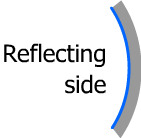
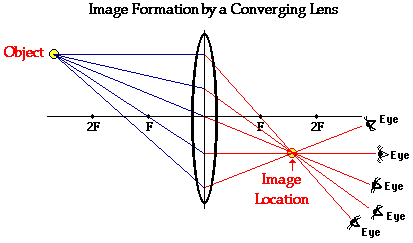


Which ray diagram shows a real image?


None of the above
Four ray diagrams show the images formed in mirrors and lenses. Which shows a virtual image?


All of the above.

Which of the following is evidence that this is a virtual image?
Virtual images are always upright.
Virtual images are always larger than the original object.
Virtual images always have converging rays.
Virtual images always have positive focal lengths.
Which of the following is evidence that this is a virtual image?
Virtual images are always upright.
Virtual images are always larger than the original object.
Virtual images always have converging rays.
Virtual images always have positive focal lengths.
An image is created whose di = -5 cm. What does this indicate?
The image is virtual.
The image is smaller than the original object.
The image is inverted.
The image is larger than the original object.
The straight line that joins between the two centers of curvature of the lens and passes
through its its optical center is called
the focal length.
the principal axis.
the secondary axis.
the radius of curvature.


Which lens represents the path light takes through a diverging lens?


What word means to bend light rays toward each other?
Converging light
Diverging light
Virtual Light
Real Light
What word means to bend light rays toward each other?
Converging light
Diverging light
Virtual Light
Real Light

A light ray, travelling parallel to a concave mirror's axis, strikes the mirror's surface. The reflected ray _________.
passes through the mirror's focal point
again travels parallel to the mirror's axis
travels at right angles to the mirror's axis
passes through the mirror's center of curvature
What are primary colors?
Red, Green, Blue
Yellow, Purple, Orange
Black, White, Gray
Pink, Brown, Cyan
Why can you not see some colors in different situations, like underwater?
Light frequencies are absorbed by water
Colors change underwater
Water reflects all colors
Water creates new colors
What two things determine the color of light?
Wavelength and Frequency
Speed and Intensity
Amplitude and Speed
Direction and Distance
What color light do we see when ALL wavelengths of visible light are present?
White
Black
Red
Blue
What are electromagnetic waves good for in terms of information transfer?
Radio waves
Sound waves
Water waves
Earthquakes
Which term describes the height of a wave from its rest position?
Amplitude
Wavelength
Frequency
Refraction
What are the highest and lowest points of a wave known as?
Crest & Trough
Amplitude & Frequency
Wavelength & Medium
Reflection & Refraction
What is the movement of waves through a medium called?
Absorption
Transmission
Reflection
Modulation
Which term refers to the change in direction of a wave when it enters a new medium?
Reflection
Refraction
Absorption
Transmission
What is the term for the highest point of a wave?
Trough
Crest
Amplitude
Wavelength
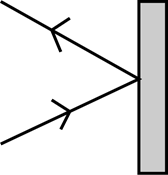
In the illustration, the light ray striking the object is-



