
 Worksheets
levels of organization in ecosystems
Total questions: 222
Worksheet time: 5hrs 14mins
What is a community?
ecosystem made mostly of land, but can have some water
ecosystem made up mostly water, but can have some land
different organisms that coexist in the same area
members of the same type of organism that live in an environment
What is a population?
ecosystem made mostly of land, but can have some water
ecosystem made up mostly water, but can have some land
different organisms that coexist in the same area
members of the same type of organism that live in an environment
Some examples of non-living things in an ecosystem are
flowers and plants.
frog and ducks.
rocks and water.
fish and grass.
Deserts, mountains, and rivers are all examples of ________.
vacation spots
tundra
ecosystems
wetlands
A group of the same type of organisms living in the same place at the same time.
threatened species
populations
community
limiting factor
All of the populations that live in one area together
limiting factors
populations
community
speed limit
All the bears that live in one forest are an example of a(n)...
population
community
habitat
niche
Ecosystems are made up of only the living things in a habitat.
True
False


How are populations different from communities?
Populations consist of one species; communities consist of many species.
Populations can contain plants and fungi; communities consist of animals only.
Populations consist of many species; communities consist of one species.
Populations consist of animals only; communities can contain plants and fungi.

What can you infer about the kangaroo rat from the fact that it thrives in the desert?
It must be very large.
It must eat cacti.
It must live in a very small community.
It must be able to survive on very little water.

Which of the following is an example of a living thing interacting with a nonliving thing?
A flower that's pollinated by a bee
A plant and a fungus growing together as lichen
A prairie dog that lives beneath the soil
A beaver that cuts down trees with its teeth

Why can't you find scorpions in the Arctic? Choose the best answer.
Because they can't walk on ice.
Because they only like to catch warm-blooded prey.
Because their stingers don't work at cold temperatures.
Because their bodies are not adapted to life in the Arctic.

What can you conclude about polar bears from the fact that they live in the Arctic?
They would not be able to thrive in the desert
They are not biologically related to other bear species
They eat mostly scorpions and kangaroo rats
They must be able to survive with very little water
How are ecosystems important to humans
They clean the air
They are great for activities
All of these answers are correct
They provide resources like wood

Humans have a large effect on ecosystems.
True
False
Light, water, air and soil are living factors in an ecosystem.
True
False

Could a stone be a component of an ecosystem?
Yes.
No.
Only if it's a beautiful stone.
Only it it's covered with moss.
Which represents community level of organization?
lions, zebras, giraffes, trees, grass
lions
lions, zebras, rocks, trees
lions and their cubs
Different species, living in the same area:
Organism
Population
Community
Ecosystem
ALL of the sharks living in a particular ecosystem would be considered:
An individual organism
a community
a population
an ecosystem
Sharks, Fish, Whales, Starfish, Sun, Water, Rocks all in the same area:
Organism
Population
Community
Ecosystem
An individual shark:
Organism
Population
Community
Ecosystem
Hippos, Zebras, Giraffes, Trees, Grass in an area:
Organism
Population
Community
Ecosystem
Jacob is going out to his grandparents farm. On the farm is a stream that he likes to fish at. When he is fishing he sees many differernt speacies of fish as well as maple and oak trees and dragonflies. What Jacob is seeing is an example of what level of organization?
organism
population
community
ecosystem

This image depicts which organizational level of the environment?
Organism
Population
Community
Ecosystem
All the alligators in the same area are an example of a(n) _______________.
organism
community
population
group
All the tiger sharks in the ocean.
All the oak trees in a forest.
All the cows on a farm.
The plants and animals in the same area.


All of the squirrels living in Hubbard Park would be considered a
population
community
ecosystem
organism

All of the fish and aquatic plants living in Mirror Lake are considered a
species
population
community
biome

The portion of the planet in which living things are found
ecosystem
biosphere
biome
atmosphere
When all the ecosystems on Earth are combined it is called...
a community.
a biome.
a biosphere.
an Earthsphere.

What level of ecological organization does the bird represent?
Organism
Population
Community
Ecosystem

What level of ecological organization does this entire picture represent?
Organism
Population
Community
Ecosystem

What is a population?
One individual member of a species
a group of individuals that belong to the same species and live in the same area
all the different populations of species that live together in an area
a community of species and the physical environment
A group of living an nonliving things that interact with each other is called
an ecosystem
abiotic
a community
a neighborhood

What level of organization can be seen here?
Species
Population
Community
Ecosystem

cactus, snake, coyote, sagebrush, and hare in the same area.
community
abiotic factors
population
niche
Coyote, sand, 102 degrees, cactus, and snake.
ecosystem
biomes
niche
community

Organism
a lion
all lions
lions, zebras, elephants, trees, plants, etc.
living and nonliving interacting in an area

A group of the same organisms living together in the same place at the same time is:
An organism
A population
A community
A biome

What are groups of different populations living togther in the same place at the same time called?
An organism
A population
A community
A biosphere

The organisms in a community, as well as all of the nonliving aspects of the environment are a(n):
Population
Community
Habitat
Ecosystem
An ecosystem contains living and nonliving things.
True
False
Which of the following is a population?
hawks, barred owls, and eagles on NC coast
mountain stream
all the frogs in a pond
a blue-tailed skinks (lizard) around a barn
What are the ecological levels of organization from smallest to the largest?
organism, population, community, ecosystem
organism, community, population, ecosystem
organism, population, community, biome, ecosystem
organism, community, population, biome, ecosphere

Which DOES NOT represent an Ecosystem?
A
B
C
D

Which level of organization does "N", in the Tundra biome represent from the picture?
ecosystem
organism
community
population
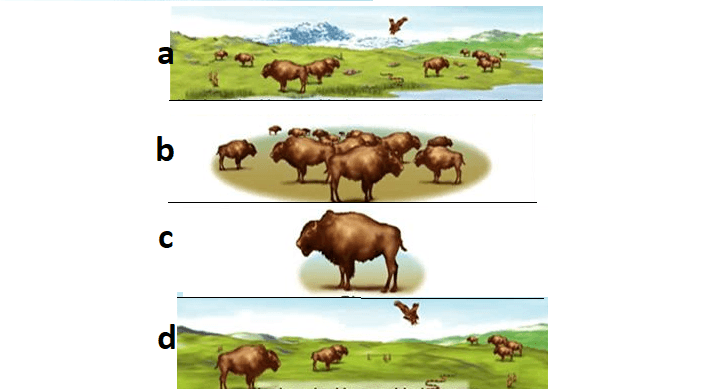
Which represents an organism?
a
b
c
d


All the individuals of one species in a given area is called a ______________. A herd of zebras would be an example.
Population
Community
Non-living
Organism

The total sum of all the populations of living things within an area that interact with one another is called_________. Zebra, elephants, and giraffes would be an example
Biosphere
Population
Community
Organism
A population is all the ____________ species.
Same
Different
Other
Alternating

What level of organization is all the fish and plants in a pond, plus the water, air, rocks and mud?
Ecosystem
Community
Population
Organism
What is an example of a population?
My cat
A group of lizards living on the back fence
All the different bugs in the garage
A potted plant, plus the soil and the bugs living in the soil
Which of the following correctly lists the levels of organization from least complex to most complex?
Community, Organism, Population, Ecosystem
Population, Community, Ecosystem, Organism
Organism, Population, Community, Ecosystem
Ecosystem, Population, Organism, Community
Which organizational level of the ecosystem does a pack of wolves represent?
Ecosystem
Organism
Population
Habitat
Which of the following descriptions represents the community level of organization?
A single individual rabbit, of a certain species, living in a forest
A group of rabbits, all of the same species, living in a forest
All of the rabbits in a forest, as well as their predators and food plants
All of the animals, plants, and non-living elements in a forest
At what level of organization in an ecosystem is an individual plant or animal?
Population
Organism
Community
Ecosystem
All speckled sting-ray that live in the Pacific Ocean
A beautiful butterfly.
Water, Fish, Turtles, Oxygen, Rocks and Moss interacting in a river system.
Chicken, Cow, Grass, Buffalo, and Mouse living on farmland.

A collection of living organisms that belong to different populations but all live in the same area and interact with one another is a...
Population
Ecosystem
Community
Ecosphere

Which of the following best describes a community?
sharks, groupers, anemones and shrimp on a coral reef
decorator crabs on the seafloor
loggerhead sea turtles in Atlantic
prairie grassland in Wyoming
Which example best illustrates the difference between a community and a population?
All the people in a town would be a community; all the people in a country would be a population
The two terms are interchangeable, a population IS a community.
All the people in a town would be a community; all their cattle would be a population.
All the different animals in a national park would be a community; all of the brown bears in the park would be a population.
Where all life on Earth exists; encompassing all of Earth’s ecosystems
biosphere
biome
ecosystem
community

A collection of organisms that make up a community as well as all of the nonliving components of the environment.
Population
Community
Habitat
Ecosystem
What level of ecological organization does the bird represent?
Organism
Population
Community
Ecosystem
What level of ecological organization does this entire picture represent?
Organism
Population
Community
Ecosystem
Two organisms that are so similar are from the same ...
When all the ecosystems on Earth are combined it is called...
a community.
a biome.
a biosphere.
an Earthsphere.
The Biosphere contains all ecosystems
True
False
Earth is the only biosphere we currently study
True
False
An Ecosystem is a community and it's living and non living surroundings.
True
False
A Population is a group of organisms of 1 type that live in the same area
True
False
Select from the following, examples of a population.
Herd of buffalo
School of fish
All the people living in a town
The people, animals, and plants at Liberty Elementary School.
All the alligators in a swamp are an example of a(n) _______________.
organism
community
population
group


Which DOES NOT represent an Ecosystem?
A
B
C
D

An organism
A population
A community
A biome
ecosystem

An organism
A population
A community
A biome
ecosystem

An organism
A population
A community
A biome
ecosystem

This picture represents an....
Biome
Ecosystem
Community
Organism

Organism
Population
Biome
Community

Organism
Population
Biome
Community

The table lists levels of organization in an ecosystem from least complex to most complex. Which of the following belongs in the table where the question mark is?
class
society
species
population
Which statement is correct?
A population is the same as a community
A community is a group of populations
A community is a part of a population
A population is a group of communities
These are different groups of organisms that do not belong to the same species (Example: rats, rabbits, snakes)
Population
Community
Producers
Consumers
Species
Broadest groups of taxonomy
The taxonomic group that follows domains
Same type of organism
A living thing
What is a community?
ecosystem made mostly of land, but can have some water
ecosystem made up mostly water, but can have some land
different organisms that coexist in the same area
members of the same type of organism that live in an environment
What is a population?
ecosystem made mostly of land, but can have some water
ecosystem made up mostly water, but can have some land
different organisms that coexist in the same area
members of the same type of organism that live in an environment
Some examples of non-living things in an ecosystem are
flowers and plants.
frog and ducks.
rocks and water.
fish and grass.
Deserts, mountains, and rivers are all examples of ________.
vacation spots
tundra
ecosystems
wetlands
A group of the same type of organisms living in the same place at the same time.
threatened species
populations
community
limiting factor
All of the populations that live in one area together
limiting factors
populations
community
speed limit
All the bears that live in one forest are an example of a(n)...
population
community
habitat
niche
Ecosystems are made up of only the living things in a habitat.
True
False
How are populations different from communities?
Populations consist of one species; communities consist of many species.
Populations can contain plants and fungi; communities consist of animals only.
Populations consist of many species; communities consist of one species.
Populations consist of animals only; communities can contain plants and fungi.
What can you infer about the kangaroo rat from the fact that it thrives in the desert?
It must be very large.
It must eat cacti.
It must live in a very small community.
It must be able to survive on very little water.
Which of the following is an example of a living thing interacting with a nonliving thing?
A flower that's pollinated by a bee
A plant and a fungus growing together as lichen
A prairie dog that lives beneath the soil
A beaver that cuts down trees with its teeth
Why can't you find scorpions in the Arctic? Choose the best answer.
Because they can't walk on ice.
Because they only like to catch warm-blooded prey.
Because their stingers don't work at cold temperatures.
Because their bodies are not adapted to life in the Arctic.
What can you conclude about polar bears from the fact that they live in the Arctic?
They would not be able to thrive in the desert
They are not biologically related to other bear species
They eat mostly scorpions and kangaroo rats
They must be able to survive with very little water
How are ecosystems important to humans
They clean the air
They are great for activities
All of these answers are correct
They provide resources like wood
Humans have a large effect on ecosystems.
True
False
Light, water, air and soil are living factors in an ecosystem.
True
False
Could a stone be a component of an ecosystem?
Yes.
No.
Only if it's a beautiful stone.
Only it it's covered with moss.
Which represents community level of organization?
lions, zebras, giraffes, trees, grass
lions
lions, zebras, rocks, trees
lions and their cubs
Different species, living in the same area:
Organism
Population
Community
Ecosystem
ALL of the sharks living in a particular ecosystem would be considered:
An individual organism
a community
a population
an ecosystem
Sharks, Fish, Whales, Starfish, Sun, Water, Rocks all in the same area:
Organism
Population
Community
Ecosystem
An individual shark:
Organism
Population
Community
Ecosystem
Hippos, Zebras, Giraffes, Trees, Grass in an area:
Organism
Population
Community
Ecosystem
Jacob is going out to his grandparents farm. On the farm is a stream that he likes to fish at. When he is fishing he sees many differernt speacies of fish as well as maple and oak trees and dragonflies. What Jacob is seeing is an example of what level of organization?
organism
population
community
ecosystem
This image depicts which organizational level of the environment?
Organism
Population
Community
Ecosystem
All the alligators in the same area are an example of a(n) _______________.
organism
community
population
group
All the tiger sharks in the ocean.
All the oak trees in a forest.
All the cows on a farm.
The plants and animals in the same area.
All of the squirrels living in Hubbard Park would be considered a
population
community
ecosystem
organism
All of the fish and aquatic plants living in Mirror Lake are considered a
species
population
community
biome
The portion of the planet in which living things are found
ecosystem
biosphere
biome
atmosphere
When all the ecosystems on Earth are combined it is called...
a community.
a biome.
a biosphere.
an Earthsphere.
What level of ecological organization does the bird represent?
Organism
Population
Community
Ecosystem
What level of ecological organization does this entire picture represent?
Organism
Population
Community
Ecosystem
What is a population?
One individual member of a species
a group of individuals that belong to the same species and live in the same area
all the different populations of species that live together in an area
a community of species and the physical environment
A group of living an nonliving things that interact with each other is called
an ecosystem
abiotic
a community
a neighborhood
What level of organization can be seen here?
Species
Population
Community
Ecosystem
cactus, snake, coyote, sagebrush, and hare in the same area.
community
abiotic factors
population
niche
Coyote, sand, 102 degrees, cactus, and snake.
ecosystem
biomes
niche
community
Organism
a lion
all lions
lions, zebras, elephants, trees, plants, etc.
living and nonliving interacting in an area
A group of the same organisms living together in the same place at the same time is:
An organism
A population
A community
A biome
What are groups of different populations living togther in the same place at the same time called?
An organism
A population
A community
A biosphere
The organisms in a community, as well as all of the nonliving aspects of the environment are a(n):
Population
Community
Habitat
Ecosystem
An ecosystem contains living and nonliving things.
True
False
Which of the following is a population?
hawks, barred owls, and eagles on NC coast
mountain stream
all the frogs in a pond
a blue-tailed skinks (lizard) around a barn
What are the ecological levels of organization from smallest to the largest?
organism, population, community, ecosystem
organism, community, population, ecosystem
organism, population, community, biome, ecosystem
organism, community, population, biome, ecosphere
Which DOES NOT represent an Ecosystem?
A
B
C
D
Which level of organization does "N", in the Tundra biome represent from the picture?
ecosystem
organism
community
population
Which represents an organism?
a
b
c
d
All the individuals of one species in a given area is called a ______________. A herd of zebras would be an example.
Population
Community
Non-living
Organism
The total sum of all the populations of living things within an area that interact with one another is called_________. Zebra, elephants, and giraffes would be an example
Biosphere
Population
Community
Organism
A population is all the ____________ species.
Same
Different
Other
Alternating
What level of organization is all the fish and plants in a pond, plus the water, air, rocks and mud?
Ecosystem
Community
Population
Organism
What is an example of a population?
My cat
A group of lizards living on the back fence
All the different bugs in the garage
A potted plant, plus the soil and the bugs living in the soil
Which of the following correctly lists the levels of organization from least complex to most complex?
Community, Organism, Population, Ecosystem
Population, Community, Ecosystem, Organism
Organism, Population, Community, Ecosystem
Ecosystem, Population, Organism, Community
Which organizational level of the ecosystem does a pack of wolves represent?
Ecosystem
Organism
Population
Habitat
Which of the following descriptions represents the community level of organization?
A single individual rabbit, of a certain species, living in a forest
A group of rabbits, all of the same species, living in a forest
All of the rabbits in a forest, as well as their predators and food plants
All of the animals, plants, and non-living elements in a forest
At what level of organization in an ecosystem is an individual plant or animal?
Population
Organism
Community
Ecosystem
All speckled sting-ray that live in the Pacific Ocean
A beautiful butterfly.
Water, Fish, Turtles, Oxygen, Rocks and Moss interacting in a river system.
Chicken, Cow, Grass, Buffalo, and Mouse living on farmland.
A collection of living organisms that belong to different populations but all live in the same area and interact with one another is a...
Population
Ecosystem
Community
Ecosphere
Which of the following best describes a community?
sharks, groupers, anemones and shrimp on a coral reef
decorator crabs on the seafloor
loggerhead sea turtles in Atlantic
prairie grassland in Wyoming
Which example best illustrates the difference between a community and a population?
All the people in a town would be a community; all the people in a country would be a population
The two terms are interchangeable, a population IS a community.
All the people in a town would be a community; all their cattle would be a population.
All the different animals in a national park would be a community; all of the brown bears in the park would be a population.
Where all life on Earth exists; encompassing all of Earth’s ecosystems
biosphere
biome
ecosystem
community
A collection of organisms that make up a community as well as all of the nonliving components of the environment.
Population
Community
Habitat
Ecosystem
What level of ecological organization does the bird represent?
Organism
Population
Community
Ecosystem
What level of ecological organization does this entire picture represent?
Organism
Population
Community
Ecosystem
Two organisms that are so similar are from the same ...
When all the ecosystems on Earth are combined it is called...
a community.
a biome.
a biosphere.
an Earthsphere.
The Biosphere contains all ecosystems
True
False
Earth is the only biosphere we currently study
True
False
An Ecosystem is a community and it's living and non living surroundings.
True
False
A Population is a group of organisms of 1 type that live in the same area
True
False
Select from the following, examples of a population.
Herd of buffalo
School of fish
All the people living in a town
The people, animals, and plants at Liberty Elementary School.
All the alligators in a swamp are an example of a(n) _______________.
organism
community
population
group
Which DOES NOT represent an Ecosystem?
A
B
C
D
An organism
A population
A community
A biome
ecosystem
An organism
A population
A community
A biome
ecosystem
An organism
A population
A community
A biome
ecosystem
This picture represents an....
Biome
Ecosystem
Community
Organism
Organism
Population
Biome
Community
Organism
Population
Biome
Community
The table lists levels of organization in an ecosystem from least complex to most complex. Which of the following belongs in the table where the question mark is?
class
society
species
population
Which statement is correct?
A population is the same as a community
A community is a group of populations
A community is a part of a population
A population is a group of communities
These are different groups of organisms that do not belong to the same species (Example: rats, rabbits, snakes)
Population
Community
Producers
Consumers
Species
Broadest groups of taxonomy
The taxonomic group that follows domains
Same type of organism
A living thing

