
 Worksheets
Non-contact forces - electrostatic focus
Total questions: 21
Worksheet time: 11mins
When one object is pulled towards another object, the objects are said to _______________ each other.
repel
attract
push
move
When one object is pushed away from another object, the objects are said to _______________ each other.
repel
attract
ignore
not effect
Electrons have a ______________ charge
positive
negative
neutral
non existent
Protons have a ______________ charge
positive
negative
neutral
non existent
Neutrons have a ______________ charge
positive
negative
neutral
non existent
Which of the following metals is non-magnetic
Iron
Nickel
Aluminium
Cobalt
The electrostatic force between two objects is _____________ when they are more charged and/or closer to one another
weaker
greater
irresistable
cuter

Select the correct answer from top to bottom
Attract, repel, attract
Repel, attract, attract
Attract, repel, repel
Repel, attract, repel
A material in which electric current will not flow freely is known as a
Insulator
Conductor
Blocker
Resistor
An object or type of material that allows the flow of electric charge is known as an
insulator
conductor
resistor
amplifier
Opposites....
Repel
are different
attract
are the same
Any force that can occur when two objects are not touching
Contact force
Untouchable force
Non-Contact force
Touchable force
Attractive or repulsive forces between particles that are caused by their electric charges
Magnetic force
Electrostatic force
Gravity
Electromagnetic force
attraction or repulsion that arises between electrically charged particles because of their motion
Magnetic force
Electrostatic force
Gravity
Electromagnetic force
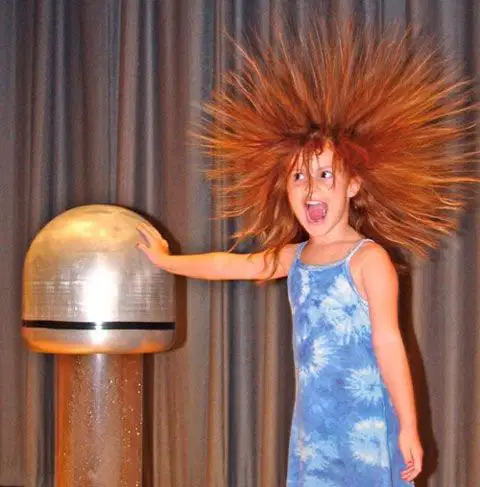
Why does your hair stand up while gaining a charge from the Van de Graaff machine?
Because its exciting
The positive charge from the machine is transferred to your body, making each hair positively charged and attracted to one another
The positive charge from the machine is transferred to your body, making each hair positively charged and repelled from one another
The machine is taking the positive charge from your body, making each hair negatively charged and repelled from one another
Why does the Van de Graaff create a spark when the opposingly charged wand is placed near it?
Because its magic
Air doesn't emit light when the ions recombine with electrons from the wand, you are seeing things.
As the negative charge from the wand and the positive charge from the generator move through the air, it exites air molecules, causing them to give off light.
because it's broken
Explain why this is happening
The plates are being blown away by the wind created by the Van de Graaff
The plates are rubber so do not conduct electricity and are pushed away
The pans all gain the opposite electrical charge from the Van de Graaff so are attracted and push away from the Van de Graaff
The pans all gain the same electrical charge from the Van de Graaff so are repelled and push away from the Van de Graaff

lightning is an example of which type of non-contact force?
Magneitc
Electrostatic
Gravitational
Gravity

The image is an example of which type of non-contact force?
Magnetic
Electrostatic
Gracitational
Gravity
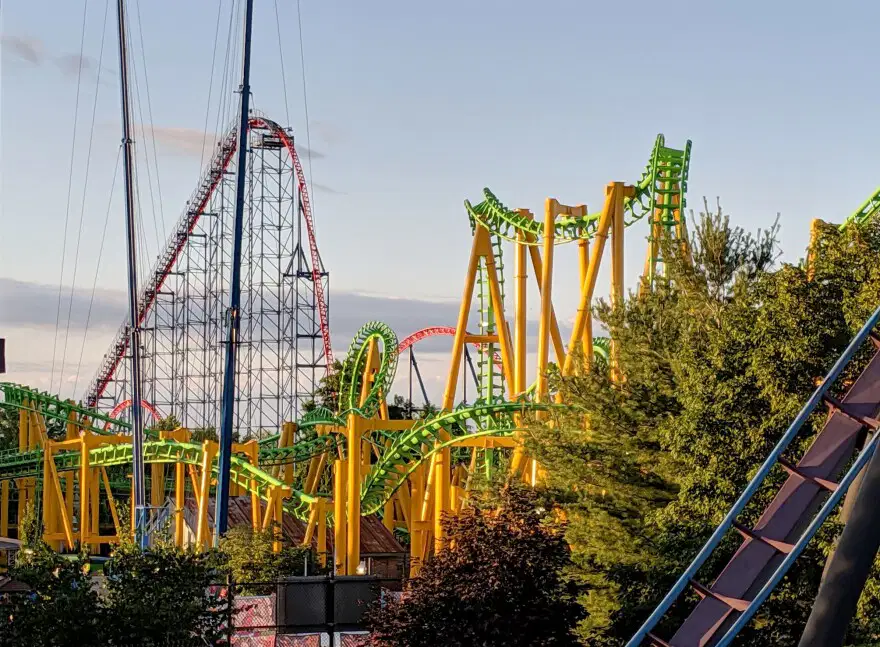
After the initial mechanical incline to the first drop, roller coasters use what non-contact force to propel through the rest of the ride?
Magnetic
Electrostatic
Gravitational
Push and Pull

