wayground logo

Free Printable Worksheets

Font size

S
M
L
XL
Worksheets

8 Electricity Test Unit 2 L1,2,3

Total questions: 20

Worksheet time: 10mins
Name
Class
Date
1.
1. Which of the following best describes electric charge?
a)
A. a force that causes objects to heat up
b)
B. a high-voltage material that can cause damage to objects
c)
C. a fundamental property that causes electric and magnetic interactions
d)
D. a particle that moves freely through matter and causes static electricity to build up on objects
2.
2. Peter’s teacher tells him that he should not place his electric stereo near the edge of a pool because the water in the pool is a conductor. What does she mean when she says that the water is a conductor?
a)
A. Water is a type of electrical energy.
b)
B. Water damages electric circuits.
c)
C. Electric charges cannot flow without water.
d)
D. Electric charges move through the water in the pool
3.
3. When Bethany walks across a carpet, her socks pick up many negative electric charges. Later in the day, these negative charges are no longer present on her socks. What most likely happened to the negative charges?
a)
A. The charges disappeared.
b)
B. The charges transferred to another object.
c)
C. The charges switched from negative to positive.
d)
D. The charges broke apart into smaller positive and negative particles.
4.
4. An engineer is building an electronic device. She wants to use a material that will give her the most control over the amount of electric charge that flows through a circuit. Which material should she use?
a)
A. a conductor
b)
B. an insulator
c)
C. a semiconductor
d)
D. a tube
5.
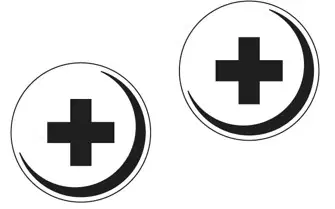
5. The following image shows two circular objects. Each object has an electric charge, as shown: What will happen to these objects when they are placed near each other?
a)
A. The objects will remain still.
b)
B. The objects will both move to the left.
c)
C. The objects will move towards each other.
d)
D. The objects will move away from each other
6.
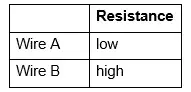
1. The following table describes the resistance of two different wires. Based on this table, which of the following is most likely true?
a)
A. Wire A is longer and thinner than wire B.
b)
B. Wire A is shorter and thicker than wire B.
c)
C. Wire A is a poor conductor of electric current.
d)
D. Wire B is a good conductor of electric current.
7.
2. Plastic and wood are poor conductors of electric current, while copper and steel are good conductors of electric current. Which combination of materials would supply the most amount of resistance to an electric current?
a)
A. copper and steel
b)
B. plastic and copper
c)
C. plastic and wood
d)
D. wood and steel
8.
3. Which of the following best describes electric voltage?
a)
A. the rate at which electric charges move
b)
B. the amount of electrical energy contained inside a battery
c)
C. the work needed to move an electric charge between two points
d)
D. the shock that a person experiences when he or she comes in contact with electricity
9.
4. What is electric current?
a)
A. the rate at which electric charges pass a given point
b)
B. a material’s opposition to the flow of electric charge
c)
C. the number of electric charges that pass a given point
d)
D. the amount of work to move a unit of electric charge between two points
10.
5. Some electric devices use direct current while others use alternating current. Which of the electric devices listed below uses mostly alternating current?
a)
A. digital camera
b)
B. dishwasher
c)
C. flashlight
d)
D. mp3 player
11.
1. Most strings of outdoor lights are wired in a parallel circuit. Which of the following is the best reason why a string of outdoor lights should be wired in a parallel circuit and not a series circuit?
a)
A. Parallel circuits are safer to use than series circuits.
b)
B. The lights in a parallel circuit will light up brighter than the lights in a series circuit.
c)
C. If one light in the string burns out in a parallel circuit, the rest of the lights will continue to shine.
d)
D. You need to use more wires to construct a series circuit than a parallel circuit.
12.
2. A student is building a simple circuit with a battery, light bulb, and copper wires. When she connects the wires to the battery terminals, the light bulb does not light up. Which of the following could explain why the bulb does not light?
a)
A. There is no energy source.
b)
B. The circuit is open.
c)
C. This circuit is too simple to light up a light bulb.
d)
D. Copper wires do not conduct electric current.
13.
3. Brent wants to fly a kite during a lightning storm at night. His friend warns him that this increases his chance of being struck by lightning. Which of the following helps to explain why this is true?
a)
A. Lightning usually strikes at night.
b)
B. Lightning usually strikes moving objects.
c)
C. Lightning usually strikes objects made of fabric.
d)
D. Lightning usually strikes objects high above the ground.
14.
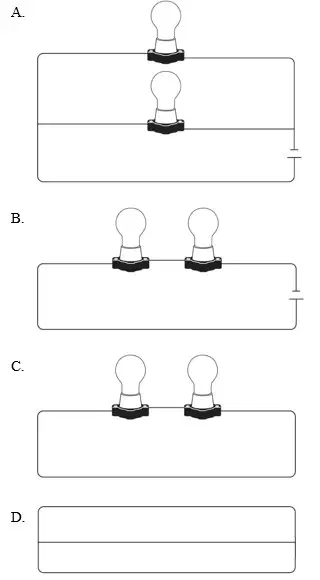
4. Which of the following circuit diagrams represents a complete series circuit?
a)
A
b)
B
c)
C
d)
D
15.
5. A GFCI is an example of what kind of electrical safety device?
a)
A. a frayed cord
b)
B. a lightning rod
c)
C. a parallel circuit
d)
D. a circuit breaker
16.

A(n) ​ (a)   is a material through which electrons (and therefore charge) move easily.

A(n) ​ (b)   is a material through which electrons (and therefore charge) do not move easily.

Choose from the below words
conductor
insulator
circuit
current
17.

Two particles with opposite charges​ (a)   each other.

Two particles with the same charge ​ (b)   each other.

Choose from the below words
attract
repel
amplify
destroy
18.

1. What happens to the resistance of a wire if its length is doubled while keeping its thickness constant?

a)

A. The resistance is halved.

b)

B. The resistance remains the same.

c)

C. The resistance is doubled.

d)

D. The resistance is quadrupled.

19.

2. Which of the following materials is most likely to be used as an insulator in electrical circuits?

a)

A. Copper

b)

B. Aluminum

c)

C. Rubber

d)

D. Silver

20.

3. If a light bulb in a series circuit burns out, what will happen to the rest of the bulbs in the circuit?

a)

C. The rest of the bulbs will shine brighter.

b)

D. The rest of the bulbs will flicker.

c)

A. The rest of the bulbs will continue to shine.

d)

B. The rest of the bulbs will also go out.