
 Worksheets
WATER IN THE WORLD TOPIC TEST
Total questions: 70
Worksheet time: 51mins
Why is Australia uniquely challenged when it comes to water resources?
It has too many rivers
It is the driest inhabited continent on Earth
It has too much rainfall
It has unlimited groundwater
How many liters of water does it take to make one pair of jeans?
1,000 litres
5,000 litres
7,000 litres
15,000 litres
During the Millennium drought (2003-2012), what was one way the NSW government responded?
They gave away free water
They issued fines for banned water usage
They built more swimming pools
They encouraged more water usage
Which statement best explains why water is important beyond just drinking?
It's only needed for swimming
It's only used for washing
It's required to produce most things we eat, wear and use
It's only needed for plants
What percentage of Earth's total water is freshwater available for human use?
50%
25%
10%
Less than 1%
How many people approximately die every minute due to water-related issues?
2 people
4 people
7 people
10 people
Which of these uses the MOST water to produce?
One apple
One piece of paper
One pair of jeans
One glass of water
How have water resources contributed to global conflicts?
They never have
Only in ancient times
At least 21 military conflicts in the past 50 years
Only in desert regions
What is the main challenge with Earth's water supply?
There isn't enough water on Earth
Most water is saltwater or frozen and not directly usable
What is the primary state of water found in oceans and rivers?
Solid
Liquid
Gas
Plasma
How do economic and aesthetic values of water differ?
They are always the same
They represent different ways people value water (monetary vs. beauty)
Only economic values matter
Only aesthetic values matter
What role do climate changes play in water availability?
No role at all
Only affects ocean levels
Can significantly impact water resources and availability
Only affects polar regions
How are Aboriginal and Torres Strait Islander Peoples' perspectives on water unique?
They don't value water
They only value it for drinking
They have cultural and spiritual connections to water
They only value it for farming
What is the relationship between water availability and latitude?
There is no relationship
Water availability varies with latitude due to climate patterns
Only the equator has water
Latitude has no effect on water resources
What makes water management a complex issue?
It only affects one country
It involves multiple stakeholders and competing needs
It's only about drinking water
It's only about conservation
Why is understanding the water cycle important?
It only affects weather
It shows how water connects different places and people
It's only important for sailors
It only matters in rainforests
What is a key factor in water scarcity?
Only total rainfall amount
Only population size
Multiple factors including climate, geography, and human use
Only temperature
Why is groundwater important in Australia?
It's not important
It's only used for mining
It's a crucial water resource in many areas
It's only found near cities
What is the main message about water conservation from this unit?
Only some countries need to worry about it
It's only important during droughts
Water is a vital resource that requires careful management
Water conservation isn't necessary
Why is the water cycle sometimes called the "hydrological cycle"?
Because it only occurs in hydro plants
Because it describes the continuous movement and state changes of water
Because it only happens in the ocean
Because it's a man-made process
In a drainage basin, what is the correct sequence of water movement?
Evaporation → Precipitation → Infiltration → Runoff
Precipitation → Infiltration → Runoff → Evaporation
Runoff → Evaporation → Precipitation → Infiltration
Infiltration → Runoff → Precipitation → Evaporation
Match the following locations with the reasons why scientists prefer to study the water cycle there.
Because Antarctica is too cold
Antarctica
Because drainage basins show more active and observable processes
Drainage basins
Because drainage basins are easier to reach
Remote locations
Because Antarctica doesn't have a water cycle
Deserts
What distinguishes percolation from infiltration?
Percolation occurs in air, infiltration occurs in soil
Infiltration is water entering soil, percolation is water moving deeper through soil
Percolation happens faster than infiltration
They are the same process with different names
Which statement best explains evapotranspiration?
The combination of evaporation and transportation
The combination of evaporation from surfaces and transpiration from plants
The movement of water through pipes
The process of water turning into ice
What percentage of water returns to the atmosphere through transpiration?
90%
50%
10%
75%
What is the primary driver of the water cycle?
Wind
Solar energy
Gravity
Human activity
Which process represents an "INPUT" in the water cycle?
Evaporation
Transpiration
Precipitation
Percolation
How does surface runoff differ from infiltration?
Surface runoff moves water horizontally, infiltration moves water vertically
Surface runoff is faster than infiltration
Surface runoff only occurs in winter
Infiltration only occurs in summer
What role do plants play in the water cycle?
They only absorb water
They only release water
They both absorb and release water through transpiration
They have no role in the water cycle
Which factor would most likely increase the rate of evaporation?
Lower temperatures
Higher humidity
Higher temperatures
Less wind
Why do clouds form during the water cycle?
Because of water vapor cooling and condensing
Because of water vapor heating up
Because of surface runoff
Because of infiltration
What is the main difference between storage and transfer in the water cycle?
Storage involves movement, transfer doesn't
Storage keeps water in one place, transfer moves it between places
They are the same thing
Transfer only happens in rivers
How does gravity influence the water cycle?
It only affects precipitation
It affects multiple processes including runoff and percolation
It has no effect on the water cycle
It only affects ocean water
Match the following processes with their descriptions.
It all evaporates immediately
Precipitation that does not infiltrate the ground or evaporate
It all becomes groundwater
Precipitation that seeps into the soil and replenishes aquifers
It follows multiple paths including runoff, infiltration, and evaporation
Precipitation that undergoes various processes such as runoff, infiltration, and evaporation
It all flows to the ocean
Precipitation that directly enters rivers and streams flowing to the sea
What role do oceans play in the water cycle?
They only receive water
They only release water
They both store and release water
They have no role in the water cycle
How might climate change affect the water cycle?
It would have no effect
It could alter precipitation patterns
It would stop the water cycle
It would only affect oceans
Why are some catchment areas called "closed basins"?
Because they are surrounded by mountains
Because no water can enter them
Because water can only leave through evaporation or groundwater
Because they are located inland
In the natural water cycle, which statement best describes river flow direction?
Water flows from the ocean up the rivers
Water flows downhill into rivers and then to the ocean
Water only flows during rainy seasons
Water flows in circles within catchment areas
What makes it challenging to identify catchment boundaries in some areas?
There isn't enough rainfall
The rivers are too large
The lack of obvious elevation changes like mountains
Too many tributaries
Match the following geographical terms with their definitions:
A watershed
The area of land where all of the water under it or draining off of it goes into the same place
A confluence
The point where two rivers meet and join together
A tributary
A smaller river or stream that flows into a larger river or stream
A source point
The original point from which the river flows
Match the following reasons with their purposes for creating exaggerated relief images.
To make maps look more interesting
Enhancing the aesthetic appeal of maps
To help people better visualize height differences and water flow
Facilitating the understanding of topographical variations
To show political boundaries
Defining the borders between countries or regions
To mark river locations
Indicating the paths of rivers
What is the relationship between a tributary and the main river?
They flow in opposite directions
The tributary is always larger
The tributary joins and contributes water to the larger river
They never meet each other
What is the key difference between an "open" and "closed" catchment basin?
Open basins have more rainfall
Closed basins have no mountains
Open basins eventually drain to the ocean, while closed basins don't
What is a catchment area?
An area where water is collected by the natural landscape
A man-made reservoir
A type of irrigation system
A water treatment plant
Which of the following is not a characteristic of a catchment area?
It collects rainfall
It is always man-made
It can include rivers and lakes
It is part of the natural landscape
How does deforestation affect catchment areas?
Increases water retention
Reduces water quality
Has no effect
Increases biodiversity
What role do wetlands play in a catchment area?
They increase flooding
They filter pollutants
They decrease biodiversity
They have no role
Which human activity can negatively impact catchment areas?
Sustainable farming
Urban development
Reforestation
Conservation efforts
What is the primary source of water in a catchment area?
Groundwater
Rainfall
Oceans
Desalination plants
Match the following effects of climate change on catchment areas with their descriptions.
No effect
Climate change has no impact on the hydrological cycle of catchment areas.
Alters rainfall patterns
Climate change leads to changes in precipitation distribution and intensity.
Decreases temperature
Climate change results in a reduction of average temperatures in catchment areas.
Increases water availability
Climate change causes an increase in the amount of water available in catchment areas.
Which statement is true about open and closed basins?
Open basins do not drain to the ocean
Closed basins drain to the ocean
Open basins are larger than closed basins
Closed basins are smaller than open basins
Which factor would most influence the size of a catchment area?
The amount of annual rainfall
The landscape's topography and elevation changes
The number of cities in the area
The temperature of the region

What is the water cycle?
The 3 forms of water
The movement of water on, above, or below the surface of the Earth
When water melts after being in a frozen state
When clouds form in the sky

Which best explains why runoff is important?
It returns water to other locations on Earth
It increases the chance of flooding
It makes evaporation occur faster
It increases condensation

Snow, sleet, hail, and rain are all examples of ________________.
evaporation
condensation
accumulation
precipitation

What is it called when plants give off water vapor as a waste product?
condensation
evaporation
sublimation
transpiration
A climate graph shows information about which two things
Climate zones & rainfall
Rainfall & temperature
Temperature & humidity
Rainfall & humidity
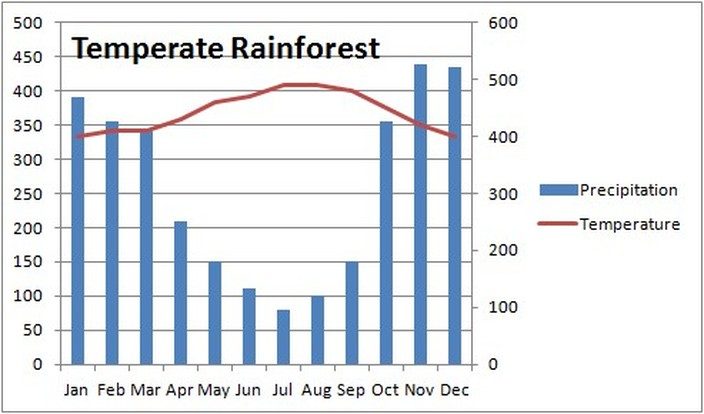
If this rainforest was in northern Queensland, which 'season' sees the most rainfall?
Summer
Autumn
Winter
Spring
If this rainforest was in northern Queensland, which 'season' is the coolest?
Summer
Autumn
Winter
Spring
What is the name of the large body of ground water underneath much of Australia's east?
The Great Big Waterhole
The Great Wet Lake
The Great Underground Watery Place
The Great Artesian Basin
What are the 3 states of water?
Liquid, Gas, Plasma
Liquid, Ice, Salty
Liquid, Solid, Gas
Hot, Cold, Wet
What is the largest ocean in the world?
Indian Ocean
Atlantic Ocean
Southern Ocean
Pacific Ocean
Pick the correct term for this definition.
When cooled high in the atmosphere, water vapour changes into liquid form and becomes water droplets, forming clouds.
Condensation
Precipitation
Transpiration
Infiltration
Which river is in Australia?
Murray River
East River
Mekong River
River Thames
What is the primary reason for the formation of deltas at river mouths?
High water velocity
Deposition of sediments
Evaporation of water
Increased salinity
Which process in the water cycle is directly responsible for cloud formation?
Evaporation
Infiltration
Condensation
Precipitation
How does urbanization typically affect local water cycles?
Increases natural infiltration
Decreases surface runoff
Increases surface runoff and reduces infiltration
Has no effect on water cycles
What is the process called when water vapor turns into liquid water?
Condensation
Precipitation
Evaporation
Infiltration
Which human activity has the greatest impact on water pollution?
Hiking
Fishing
Agriculture
Swimming
What is the term for the area of land where all precipitation collects and drains off into a common outlet?
Delta
Glacier
Reservoir
Watershed

