
 Worksheets
Gas Laws + States of Matter
Total questions: 25
Worksheet time: 23mins
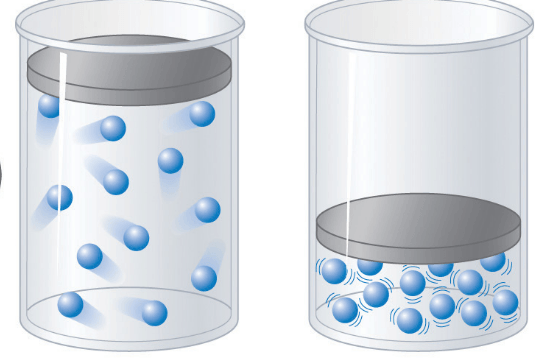
If a hairspray can is heated, what can be expected of the pressure of the gas inside the can?
The pressure will increase
The pressure will decrease
The pressure will remain constant
The pressure will equalize

What is the Standard for Temperature and Pressure?
273 K and 1 atm
273 C and 1 kPa
273 F and 1 mmHg
273 K and 1 Torr

When Temperature of a gas increases, the Pressure will ____________________
Increase
Decrease
Stay the Same

When Temperature of a gas increases, the Volume will ____________________
Increase
Decrease
Stay the Same
What does the unit atmosphere, atm, measure?
Pressure
Temperature
Volume
Moles

Gas particles are in constant motion. They travel in straight lines, and they constantly bounce off the walls of any container that holds them.
What does this constant bombardment of particles against the walls of the container create?
Pressure
Density
Temperature
Magnetism

Which of the following set of conditions would allow a gas to behave ideally?
(HINT: Remember that gases like to spread far apart! Which conditions would allow the molecules to easily spread apart?)
High Temperature, Low Pressure
High Temperature, High Pressure
Low Temperature, High Pressure
Low Temperature, Low Pressure
Which graph represents the relationship between pressure and volume for a sample of an ideal gas at constant temperature?


As the temperature of a gas is increased, the average kinetic energy of its molecules
Decreases
Increases
Remains the same
Which graph shows the correct relationship between the volume of a gas (V) and its absolute temperature (T), when pressure is held constant?


Define kinetic energy
energy of motion
static energy
stored energy
energy use

Which of the following is true about gases according to the Kinetic Molecular Theory?
Which of the following is an assumption of the kinetic-molecular theory of gases?
Collisions between gas particles are inelastic.
Gases consist of closely spaced particles.
Gas particles move around in an orderly manner.
The temperature of a gas depends on the average kinetic energy of the gas particles.
What is Avogadro's law?
Avogadro's law states that equal volumes of gases, at the same temperature and pressure, contain the same number of molecules.
Avogadro's law states that equal volumes of gases, at different temperatures and pressures, contain the same number of molecules.
Avogadro's law states that equal volumes of gases, at different temperatures and pressures, contain different number of molecules.
Avogadro's law states that equal volumes of gases, at the same temperature and pressure, contain different number of molecules.

