
 Worksheets
ELECTRONIC CIRCUITS
Total questions: 19
Worksheet time: 10mins
The input power to a device is 10,000 W at a voltage of 1,000 V. The output power is 500 W and the output impedance is 20 Ω. Find the voltage gain in decibels
-13 dB
-20 dB
-10 dB
-3 dB
Two stages have voltage gains of 100 and 200. The total decibel voltage gain is
46 dB
66 dB
86 dB
106 dB
A two-pole high-pass active filter would have a roll-off rate of
40 dB/decade
-40 dB/decade
20 dB/decade
-20 dB/decade
If f_unity is 10 MHz and midband open-loop voltage gain is 1,000,000, then the open-loop cutoff frequency of the op-amp is
10 Hz
20 Hz
50 Hz
100 Hz
The center frequency of a bandpass filter is always equal to
The bandwidth
Geometric average of the cutoff frequencies
Bandwidth divided by Q
3-dB frequency
Determine the quality factor of a bandpass filter with a lower cutoff frequency of 20.1 kHz and an upper cutoff frequency of 20.3 kHz.
10
10.1
101
202
For a passive bandpass filter using RLC circuit, which of the following below is the expression for its bandwidth?
BW = 1/(2*pi*sqrt(L*C))
BW = 1/(2*pi*f*C)
BW = R/(2*pi*L)
BW = R/(2*pi*f*L)
The bandwidth in a ______ filter equals the critical frequency.
low-pass
high-pass
band-pass
band-stop
What is the level of the roll-off in most op-amps?
-6 dB/decade
-20 dB/octave
-6 dB/decade or -20 dB/octave
-20 dB/decade or -6 dB/octave
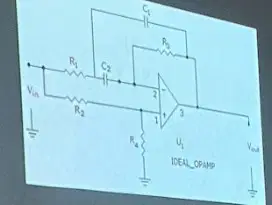
What is this circuit?
a low-pass filter
a high-pass filter
a bandpass filter
a band-stop filter
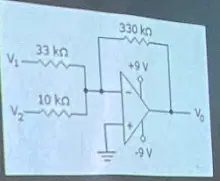
Calculate the output voltage if V_1 = V_2 = 0.15 V
0 V
4.65 V
6.45 V
-6.45 V
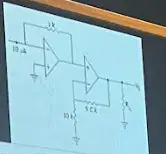
The output V_o in figure is
- 100 V
- 100 mV
10 V
10 mV
The input frequency of a single-pole, low-pass active filter increases from 1.5 kHz to 150 kHz. If the critical frequency is 1.5 kHz, the gain decreases by
3 dB
20 dB
40 dB
60 dB
In a certain four-input summing amplifier, all the input resistors and the feedback resistor has a value of 2.2kΩ. If all the input voltages are 2V, what is the output voltage?
-8V
-2V
-2.2V
-10V
Determine the input and output impedance with feedback for current-shunt feedback having A = - 100, R_i = 10 kΩ, and R_o = 20 kΩ for feedback of β = -0.1
909.09Ω, 1.82 kΩ
909.09Ω, 220 kΩ
110 kΩ, 392.16 Ω
110 kΩ, 1.82 kΩ
If an amplifier with gain of - 1000 and feedback of β = -0.1 has a gain change of 20% due to temperature, calculate the change in gain of the feedback amplifier.
2%
1%
0.2%
0.5%
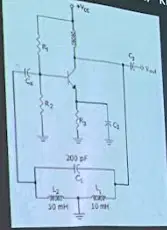
Refer to this figure. Determine the resonant frequency.
123.4 kHz
61.7 kHz
45.94 kHz
23.1 kHz
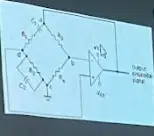
Calculate the value of C1 = C2 for the Wien bridge oscillator to operate at a frequency of 20 kHz. Assume R1 = R2 = 50 kΩ and R3 = 3 R4 = 600 Ω
1.59 pF
15.9 pF
159 pF
1.59 nF
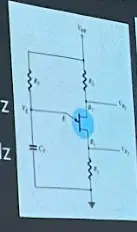
Determine the frequency of oscillation given VBB = 12 V, R1 = 0.1 kΩ, R2 = 0, RT = 50kΩ, CT = 0.1 pF, Π = 0.6
281.27 Hz
218.27 kHz
218.27 MHz
281.27 MHz

