Wayground logo

Free Printable Worksheets

Font size

S
M
L
XL
Worksheets

Enzyme and Nucleic Acid Functions Review

Total questions: 23

Worksheet time: 23mins

Name
Class
Date
1.
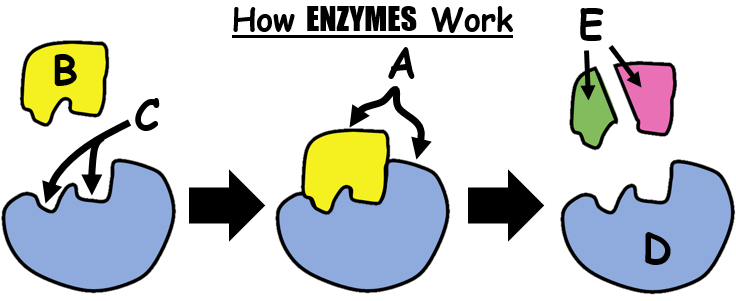
What is being represented by the letter A in the image?
a)
Substrate
b)
Enzyme
c)
Product
d)
Complex
2.
What is being represented by the letter B in the image?
a)
Substrate
b)
Enzyme
c)
Substrate
d)
Product
3.
REVIEW: Which of the following best describes the function of nucleic acids?
a)
Nucleic acids are used as the building blocks of proteins.
b)
Nucleic acids inhibit and stop the flow of biochemical reactions. 
c)
Nucleic acids contain the genetic code for protein synthesis. 
d)
Nucleic acids transmit signals that begin biochemical processes.
4.
Enzymes will make a reaction go _______ and use ______ energy.
a)
faster, less
b)
faster, more
c)
slower, less
d)
slower, more
5.
Which of the following tasks listed below is most associated with enzymes?
a)
catalyze chemical reactions                  
b)
store genetic information       
c)
store chemical energy in the cell   
d)
dissolve nutrients and minerals 
6.
Which factors can change the shape of an enzyme and thus denatures a enzyme?
a)
Excessive heat and changes in pH
b)
Nothing can
c)
Exposure to light and sound
d)
Exposure to bacteria and Amoebas
7.
Enzymes are composed of what organic molecule?
a)
Sugars
b)
DNA
c)
Proteins
d)
Fatty Acids
8.
The "lock and key hypothesis" attempts to explain the mechanism of?
a)
Vacuole formation
b)
Pinocytosis
c)
Sharing of electrons
d)
Enzyme are specific to a substrate
9.
In the diagram, what is letter A? 
a)
product
b)
substrate
c)
enzyme-substrate complex
d)
active site
10.

Which macromolecule has amino acids as monomers?

a)

Carbohydrates

b)

Lipids

c)

Proteins

d)

Nucleic acids

11.

This macromolecules is responsible for providing our genetic material. Choose the macromolecule that best fits.

a)

Carbohydrates

b)

Lipids

c)

Proteins

d)

Nucleic acids

12.

My monomers are glycerol and fatty acids. Which macromolecule am I?

a)

Carbohydrates

b)

Lipids

c)

Proteins

d)

Nucleic acids

13.

My monomers are monosaccharides. Which macromolecule am I?

a)

Carbohydrates

b)

Lipids

c)

Proteins

d)

Nucleic acids

14.
DNA and RNA are examples of 
a)
Carbohydrates
b)
Lipids
c)
Proteins
d)
Nucleic Acids
15.
What is the function of nucleic acids?
a)
store genetic information
b)
store energy (long-term)
c)
store energy (short-term)
d)
build skin, hair, nails, muscles
16.
Animals, such as bears, that hibernate for long periods of time store most of their long term energy reserves as _______ because
a)
glucose; it is easy to break down.
b)
Lipid/fat; they store twice as much energy per gram
c)
protein; it is a compact source of energy in their bodies.
d)
carbohydrates; they store twice as much energy per gram of glucose.
17.

During transcription, this type of ribonucleic acid is responsible for copying the DNA and brining it out of the nucleus.

a)

tRNA

b)

mRNA

c)

rRNA

d)

dRNA

18.

When these bond together, they form a protein

a)

Amino Acids

b)

Peptide Bonds

c)

Ribose

d)

Nucleotides

19.

mRNA occurs during this process

a)

Translation

b)

Transcription

c)

Replication

d)

Delivery

20.
The process to go from DNA to mRNA is _______
a)
translation
b)
transcription
c)
replication
21.
The process to go from mRNA to a protein is called ____
a)
transcription
b)
rRNA
c)
replication
d)
translation
22.
Genetic info flows in one direction. Which best represents this flow?
a)
DNA-protein-RNA
b)
Protein-RNA-DNA
c)
RNA-protein-DNA
d)
DNA-RNA-protein
23.

What brings the amino acids to the ribosome to assemble a protein?

a)
mRNA
b)
tRNA
c)
rRNA
d)

DNA