Wayground logo

Free Printable Worksheets

Font size

S
M
L
XL
Worksheets

Geometry Exam Review

Total questions: 69

Worksheet time: 4hrs 54mins

Name
Class
Date
1.

Are the points shown collinear?

a)

Yes

b)

No

2.

Choose the points that are collinear.

a)

A, B, and C

b)

A, C, and D

c)

A, E, and F

d)

B, C, and D

3.

Are the points shown collinear?

a)

Yes

b)

No

4.
Solve for x
a)
x = 2
b)
x = 4
c)
x = 6
d)
x = 8
5.
What does the word BISECT mean?
a)
To cut something into more than five pieces.
b)
It is a plane with two sets of wings.
c)
A shape that has three sides. 
d)
To cut something into two congruent pieces or in half.
6.
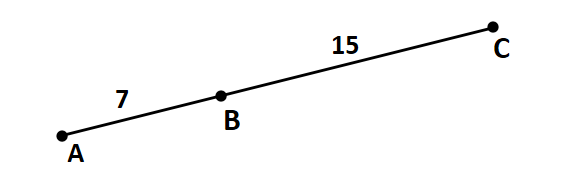
Find AC
a)
7
b)
8
c)
22
d)
23
7.

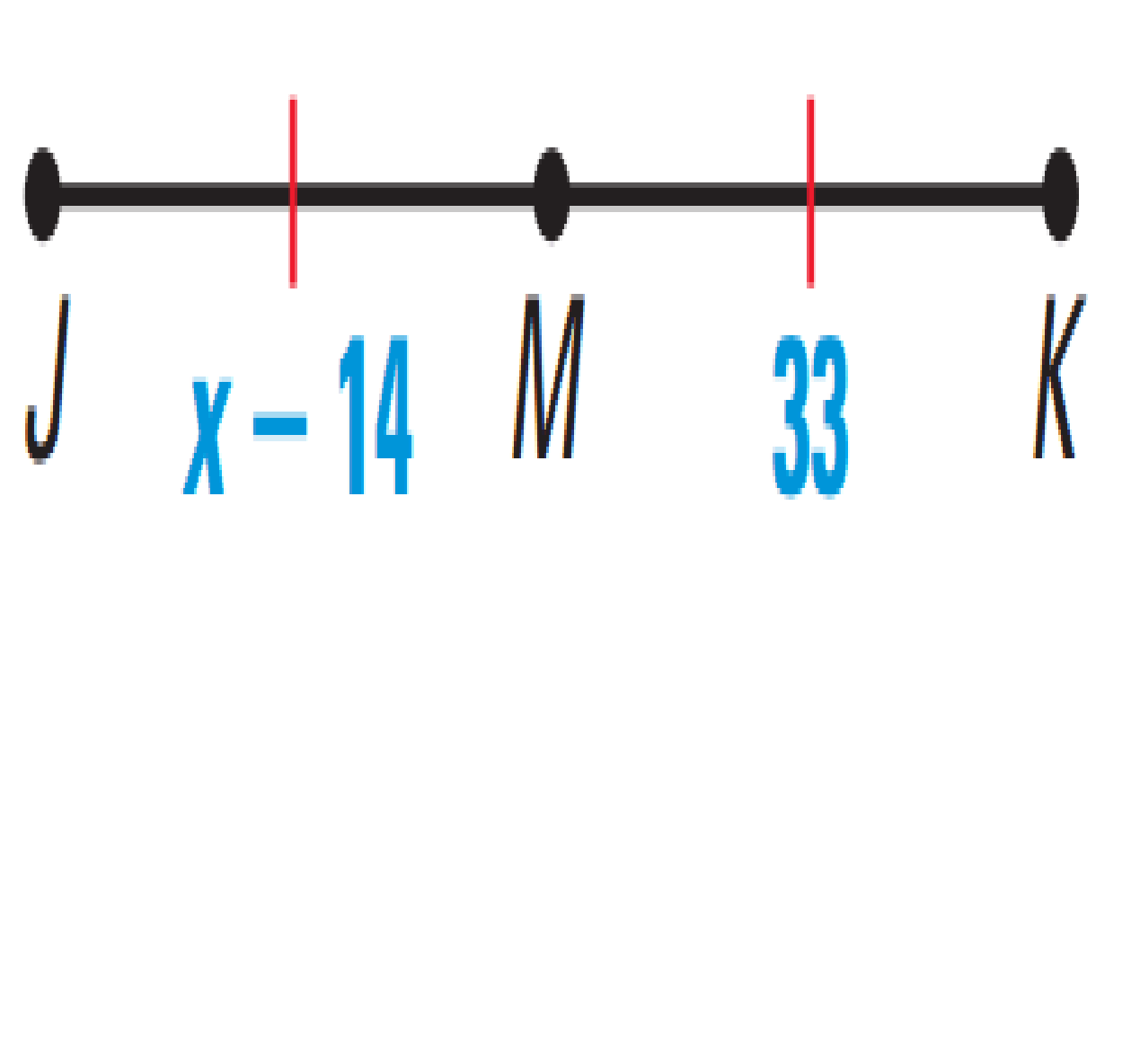
M is the midpoint of the line segment. Find the value of x.

a)

x=47

b)

x=19

c)

x=33

d)

x= -47

8.

Calculate m∠ABC.

a)

45°

b)

60°

c)

105°

d)

15°

9.
a)

x = 6°

b)

x = 7°

c)

x = 12°

d)

x = 144°

10.
a)

x = 5°

b)

x = 11°

c)

x = 33°

d)

x = 55°

11.

Find the midpoint of the line segment with the given endpoints (1,1) and (9,9)

a)

(5,5)

b)

(1,9)

c)

(17,17)

d)

(-4,-4)

12.

Find the midpoint: (2,−7),(10,1)\left(2,-7\right),\left(10,1\right)  

a)

(-3,6)

b)

(6,-3)

c)

(4,4)

d)

none

13.
Find the distance between (3, 24) and (7, 56).
a)
32.1
b)
32.2
c)
32.4
d)
33.2
14.
Find the distance between ( 1, 3) and (5, 6) 
a)
3
b)
4
c)
5
d)
6
15.
Find the value of x
a)
16
b)
8
c)
32.8
d)
39.2
16.
Find the value of r
a)
46
b)
44
c)
43
d)
47
17.
Find the next term in the sequence:
A, D, G, J, _____
a)
L
b)
M
c)
P
d)
K
18.
What are the missing numbers in this pattern?
23, 33, ___, 53, ___, 73
a)
32, 62
b)
42, 63
c)
43, 63
d)
42, 62
19.

Which of the following provide a counterexample to the claim:

"If two angles are supplementary, then they are not congruent."

a)

40° and  140°40\degree\ and\ \ 140\degree

b)

80° and  80°80\degree\ and\ \ 80\degree

c)

30° and  150°30\degree\ and\ \ 150\degree

d)

90° and  90°90\degree\ and\ \ 90\degree

20.

Which is a counterexample to the following statement?

If an angle is obtuse, then it is 125°125\degree .

a)

90°90\degree  

b)

57°57\degree  

c)

160°160\degree  

d)

180°180\degree  

21.
What is the hypothesis of the given Conditional Statement?
a)
Jimmy will go to Orlando
b)
Jimmy goes on vacation
c)
Jimmy will go to Orlando
d)
Who is Jimmy?
22.
What is the converse to this statement?
a)
If it isn't dark outside, then it is not night.
b)
If it is night, then it is dark outside
c)
If it is not night, then it is not dark outside.
d)
It is night.
23.
What is the inverse to this statement?
a)
If you live in Canada, you live in Montreal
b)
If you don't live in Montreal, then you don't live in Canada.
c)
If you don't live in Canada, you don't live in Montreal.
d)
Montreal is in Brazil.
24.
What is the conclusion to this?
a)
Clarkson will be the coolest
b)
Clarkson will not be the coolest
c)
Clarkson gives us Mountain Dew
d)
Clarkson will not give us Mountain Dew
25.
What is the contrapositive to this?
a)
If the food is not cooked, then it is not in the oven.
b)
If the food is not in the oven, then it is not cooked.
c)
If the food is cooked, then its in the oven.
d)
If food is not in the oven, then its cooked.
26.

What is the hypothesis of the given Conditional Statement:

If Jimmy goes on vacation, then he will go to Orlando.

a)

Jimmy goes on vacation

b)

Jimmy will go to Orlando

c)

Jimmy doesn't go on vacation

d)

Who is Jimmy?

27.

What is the conclusion to this statement?

If Susan gives us Mountain Dew, then she will be the coolest.

a)

Susan will be the coolest

b)

Susan gives us Mountain Dew

c)

Susan will not give us Mountain Dew

d)

Susan will not be the coolest

28.

Use the Law of Detachment to draw a conclusion from the two given statements. If not possible, write not possible.

Conditional: If I study for one hour each day, then I will score well on the exam.

Premise: I will score well on the exam.

a)

I study for 1 hour each day.

b)

I do not study for 1 hour each day.

c)

If I do well on the exam, I studied for 1 hour each day.

d)

not possible

29.

If possible, use the Law of Detachment to draw a conclusion from the two given statements. If not possible, write not possible.

Conditional: If two lines do not intersect, then they are coplanar and parallel, or skew.

Premise: Lines AB and CD do not intersect.

a)

Lines AB and CD are parallel and not coplanar.

b)

Lines AB and CD are skew.

c)

Lines AB and CD are parallel and coplanar or they are skew.

d)

No Conclusion can be made.

30.

If possible, use the Law of Detachment to draw a conclusion from the two given statements. If not possible, write not possible.

Conditional: If there is lightening, then it is not safe to out in the open.

Premise: Mary sees lightening from her home

a)

It is not safe for the lightening.

b)

It is not safe for Marty to be out in the open.

c)

There is lightening.

d)

No conclusion can be made.

31.
Use the law of syllogism to draw a conclusion from the two given statements:
Statement 1: If you exercise regularly, then you have a healthy body
Statement 2: If you have a healthy body, then you have more energy
a)
You have more energy
b)
If you exercise regularly, then you have more energy
c)
You have a healthy body
d)
If you do not have a healthy body, then you do not exercise regularly
32.
Use Law of Syllogism to make a conclusion.
 If a number is divisible by 10, then it is divisible by 2.  If a number is divisible by 2, then it is even.
a)
If a number is divisible by 10, then it is even,
b)
If a number is even, then it is divisible by 10.
c)
If a number is divisible by 2, then it is even.
d)
If a number is even, then it is divisible by 2.
33.
Use Law of Syllogism to make a conclusion.
If the perimeter of a square is 20 ft, then the length of a side is 5 ft.
If the length of a side of a square is 5 ft, then the area is 25 ft2.
a)
If the side of a square is 5 ft, then the perimeter is 20 ft.
b)
If the perimeter of a square is 20 ft, then the area is 25 ft2
c)
If the area of a square is 25 ft2, then the side length is 5 ft. 
d)
If the are of a square is 25 ft2, then the perimeter is 20 ft.
34.
What is reason 3?
a)
Addition Property of Equality
b)
Subtraction Property of Equality
c)
Multiplication Property of Equality
d)
Division Property of Equality
35.

What is the correct reason for line 5 and 6?

a)

5.Transitive Property of equality 6. Substitution

b)

5.Algebra 6.Definition of ≅

c)

5.Substitution 6.Definition of ≅

d)

5.Angle addition postulate 6.Substitution

36.
Name the angle relationship.
a)
Alternate Interior
b)
Alternate Exterior
c)
Corresponding
d)
Vertical Angles
37.
What is the relationship of the Angles
a)
Alternate Interior
b)
Alternate Exterior
c)
Corresponding
d)
vertical 
38.
Which pair of angles are alternate exterior angles?
a)
Angle 7 and Angle 4
b)
Angle 2 and Angle 6
c)
Angle 8 and Angle 1
d)
Angle 2 and Angle 8
39.
Name the angle relationship.
a)
Consecutive Interior
b)
Alternate Interior
c)
Corresponding
d)
Vertical Angles
40.
Name the alternate interior angle to angle 3.
a)
4
b)
5
c)
6
d)
8
41.
State the angle relationship and find the measure of angle 2
a)
Alternate Exterior
127
b)
Alternate Exterior
52
c)
Alternate Interior
127
d)
Alternate Interior
52
42.

Solve for x.

a)

A

b)

B

c)

C

d)

D

43.

Solve for x.

a)

A

b)

B

c)

C

d)

D

44.
Solve for  y.
a)
y = 20
b)
y = 120
c)
y = 60
d)
y = 10
45.

Are the slopes below parallel, perpendicular, or intersecting?
Line A: 23Line\ A:\ \frac{2}{3}  

Line B: (3, −3) and (−6, −9)Line\ B:\ \left(3,\ -3\right)\ and\ \left(-6,\ -9\right)  

a)

Parallel

b)

Perpendicular

c)

Intersecting

46.

Are the slopes below parallel, perpendicular, or intersecting?
Line A: 5Line\ A:\ 5  

Line B: (6, 33) and (11, 58)Line\ B:\ \left(6,\ 33\right)\ and\ \left(11,\ 58\right)  

a)

Parallel

b)

Perpendicular

c)

Intersecting

47.

Determine the equation of a line perpendicular to y=-3x-2 and going through the point (9, 2), in slope-intercept form.

a)

y=13x−3y=\frac{1}{3}x-3

b)

y=−13x−9y=-\frac{1}{3}x-9

c)

y=13x−1y=\frac{1}{3}x-1

d)

y=−3x−9y=-3x-9

48.

Which of the following shows an equation of a line parallel to y=3x+72y=3x+\frac{7}{2}  and going through point (-4, -5), in slope-intercept form?

a)

y=3x+7

b)

y=-3x-7

c)

y=3x-17

d)

y=-3x+17

e)

y=3x-7

49.
Are these two shapes congruent or not congruent?
a)
congruent
b)
not congruent
50.
Are these two shapes congruent or not congruent?
a)
congruent
b)
not congruent
51.
Are these shapes congruent or not congruent?
a)
congruent
b)
not congruent
52.
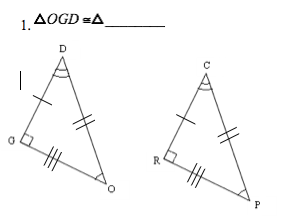
Complete the congruence statement.
a)
CRP
b)
PCR
c)
RPC
d)
PRC
53.
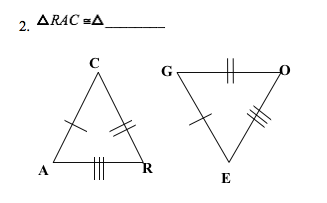
Complete the congruence statement.
a)
OEG
b)
OGE
c)
EGO
d)
GOE
54.
Use the congruency statement to answer the following: 
<F = ___
a)
<H
b)
<I
c)
<G
d)
not congruent to another angle
55.
∆EHG≅∆KFC
Which is a true statement?
a)
EH≅FK
b)
HG≅KF
c)
EG≅KC
d)
∠E≅∠C
56.
What side corresponds to ED?
a)
TA
b)
NA
c)
TN
d)
RD
57.

Given ΔABC≅ΔDEF\Delta ABC\cong\Delta DEF  , find the value of y.

a)

35

b)

40

c)

27.5

d)

30

58.

Given ABCD≅PQRSABCD\cong PQRS  find the value of x.

a)

52

b)

48

c)

42

d)

38

59.
a)
72
b)
67
c)
65
d)
54
60.
Find x.
a)
180
b)
57
c)
61.5
d)
32.7
61.
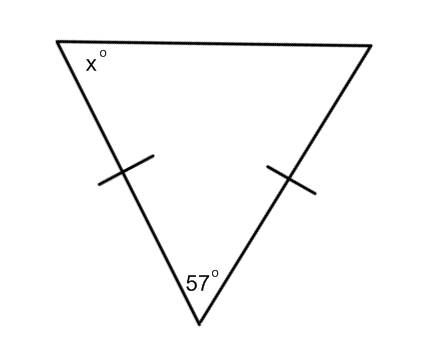
Determine x
a)
93
b)
71
c)
81
d)
55
62.
What is the value of x?
a)
51
b)
49
c)
78
63.
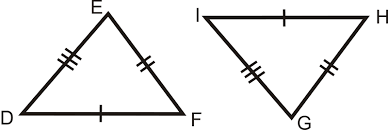
Which triangle congruence theorem can be used to prove the triangles are congruent?
a)
SAS
b)
SSS
c)
ASA
d)
HL
64.
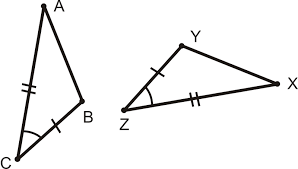
Which triangle congruence theorem can be used to prove the triangles are congruent?
a)
SSS
b)
ASA
c)
AAS
d)
SAS
65.
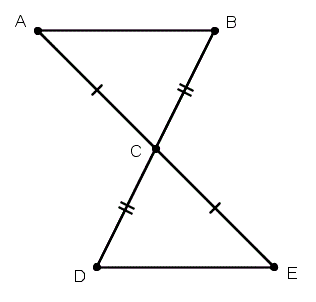
Which triangle congruence theorem can be used to prove the triangles are congruent?
a)
AAS
b)
SSS
c)
Not enough information given
d)
ASA
66.
Which triangle congruence theorem can be used to prove the triangles are congruent?
a)
AAS
b)
SSS
c)
SAS
d)
SSA
67.

What additional info would prove each pair of triangles congruent by HL?

a)

AC‾≅AC‾\overline{AC}\cong\overline{AC}

b)

AD‾≅BC‾\overline{AD}\cong\overline{BC}

c)

∠B≅∠D\angle B\cong\angle D

d)

<B and <D are right angles

68.

What additional information is needed to prove the 2 triangles are congruent by the listed theorem?

a)

RT‾ =XZ‾\overline{RT}\ =\overline{XZ}

b)

∠RST = ∠XYZ\angle RST\ =\ \angle XYZ

c)

SR‾ =YX‾\overline{SR}\ =\overline{YX}

69.
Solve for x.
a)
x = 5 
b)
x = 20
c)
x = 3
d)
x = 9