
 Worksheets
Unit 6 Review
Total questions: 147
Worksheet time: 5hrs 47mins


Velocity = _______________
Speed – direction
Speed + direction
Speed x direction
Speed / direction
You drive 25 miles in 30 minutes. What is your average speed in terms of mi/hr?
25mi/30min
5mi/6min
25mi/hr
50mi/hr
Another way to explain the speed and direction of a object would be to describe it’s ________
Speed
Velocity
Acceleration
(Final speed - Initial Speed) / time = __________________
Speed
Velocity
Acceleration
This occurs when an object speeds up, slows down, or changes direction.
Speed
Velocity
Acceleration
Speed = _______________
Distance + time
Distance – time
Distance x time
Distance / time
A car initially traveling at 8.0 meters per second doubles its speed while traveling in a northeast direction.
Students used a table to record the initial and final conditions for speed and velocity.
Which table is correct?


Which statement best describes the motion of the toy vehicle during the first 30 seconds of the investigation?
The vehicle was traveling at a constant speed
The vehicle was accelerating at a constant rate
The speed of the vehicle was increasing
The acceleration of the vehicle was increasing

Which statement best describes the cart?
The cart was stationary with a velocity of 0 m/s for the entire 7 seconds
The cart was stationary except for a short burst of acceleration of 0.5 m/s2
The cart moved at a constant velocity of 0.5 m/s for the entire 7 seconds
The cart accelerated at a constant rate of approximately 0.8 m/s2
Velocity = _______________
Speed – direction
Speed + direction
Speed x direction
Speed / direction
Which is newtons first law states
An object at rest will remain at rest unless a force is applied
An object is moving
An object has stopped
An moving object will keep going when a force is applied to it
Which is newtons 3rd law
for every thing there is reaction
for every reaction there is a unusual action
For every reaction there is an equal and opposite reaction
for every reaction there is an good action
Which type of force(s) will cause a change in an object's motion?
gravity
balanced forces
unbalanced force
net force
Which is newtons 3rd law
for every thing there is reaction
for every reaction there is a unusual action
For every reaction there is an equal and opposite reaction
for every reaction there is an good action
In referring to how much matter a body contains, we use the term:
Volume
Weight
Mass
Andrea is walking at 3 m/s. She sees the ice cream truck and starts running towards it. In 5 seconds, she speeds up to 7 m/s. What is her acceleration?
0.8 m/s^2
0.667 m/s^2
0.295 m/s^2
0.295 m/s
A biker speeds up from 10 m/s to 30 m/s in 10 seconds. What was their average acceleration?
20 m/s^2
2 m/s^2
20 m/s
0 m/s^2
Lulu is standing at the starting line for a race. She starts running and speeds up to 3 m/s in 30 seconds. What was her acceleration?
0.1 m/s^2
0.1 m/s
10 m/s^2
10 m/s
Lulu is standing at the starting line for a race. She starts running and speeds up to 3 m/s in 30 seconds. What was her acceleration?
0.1 m/s^2
0.1 m/s
10 m/s^2
10 m/s

What is this?
"This airplane is traveling at 500 mph, West"
Speed
Velocity
Acceleration
A car speeds up from 25 m/s to 45 m/s in 4 seconds. What was its acceleration?
1.8 m.s^2
11.25 m/s^2
5 m/s^s
5 m/s
If an airplane travels 500km in 5 hours, what was its speed?
100 km/hr
2,500 km/hr
0.01 km/hr
495 hm/hr
Speed = _______________
Distance + time
Distance – time
Distance x time
Distance / time
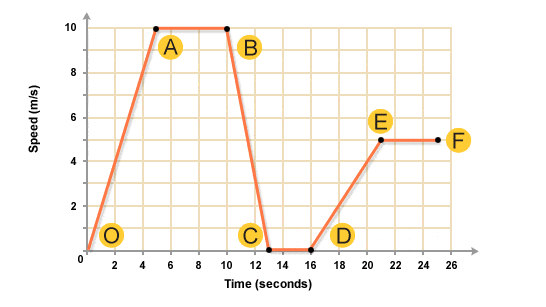


Segment B-C The bus is _________________. This is a DISTANCE - TIME graph.
at rest
returning (to original position)
moving forward

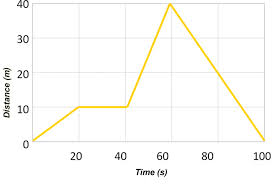
(a)
A golf ball accelerates off a tee at 15m/s2, changing its velocity from 0m/s to 50 m/s down the fairway. How LONG did it take the golf ball to accelerate?
(a)

What is happening in this graph from point B to C? This is a SPEED-TIME GRAPH !! Look CAREFULLY !
(a)

(a)

Why did Arctica lose the race?
She stopped
She ran too slow

Speeding Up
Slowing Down

Speeding Up
Slowing Down

Which section shows an object getting faster?
A only
B only
A and C
D
C and D

Which section shows an object decreasing in speed?
A
B
C
D
A bus starts from rest and accelerates to 14 m/s in 4 s. What is the average acceleration of the bus?
3.5 m/s2
5.9 m/s2
10.5 m/s2
24 m/s2
Which law states that the acceleration of an object depends on the force exerted on it and its mass?
1st Law
2nd Law
3rd Law
Which law states that an object at rest stays at rest and an object in motion stays in motion unless an unbalanced force acts on it?
1st Law
2nd Law
3rd Law
Which law states that for every action there is an equal and opposite reaction?
1st Law
2nd Law
3rd Law
Henry sees a basketball and decides to put in motion. What kind of force does Henry use to move the ball?
small
balanced
equal
unbalanced
Which activity would BEST demonstrate Newton's law of Inertia?
A plate sits on a table top.
A lady pushes a grocery cart.
A child jumps on a trampoline.
A boy swings a baseball bat.
Which activity would BEST demonstrate the Law of Action/Reaction?
A car traveling down the road.
A rocket launching to space.
A soccer ball sitting on the ground.
A lady pushing a grocery cart.
Which activity would BEST demonstrate the Law of Force and Acceleration?
A lady pushes a grocery cart.
A boy swings a baseball bat.
A soccer ball sits on the ground.
A rocket launches into space.
A jellyfish swims through the water by pulling in water and then pushing the water back out in the opposite direction. This is an example of which law of motion?
1st Law
2nd Law
3rd Law
Mary is riding in a car when the driver suddenly slams on the brakes. Mary is jerked forward out of her seat. This is an example of which law of motion?
2nd Law
1st Law
3rd Law
Billy pushes his little brother on a sled through the snow. He then tries to push his father on the the same sled. He noticed that it was much harder to push his father. Which law is this an example of?
1st Law
2nd Law
3rd Law

Which law is this picture an example of?
Law of Inertia
Law of Action / Reaction
Law of Force and Acceleration

Which law is this picture an example of?
Law of Inertia
Law of Force and Acceleration
Law of Action / Reaction

Which law is this picture an example of?
Law of Inertia
Law of Force and Acceleration
Law of Action / Reaction

What law is best described
1st
2nd
3rd
law of motion

What law is best described
A magician pulls a tablecloth out from under dishes and glasses on a table without disturbing them.
Newton's 1st Law
Newton's 2nd Law
Newton's 3rd Law


Suppose that an astronaut throws a baseball in outer space at a location far from significant influences of gravity and air resistance. One would expect that the baseball would ____.
eventually stop since all objects ultimately "lose their steam"
eventually stop as its inertia slowly becomes used up
continue in motion with the same speed and direction
either a, b, or c -- depending on whether the astronaut continues to push it
A skateboard rolls down a hill, reaches the level surface and eventually comes to a stop. The fact that the skateboard ultimately stops is best explained by ____.
an unbalanced force would be required to keep the sled moving forward at constant speed
the presence of an unbalanced force (e.g., friction) can cause a moving object to stop
the presence of inertia causes it to stop
the natural tendency of any object is to ultimately stop

The __________ between the sole of you shoe and the floor keeps you from slipping.
friction
gravity
acceleration
motion
Swimming is possible by
1st Law of motion
2nd Law of motion
3rd Law of motion
Newton's Law of gravitation

A 50 kg skater pushed by a friend accelerates 5 m/s2. How much force did the friend apply? To solve this problem you must do -
50 ÷ 5
5 ÷ 50
50 x 5

A force of 250 N is applied to an object that accelerates at a rate of 5 m/s2. What is the mass of the object? To solve this problem you must do -
250 ÷ 5
5 ÷ 250
250 x 5
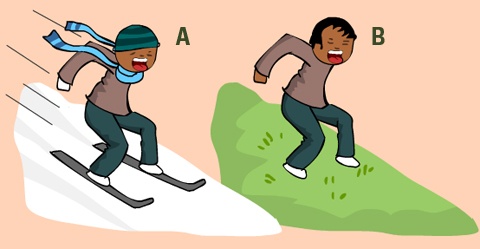

A 10 kg, 15 kg, and 20 kg rock are rolling down a hill. Which rock will require the most force to stop?
10 kg rock
15 kg rock
20 kg rock
All 3 rocks will require the same force
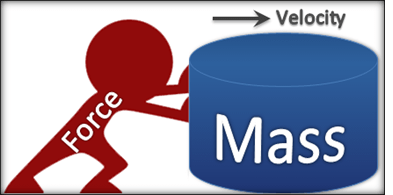
The picture is an example of Newton's...
1st Law
2nd Law
3rd Law
The picture is an example of Newton's...
1st Law
2nd Law
3rd Law


30 mph west is an example of _________.
force
speed
acceleration
velocity
The force that prevents a ball rolling on the ground from continuing on it's path forever is...
Friction
Gravity
Inertia

A simple machine makes work easier by doing which of the following?
Increasing the distance through which force is applied.
Changing the direction of applied force.
Multiplying the force of the energy applied.
All of the above.

It changes the direction of the input force.
It changes the distance over which the input force is applied.
It changes the amount of the input force applied
It changes direction and increases the effect of your input force
A grooved wheel with a rope, chain, or cable wrapped around it which can be pulled to change the direction and force on an object. This simple machine can be fixed, movable, or part of a system
Mr Ellis
pulley
wedge
wheel and axle
It takes 20 Newtons of force to move a desk 10 meters. How much work is done to move the desk?
Make sure to include unit labels

It takes 3 Newtons of force to lift a paint can up a shelf. The total work exerted is 6 joules. What distance did the paint can travel?
Use Unit Labels
A hydraulic lift exerts a force of 1,200 N to lift the frame of a car 3 meters between factory stations. How much work is done to move the car?
dont forget units
A total of 200 joules of work is exerted when hauling a tree that needs to be planted across a 20 meter field. How much force is needed to move the tree?
Don't forget units
Which surface created the most friction in the friction lab?
Dragging the brick across a wooden board.
Dragging the brick across sandpaper.
Dragging the brick across waxed paper.
Dragging the brick across Mr. Ellis
How does a movable pulley make lifting objects easier?
The amount of force needed is doubled.
the amount of force needed is increased.
the amount of force needed is reduced.
the amount of force needed stays the same.

When force is used to move an object across a distance, this is called...
effort
power
energy
work
How much work is done if I use 5N of force to move an object 2 meters?
10 Newtons
7 Newtons
10 Joules
7 Joules
work is
the place you have to go your entire adult life
the result of moving an object a certain distance
an activity involving mental or physical labor
a task or undertaking


What is needed to calculate work?
force
distance
time
mass
What is the relationship between Power and Work?
Power is the rate which Work is done
Work is not related to Power
Power is the result of work times the time it takes to complete it
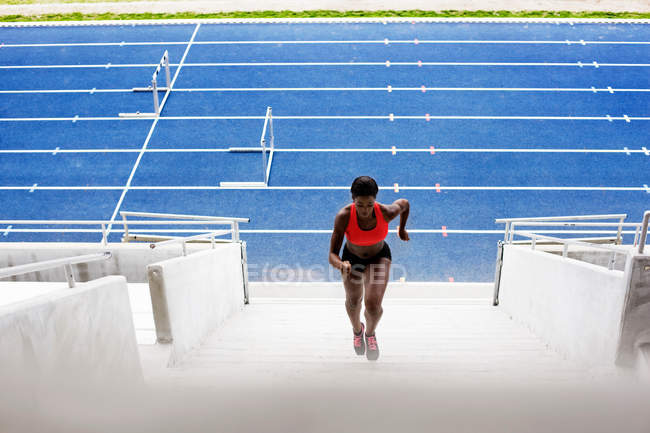
How much power is generated by Ashley (50 kg) running up a 6 m flight of stairs in 5 seconds?
60 W
62 W
600 W
1500 W
Jane carries a 5 kg box and Lorie carries a 10 kg box up a set of stairs, who did more work?
Jane because his box was lighter.
Lorie because her box weighed more.
Can't tell.
A 100 N force is applied to move an object a horizontal distance of 5 meters at constant speed in 10 seconds. How much power is done?
50J
50W
500J
500W

This chart represents the velocity of a motorcycle over time. Select the correct statement regarding the motorcycle's movement.
The motorcycle is speeding up.
The motorcycle has 0 acceleration.
The motorcycle is slowing down.
The motorcycle has constant acceleration.

What is happening between 3 seconds and 4 seconds?
The object is moving in a negative direction.
The object is returning to its starting position.
The object is slowing to a stop.
The object is changing direction.


A school bus ran its morning route to pick up students. The chart to the right shows its progress. What was the total distance the bus traveled?
10 miles
14 miles
9 miles
16 miles
A school bus ran its morning route to pick up students. The chart to the right shows its progress. When was the bus moving the slowest?
From 6:30-6:45
From 6:45-7:00
From 7:00-7:15
From 7:15-7:30
A school bus ran its morning route to pick up students. The chart to the right shows its progress. When was the bus moving the fastest?
From 6:30-6:45
From 6:45-7:00
From 7:00-7:15
From 7:15-7:30

Use the velocity/ time graph to describe what is happening at each point.
Speeding up slowly
A
Moving at a constant speed
B
Slowing down
D
Stopped
none of these
Speeding up quickly
C
The best reference points are stationary (not moving).
true
false


What would be a good reference point to prove that the boy in the train is moving?
the seat
the window
the table
the building
The people on a bus are not moving in relation the seats inside the bus, but they are in _______________ compared to the streets outside.
position
displacement
reference point
motion
What is the SI unit used to measure weight?
pounds
grams
newtons
friction

True or False: Your weight would change if you were on Mars
True
False
An object's mass _________________________ changes.
always
never
sometimes
kinda

Looking at the data table in the picture, match the following vehicle with it's correct force
Motorcycle
16,150 N
Car
25,620 N
Truck
23, 520 N
SUV
23,750 N

