
 Worksheets
6.10C-Rock Cycle- Level 3
Total questions: 40
Worksheet time: 20mins
What is a cycle?
A series of events that repeat in a predictable pattern
A type of rock
A single event that happens once
A type of plant
What are the three main types of rocks?
Igneous, Sedimentary, Metamorphic
Hard, Soft, Liquid
Red, Blue, Green
Large, Medium, Small
Is it possible for a metamorphic rock to become an igneous rock? If so, how?
Yes, by melting and cooling
No, it cannot change
Yes, by freezing
No, it only becomes sedimentary
What type of rock is formed from the melting and cooling of lava or magma?
Sedimentary
Metamorphic
Igneous
Sediments
Which type of rock is formed from the compaction and cementation of sediments?
Metamorphic
Sedimentary
Igneous
Weathering
What process involves the breaking down of rocks into smaller pieces?
Erosion
Weathering
Sedimentation
Metamorphism
Which type of rock is formed under heat and pressure?
Sedimentary
Igneous
Metamorphic
Sediments
What is the process of sediments being pressed together called?
Erosion
Compaction
Weathering
Melting
What is the term for the movement of sediments from one place to another?
Weathering
Erosion
Deposition
Melting
What is the process of sediments being glued together called?
Cementation
Erosion
Weathering
Melting
Which process involves the transformation of rocks due to heat and pressure?
Metamorphism
Erosion
Weathering
Sedimentation
What is the molten rock that erupts onto the Earth's surface called?
Magma
Lava
Sediments
Crystals
Which type of rock can be formed from the cooling of lava?
Sedimentary
Metamorphic
Igneous
Sediments
What is the process called when rocks change form due to heat and pressure?
Metamorphism
Erosion
Weathering
Sedimentation
What is the term for the natural process of breaking down rocks?
Weathering
Erosion
Melting
Cooling

Sandstone is an example of...
Metamorphic
Sedimentary
Igneous
Select the three types of rocks.
igneous
metamorphic
volcano
sedimentary
What is the process called when rocks are broken down by natural forces like wind and water?
Weathering
Erosion
Compaction
Cementation
Which type of rock is formed from the solidification of molten material?
Sedimentary
Igneous
Metamorphic
Crystalline
What is the term for the layering of sedimentary rocks?
Stratification
Metamorphism
Weathering
Erosion

Which type of rock is most likely to be form from a lava flow from a volcano?
Igneous rocks
Metamorphic rocks
Sedimentary rocks
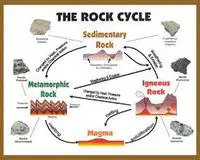
Each rock type can follow only one pathway of the rock cycle.
True
False

According to this diagram, metamorphic rock is formed by
melting and solidification
burial and compaction
weathering and erosion
heat and/or pressure

According to the diagram, how does magma become an igneous rock?
Melting
Cooling
Heat and Pressure
Compaction and Cementation

What is letter A?
Igneous Rock
Sedimentary Rock
Metamorphic Rock
Minerals
What is letter B?
Igneous Rock
Sedimentary Rock
Metamorphic Rock
Minerals
What is letter C?
Igneous Rock
Sedimentary Rock
Metamorphic Rock
Minerals

What is letter A?
Cooling
Melting
Heat and pressure
Weathering and erosion
What is letter B?
Cooling
Melting
Heat and pressure
Weathering and erosion
What is letter C?
Cooling
Melting
Heat and pressure
Weathering and erosion
What is letter D?
Cooling
Melting
Deposition, Compaction, Cementation
Weathering and erosion
What is letter E?
Heat and pressure
Melting
Deposition, Compaction, Cementation
Weathering and erosion
What is letter F?
Heat and pressure
Cooling
Deposition, Compaction, Cementation
Weathering and erosion
What is letter G?
Heat and pressure
Cooling
Deposition, Compaction, Cementation
Weathering and erosion
What is letter H?
Heat and pressure
Melting
Deposition, Compaction, Cementation
Weathering and erosion
What is letter I?(i)
Heat and pressure
Melting
Deposition, Compaction, Cementation
Weathering and erosion
What is letter J?
Heat and pressure
Melting
Deposition, Compaction, Cementation
Weathering and erosion

Look at the diagram. What processes can be used to complete the diagram of the rock cycle?
1 = cooling, 2 = weathering and erosion, 3 = pressure
1 = weathering and erosion, 2 = pressure, 3 = cooling
1 = weathering and erosion, 2 = cooling, 3 = pressure
1 = weathering and erosion, 2 = weathering and erosion, 3 = weathering and erosion

The process when rocks break into smaller pieces due to exposure to natural elements is called...
Deposition
Erosion
Weathering

Which type of rock are fossils found in?
Igenous
Sedimentary
Metamorphic

