
Font size
 Worksheets
Measuring and Graphing Distance vs. Time
Total questions: 72
Worksheet time: 54mins
What is motion?
Motion is the change in position of an object with respect to time.
Motion is the state of being at rest.
Motion is a measure of weight.
Motion is a measure of temperature.
What is speed?
distance traveled per unit time
acceleration
force
energy
How can we measure motion?
By calculating the rate of change of position over time
By weighing the object
By measuring its color
By analyzing its aroma
What is the definition of speed?
how fast something is moving
how far something is going
acceleration
kinetic energy
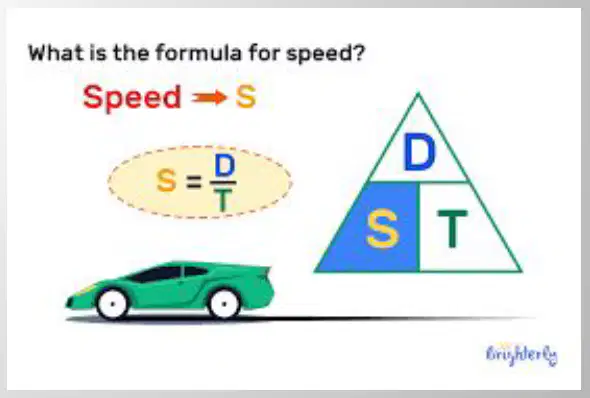
What is the formula for speed?
Speed = Distance × Time
Speed = Distance ÷ Time
Speed = Time ÷ Distance
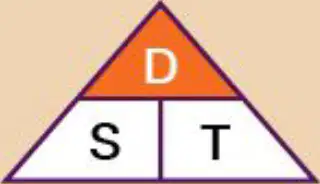
Fill in the blank: Distance = _______ × Time.
Speed
Time
Acceleration
Force
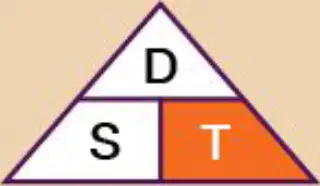
Fill in the blank: Time = Distance / _______.
Speed
Acceleration
Force
Gravity
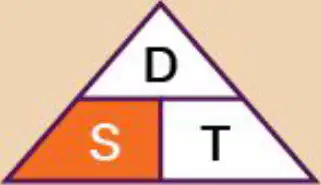
Fill in the blank: Speed = Distance / _______.
Time
Acceleration
Velocity
Mass
What does a distance vs. time graph help us see?
The speed of an object
The color of an object
The weight of an object
The temperature of an object
In a distance vs. time graph, what does the x-axis show?
The x-axis shows time.
The x-axis shows distance.
The x-axis shows speed.
The x-axis shows acceleration.
In a distance vs. time graph, what does the y-axis show?
The y-axis shows the distance.
The y-axis shows time.
The y-axis shows speed.
The y-axis shows acceleration.
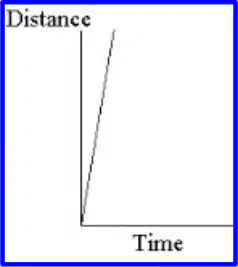
What does a steep slope line on a distance vs. time graph indicate?
The object is moving slowly.
The object is moving at a constant speed.
The object is not moving.
The object is moving fast.
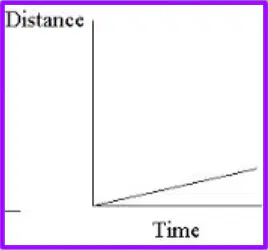
A shallow slope on a distance vs. time graph means the object is moving _______.
slowly.
quickly.
at a rapid pace.
with acceleration.
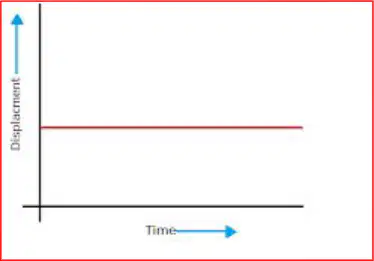
What does a flat line on a distance vs. time graph mean?
The object is moving fast.
The object is moving slowly.
The object is not moving.
The object is moving at a constant speed.
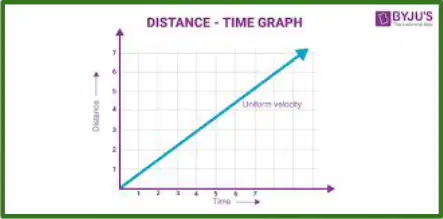
Any straight line on a distance vs. time graph indicates the object is moving at a _______ speed.
constant.
accelerated.
variable.
decelerated.
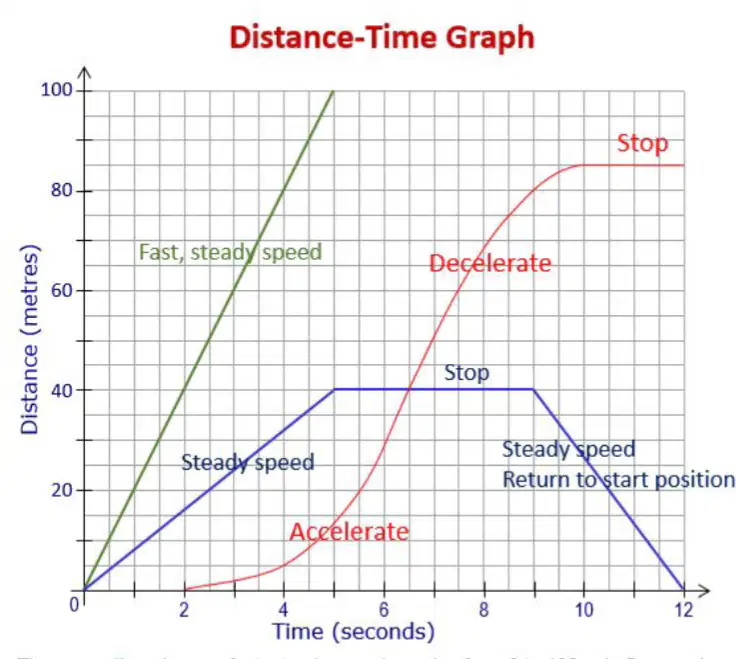
What does the green line represent in the distance-time graph?
Steady speed
Fast, steady speed
Decelerate
Stop

Determine the time at which the red line begins its journey according to the distance-time graph.
0
1
2
3
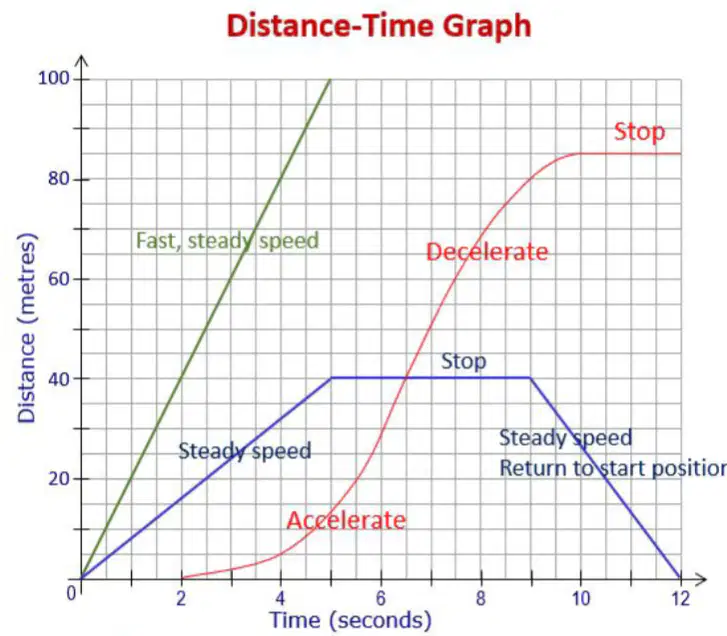
Which line shows a journey with a stop and a return to the starting position?
Green line
Blue line
Red line
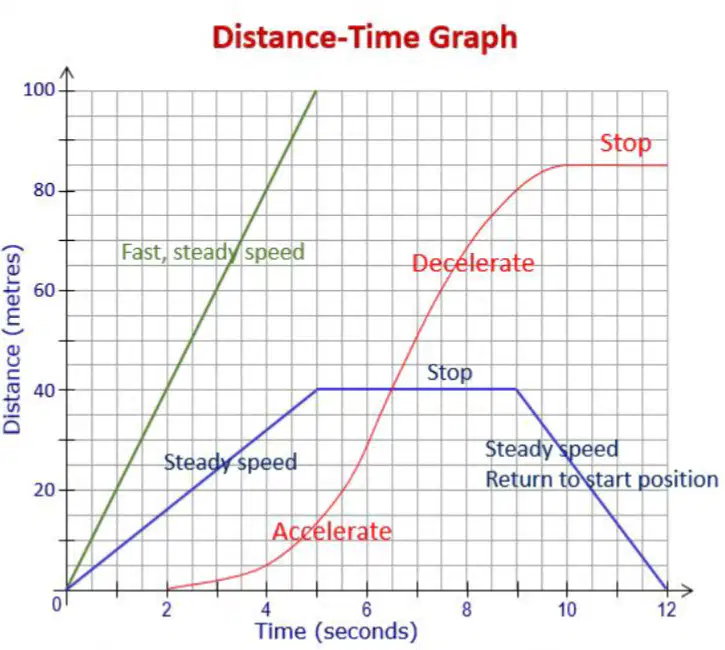
The red line in the distance-time graph represents motion that is constant. Which of the following best describes this motion?
Constant speed
Accelerating
Decelerating
At rest
The first step in graphing distance vs. time is to label the axes.
Label the axes
Plot the points
Draw the graph
Calculate the slope
When graphing distance vs. time, plot time on the x-axis and distance on the y-axis.
Plot distance on the x-axis and time on the y-axis.
Plot time on the x-axis and distance on the y-axis.
Plot both distance and time on the x-axis.
Plot both distance and time on the y-axis.
Graphing distance vs. time for an object moving at a constant speed yields a straight line. What should you do?
Plot a straight line with a constant, positive slope
Plot a horizontal line
Plot a curved line that changes slope
Plot an exponential curve

What does velocity include?
Speed only
Direction only
Both speed and direction
Neither speed nor direction

If either the speed or direction changes, what happens to the velocity?
It remains the same
It changes
It doubles
It halves

Velocity is measured in units like _______.
meters per second (m/s)
kilometers per hour (km/h)
miles per hour (mph)
feet per second (ft/s)

An object moving in a straight line at a constant speed has _______ velocity.
constant
variable
accelerating
decelerating
What is the rate at which a distance changes per unit of time called?
Speed
Acceleration
Force
Momentum
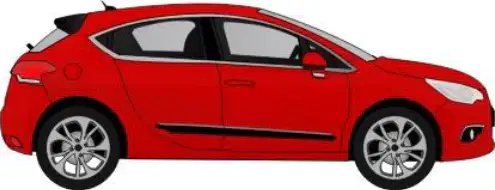
Which of the following describes velocity?
The rate at which distance changes per unit of time
The measurement of displacement change, or the rate at which displacement changes
The speed of a car
The direction of a car's movement.
What does speed tell us?
How fast something is moving
In which direction something is moving
Both how fast and in which direction something is moving
Velocity tells us both how fast and ________ something is moving.
in which direction
when
how far
how heavy
Acceleration is the rate of change of velocity per unit time.
It is the rate of change of velocity per unit time.
It is the speed measured in kilometers per hour.
It is the force acting on an object.
It is the rate of change of speed.
Acceleration is the rate at which an object's ______ changes over time.
velocity
speed
momentum
force
Which of the following is NOT a condition for acceleration?
Speeding up
Slowing down
Changing direction
Constant velocity
Acceleration is measured in units like ______.
meters per second squared
meters per second
kilometers per hour
seconds per meter
True or False: A car increasing speed, braking, or turning is an example of acceleration.
True
False
What is happening when a person is accelerating because they are speeding up?
Fill in the blank: A person on a skateboard is accelerating because they are _________.
accelerating
braking
gliding
stationary
What causes acceleration when the direction is changing?

What type of acceleration is shown in graph A?
Positive Acceleration
Negative Acceleration
Fill in the blank: Graph B represents _______ Acceleration.
Negative
Positive
Zero
Uniform
Which graphs represent constant speeds? Convert the open-ended question to an MCQ format: Which graphs represent constant speeds?
Graphs with a linear relationship between time and distance.
Graphs with a curved pattern.
Graphs with fluctuating slopes.
Graphs that do not change over time.
Which graph represents an object that is not moving? Choose the horizontal line graph.
Graph representing a horizontal line
Graph representing an increasing trend
Graph representing a decreasing trend
Graph representing a curve
Which graphs show changes in acceleration?
Graph 1
Graph 2
Graph 3
Graph 4
Graph B is traveling faster than Graph F.
B
F
Which graph shows a bicycle traveling at a constant speed of 10 m/s?
Which graph shows a car moving forward at a constant speed and then coming to a stop?
Which graph shows a motorcycle traveling at a constant speed, stopping, and then speeding up again?
What is the definition of a force?
A push or pull on an object resulting from its interaction with another object.
A measure of the gravitational pull between two objects.
The energy an object possesses because of its motion.
A combination of mass and acceleration.
Which of the following is an example of a contact force?
A) A magnet pulling paper clips
B) Pushing a cart
C) Gravity pulling an apple
D) Wind blowing a leaf
True or False: Forces can work together or against each other.
True
False
Fill in the blank: A force is a push or pull that can make an object move, stop, or change ________.
direction
speed
mass
state
What are balanced forces?
In Example 1, what happens to the book sitting on a table?
It stays on the table
It falls off the table
It gets teleported
It disappears
When forces are unbalanced, an object will accelerate.
It will accelerate.
It will decelerate.
It will remain at constant velocity.
It will come to rest.
A soccer ball being kicked demonstrates unbalanced forces as the applied force overcomes the ball's inertia, causing it to accelerate in the direction of the kick.
The ball remains stationary due to balanced forces.
The ball accelerates in the direction of the kick because the applied force is unbalanced.
The ball decelerates as friction immediately stops it.
The ball moves in a circular motion due to the balance of forces.
A person pushing a shopping cart demonstrates unbalanced forces by:
Exerting a force sufficient to overcome friction and inertia causing movement
Experience a balanced force situation where the cart remains at rest
Moving the cart solely due to gravitational force
Creating equal forces in opposite directions that cancel each other out
Unbalanced forces affect the speed of an object by causing it to either increase or decrease.
They cause the speed to increase.
They cause the speed to decrease.
They cause the speed to either increase or decrease.
They do not affect the speed.
Provide an example of how unbalanced forces can change the speed of an object. Choose the best option below.
A car accelerating because of a net forward force
A book at rest on a table
A satellite orbiting Earth in a circle
A ball simply resting on the ground
How do unbalanced forces affect the direction of an object? (Select the correct answer)
They cause acceleration in the direction of the net force.
They cause deceleration, making the object slow down.
They have no effect on the direction of motion.
Which of the following is an example of unbalanced forces changing the direction of an object?
A ball thrown in the air
A car turning on a curved road
A book resting on a table
A satellite orbiting Earth
What is the total force acting on an object called?
total force
net acceleration
centripetal force
gravity force
Balanced Forces: Equal forces cancel out leading to ________.
Balanced Forces: Equal forces cancel out leading to equilibrium.
Balanced Forces: Equal forces cancel out leading to constant motion.
Balanced Forces: Equal forces cancel out leading to acceleration.
Balanced Forces: Equal forces cancel out leading to static imbalance.
Unbalanced Forces: One force is stronger, which causes ________.
One force is stronger, which causes motion.
One force is stronger, which causes balance.
One force is stronger, which causes a state of equilibrium.
One force is stronger, which causes no movement.
In the first diagram, what is the net force acting on the rope?
0 N
300 N to the left
300 N to the right
In the second diagram, the team on the right wins the tug-of-war.
The team on the left
The team on the right
Both teams
No team wins
In the tug of war scenario, if one person pulls with 50 Newtons and the other with 30 Newtons, what is the net force?
The net force is 20 Newtons in the direction of the person pulling with 50 Newtons.
The net force is 20 Newtons in the direction of the person pulling with 30 Newtons.
The net force is 80 Newtons in the direction of the person pulling with 50 Newtons.
The net force is 0 Newtons due to force cancellation.
In the bird scenario, if the air friction is 16 Newtons and the weight is 25 Newtons, what is the net force acting on the bird?
The net force acting on the bird is the difference between the weight and the air friction.
The net force acting on the bird is the sum of the weight and the air friction.
The net force acting on the bird is the product of the weight and the air friction.
The net force acting on the bird equals the air friction only.
In the cart scenario, if one side pushes with 3 Newtons and the other with 4 Newtons, what is the net force?
The net force is 1 Newton in the direction of the side pushing with 4 Newtons.
The net force is 7 Newtons in the direction of the side pushing with 4 Newtons.
The net force is 7 Newtons in the direction of the side pushing with 3 Newtons.
The net force is 1 Newton in the direction of the side pushing with 3 Newtons.
In the rocket scenario, if the thrust is 300 Newtons and the weight is 100 Newtons, what is the net force acting on the rocket?
The net force acting on the rocket is 200 Newtons.
The net force acting on the rocket is 400 Newtons.
The net force acting on the rocket is 300 Newtons.
The net force acting on the rocket is 100 Newtons.

The net force acting on the box is:
0 N
5 N
10 N
15 N
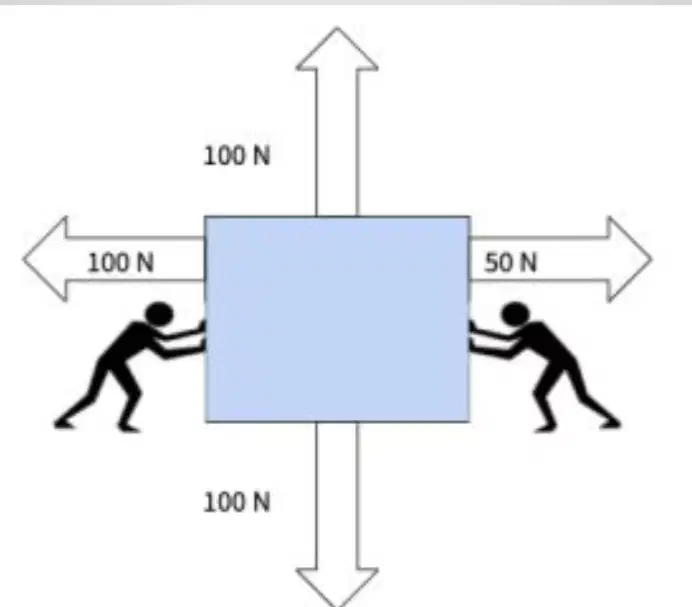
The box is going to go in the following direction:
Up
Down
Left
Right

Which of the following conditions would cause the model airplane to move toward the ground?
A. The lift is equal to the drag.
B. The lift is less than the weight.
C. The thrust is equal to the weight.
D. The thrust is greater than the drag.

