
 Worksheets
World War I & Roaring 20’s Test
Total questions: 38
Worksheet time: 22mins
Which of the following causes of World War I refers to the competition to have the largest number of colonies and the richest/strongest empires?
Militarism
Alliances
Imperialism
Nationalism
The Archduke Franz Ferdinand of Austria-Hungary was assassinated by which of the following groups?
The Black Hand
The Triple Entente
The League of Nations
NATO
The name given to the cultural movement started by African Americans after World War I, in which music, the arts, and literature were strongly influenced by the Black experience, is ___?
The Renaissance
Nativism
Suffragist Movement
The Harlem Renaissance
Which amendment to the United States Constitution is responsible for creating the Prohibition era?
13th Amendment
14th Amendment
18th Amendment
19th Amendment
Which treaty is responsible for ending World War I?
Treaty of Guadalupe Hidalgo
Treaty of Versailles
Treaty of Paris
Treaty of Westphalia
Who created the League of Nations?
Tsar Nicholas II
Woodrow Wilson
Kaiser Wilhelm II
Georges Clemenceau
Which of the following MAIN causes of World War I is best described as an intense pride in your country and the belief that your country/culture is better than others?
Militarism
Alliances
Imperialism
Nationalism
Which genre of music became incredibly popular after World War I largely due to the efforts of Black soldiers such as the Harlem Hellfighters?
R&B
Rock n Roll
Jazz
Hip-hop
What is the name of the medical condition that some soldiers suffered from when returning home from war that affected their mental health?
Trench brain
Shell shock
Gangrene
Amnesia
The Espionage and Sedition Acts were highly controversial because (a) ?
Because of their political nature
Because of the lack of evidence
Because of public opinion
Because of their international impact
Which of the following home front efforts was used to raise money for the war effort?
War bonds
Victory gardens
Food rationing
Electricity conservation
Germany, Austria-Hungary, and the Ottoman Empire fought on which side of the war?
Allied Powers
Confederate Powers
Central Powers
Axis Powers
What is the term used to describe informative advertising by the government with the purpose of influencing public opinion for or against an issue?
Disinformation
Propaganda
Conscription
Brainwashing
What military strategy was the German navy using during the war with their u-boats?
Unrestricted Submarine Warfare
Bayonet Charges
Trench Warfare
Total Tank Warfare
What new technology was developed to handle the treacherous terrain created by trench warfare?
Poisons gas
Submarines
Fighter planes
Tanks
True or False: Write a T or F on the line next to each statement to indicate if it is true or false. (2 points each) 1. World War I was much more deadly than previous wars due to new technologies and outdated battle strategies. True or False.
True
False
Elizabeth Cady Stanton and Susan B. Anthony were two outspoken activists who fought against the women's suffrage movement.
True
False
Austria-Hungary was forced to accept full responsibility for the war and also to pay reparations, which led to the division of the Empire.
True
False
Trench foot is a condition in which, due to the wet conditions of the trenches, soldiers' feet would begin to rot if not properly cared for.
True
False
The Lusitania was a United States warship that threatened German waters when it was sunk by a German submarine.
True
False
Militarism is the practice of increasing the size and strength of your army. True or False.
True
False
A bootlegger is the name of a place where people could go to drink alcohol during the Prohibition era.
True
False
With electricity now powering homes, Americans began to enjoy new technologies such as refrigerators, fans, radios, and more.
True
False
The name given to young women who worked as telephone operators during the war was "Flappers" because of the amount of communication they were responsible for.
True
False
Organized crime gangs and "gangsters" rose to power by smuggling alcohol during the Prohibition era.
True
False
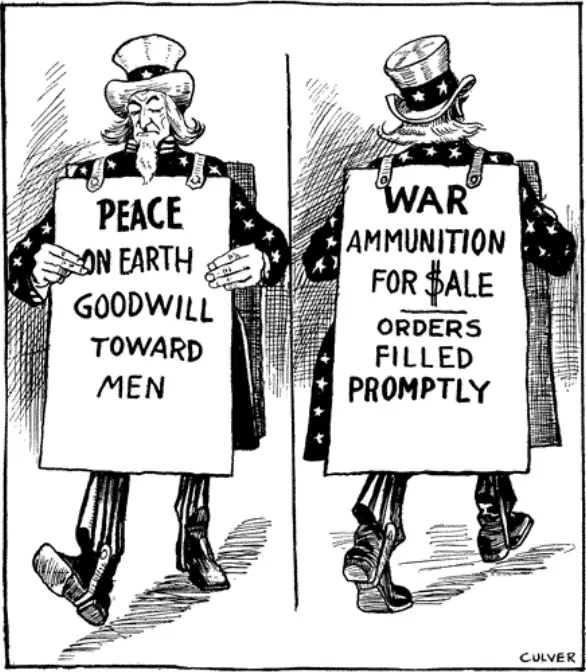
The panel on the left of the cartoon reflects the attitudes of the American people toward war before joining World War I as shown by:
Pro-peace
Enthusiasm for war
Indifference
Confusion
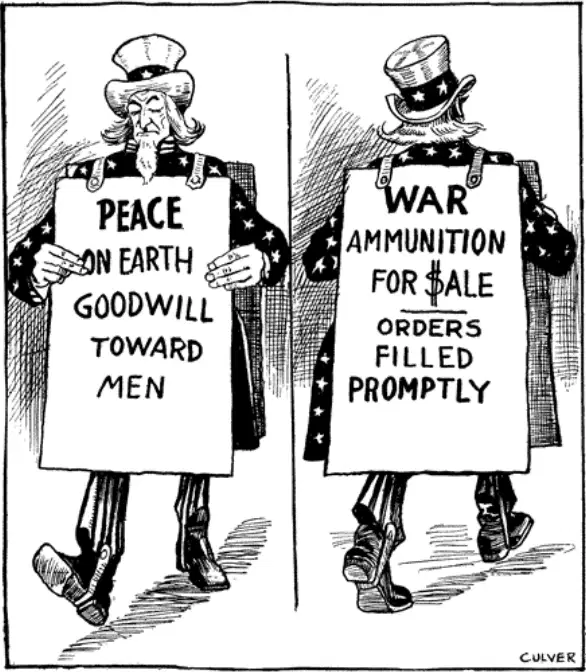
Based on the right panel of the cartoon, was the U.S. government following the wishes of the American people?
Yes, it was following the wishes of the people.
No, it was not following the wishes of the people.
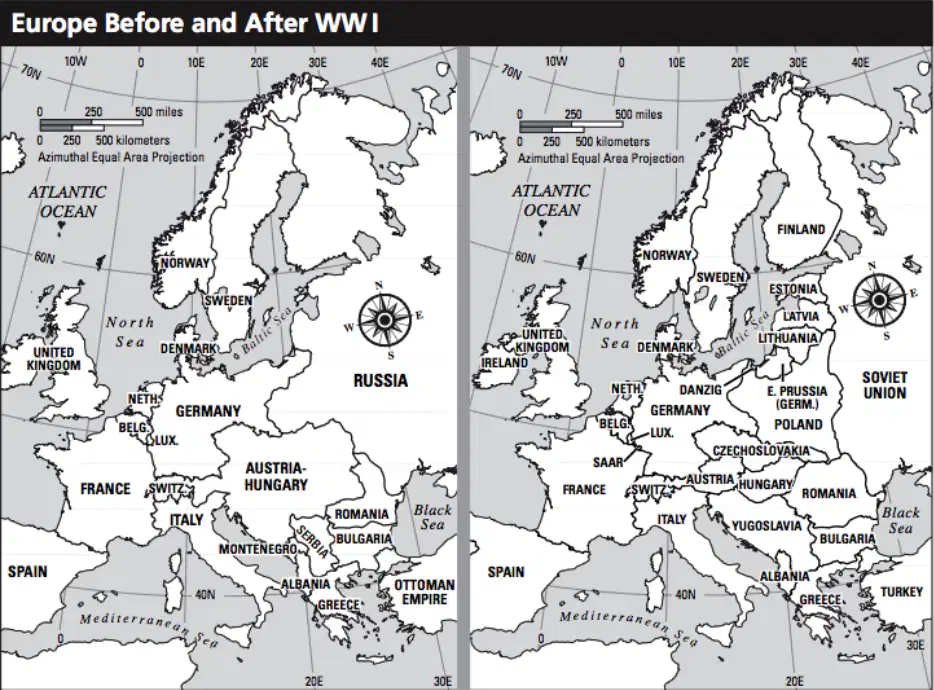
Three new countries that were formed after World War I are:
Czechoslovakia, Yugoslavia, and Poland
Germany, Italy, and France
Spain, Portugal, and Belgium
Russia, China, and India
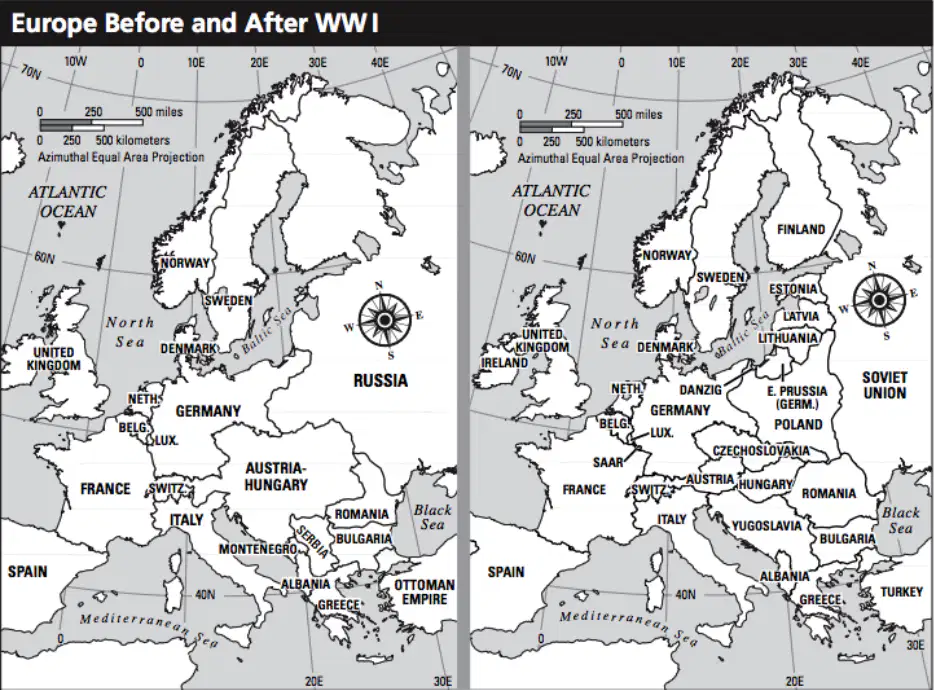
The change of borders after the war impacted the power and influence of the countries that lost territory by reducing it.
The countries lost power and influence
The countries gained power and influence
The impact was minimal
The countries maintained their previous power and influence

The Allied Powers suffered the highest total number of casualties, while the Central Powers suffered the highest percentage of casualties relative to their total fighting force. Which option correctly reflects this statement?
Allies: highest total number of casualties; Central Powers: highest percentage of casualties.
Central Powers: highest total number of casualties; Allies: highest percentage of casualties.
Both sides suffered equally.
None of the above.
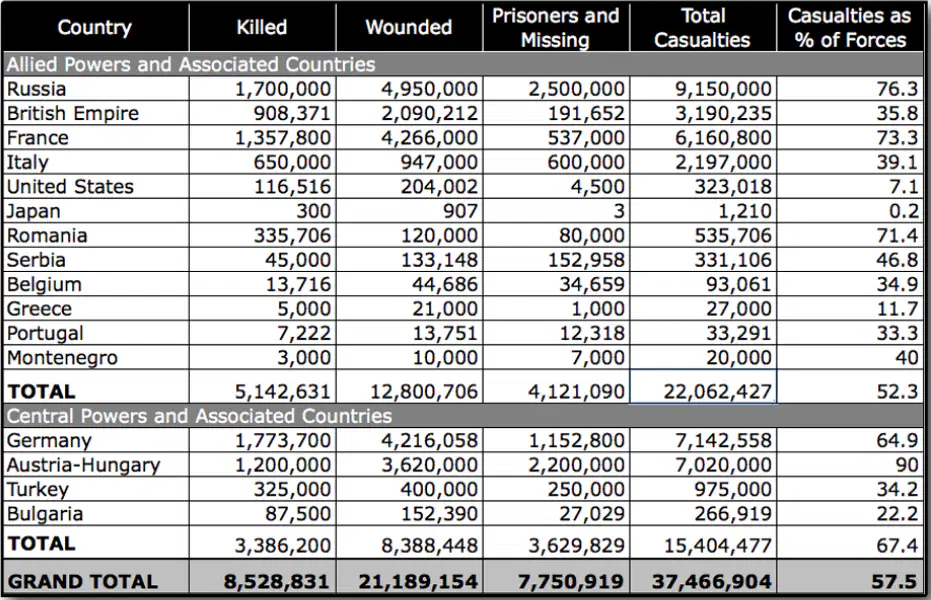
The significantly higher casualties in this war compared to previous wars were mainly due to advances in technology and military tactics.
Advances in technology and military tactics
Better medical care and evacuation
Improved logistics and supply chains
Improved political strategies

7. What are three (3) of Wilson's objectives in this speech? (List 3 things he hopes to achieve in his points)

Was Wilson's 14th Point, the League of Nations, successful?
It was successful because it effectively maintained peace.
It was not successful, largely due to lack of enforcement and the U.S. not joining.
It was partially successful with mixed results.
It was successful at first but later became ineffective.
The flapper movement was a social revolution among women in the 1920s characterized by a new rebellious lifestyle. Which two characteristics best describe flappers?
They were young rebellious women known for short skirts, bobbed hair, and defying traditional norms.
They were strictly dedicated to traditional roles and conservative styles.
They adopted Victorian values in dress and behavior.
They preferred long skirts and elaborate hairstyles typical of earlier eras.
What were two (2) important events in the women's suffrage movement? Why was each one important? (Choose the correct events and their significance)
The Seneca Falls Convention established fundamental ideas for women's rights, and the passage of the Nineteenth Amendment granted women the right to vote.
The Civil War and the Emancipation Proclamation directly addressed women's rights.
The Industrial Revolution and the Great Depression created economic challenges that led to suffrage reform.
World War I and World War II indirectly led to reforms in voting rights.
The Zimmerman Telegram was a diplomatic communication from Germany to Mexico offering an alliance, which played a role in provoking America to join the war.
It was a proposal of alliance from Germany to Mexico, influencing America to join the war.
It was a message from the United States seeking an alliance with Germany.
It was a memo from Great Britain to Mexico, urging neutrality.
It was a simple notification of war from Germany to the United States.
Select the correct expansion of the acronym “M.A.I.N.S.” that explains its role as a cause of the Great War.
Militarism, Alliances, Imperialism, Nationalism, and the Assassination of Archduke Franz Ferdinand
Militarism, Greed, Imperialism, Nationalism, and the Storming of the Bastille
Mercantilism, Alliances, Individualism, Nationalism, and Everlasting Peace
Militarism, Alliances, Imperialism, Nationalism, and Support for Monarchies
Three (3) ways Americans could contribute to the war effort on the home front include buying war bonds, rationing food and materials, and joining the industrial workforce.
Buying war bonds, rationing food and materials, and joining the industrial workforce.
Enlisting in the military, organizing parades, and traveling abroad.
Selling valuable assets, completely reducing consumption, and isolating themselves.
None of the above.

