
 Worksheets
Environmental
Total questions: 99
Worksheet time: 2hrs 35mins
What is the energy conservation legislation that applies to the building services industry?
Energy Conservation Act
Building Services Act
Environmental Protection Act
Sustainable Building Act
What are the applications of energy sources used in the building services industry?
Heating and cooling systems
Lighting and electrical systems
Water heating systems
All of the above
Energy conservation is important when commissioning building services systems because:
it reduces operational costs and environmental impact.
it increases the complexity of the system.
it delays the commissioning process.
it requires more resources.
What are the methods of reducing waste and conserving energy while working in the building services industry?
Implementing energy-efficient technologies and recycling programs
Increasing energy consumption and waste production
Ignoring energy conservation practices
Focusing solely on aesthetic improvements
How can materials used in the building services industry be safely disposed of?
By recycling and reusing
By incineration
By landfill
By composting
What are the methods of conserving and reducing wastage of water within the building services industry?
Implementing water-efficient fixtures and appliances
Ignoring leaks and drips
Increasing water pressure in pipes
Using more water-intensive landscaping
What is the target set by the Climate Change Act 2008 for reducing carbon emissions by 2050?
Which of the following is NOT one of the four main objectives of the EU Directive on the Energy Performance of Buildings (2002/91/EC)?
To promote the improvement of the energy performance of buildings within the EU.
To establish a common framework for calculating energy performance.
To mandate the use of renewable energy sources in all new buildings.
To require the certification of building energy performance.
What percentage of energy generated is consumed by buildings across Europe?
The role of the Committee on Climate Change according to the Climate Change Act 2008 is to:
advise the government on emissions targets
implement climate change policies
enforce environmental regulations
fund renewable energy projects
What must be included when buildings are advertised for sale or rent?
Location details
Contact information
Price details
Property size
Which type of buildings must display a Display Energy Certificate (DEC)?
Buildings that are required to display a Display Energy Certificate (DEC) typically include public buildings with a total floor area over 250 square meters that are frequently visited by the public.
Residential buildings with private ownership and no public access.
Industrial buildings used solely for manufacturing purposes.
Agricultural buildings used for storage of farm equipment.
By what date must all new buildings be nearly zero energy buildings?
All new buildings must be nearly zero energy buildings by December 31, 2020.
All new buildings must be nearly zero energy buildings by January 1, 2025.
All new buildings must be nearly zero energy buildings by June 30, 2023.
All new buildings must be nearly zero energy buildings by March 15, 2022.
The main objective of the Home Energy Conservation Act (HECA) 1995 is:
to reduce carbon emissions by promoting energy efficiency in homes.
to increase the use of renewable energy sources in industrial sectors.
to provide financial assistance for building new homes.
to regulate the prices of electricity and gas.
What percentage improvement in UK energy consumption was estimated by the Department for the Environment?
10%
15%
20%
25%
Under the 2016 amendments, who must arrange for the enforcement of obligations under the 2012 Regulations?
The enforcement of obligations under the 2012 Regulations must be arranged by the relevant authority or designated body as specified in the 2016 amendments.
The enforcement of obligations under the 2012 Regulations must be arranged by the local government.
The enforcement of obligations under the 2012 Regulations must be arranged by the individual companies.
The enforcement of obligations under the 2012 Regulations must be arranged by the international committee.
What is the Dwelling Emission Rate (DER) used for?
Fill in the blank: Installed building services should achieve a reasonable standard of ________.
efficiency
safety
comfort
durability
What should be limited according to the key points of Part L?
Fill in the blank: The performance of the building should be in line with the ________ Emission Rate.
Target
Average
Maximum
Minimum
What provision should be made for energy efficient operation?
Fill in the blank: Limiting heat loss through the fabric of the building by stipulating the ________ of the various building components.
thermal performance
color
shape
weight
What does Part F of the Building Regulations deal with?
Ventilation
Fire Safety
Structural Integrity
Energy Efficiency
What is the downside to ventilation of buildings according to Part F?
Increased energy consumption
Improved air quality
Reduced noise levels
Enhanced structural integrity
What are the benefits of removing stale air as defined in Part F?
Improved air quality and health
Increased energy consumption
Reduced noise levels
Enhanced structural integrity
What does Part F encourage as an important part of ventilation systems?
Regular maintenance
Energy efficiency
Air filtration
Natural ventilation
The purpose of the Domestic Building Services Compliance Guide 2013 is to:
Provide guidelines for energy efficiency in buildings
Offer financial advice for homeowners
Regulate the construction of commercial buildings
Promote international building standards
When did the 2018 amended document of the Domestic Building Services Compliance Guide come into effect?
January 1, 2018
April 6, 2018
July 1, 2018
October 1, 2018
What are the four fuel-based sections mentioned in the guide?
Gasoline, Diesel, Kerosene, and Propane
Petrol, Coal, Natural Gas, and Biomass
Ethanol, Biodiesel, Hydrogen, and Electricity
Oil, Natural Gas, Solar, and Wind
What are the nine technology-specific sections mentioned in the guide?
Cloud Computing, Cybersecurity, Data Science, Artificial Intelligence, Internet of Things, Blockchain, Augmented Reality, Virtual Reality, Quantum Computing
Cloud Computing, Cybersecurity, Data Science, Artificial Intelligence, Internet of Things, Blockchain, Augmented Reality, Virtual Reality, Robotics
Cloud Computing, Cybersecurity, Data Science, Artificial Intelligence, Internet of Things, Blockchain, Augmented Reality, Virtual Reality, Machine Learning
Cloud Computing, Cybersecurity, Data Science, Artificial Intelligence, Internet of Things, Blockchain, Augmented Reality, Virtual Reality, Software Engineering
What is covered in Section 2 of the fuel-based sections?
Introduction to fuel types
Safety measures for handling fuel
Environmental impact of fuel usage
Regulations and compliance
Section 3 of the fuel-based sections covers:
Fuel types and classifications
Safety regulations
Environmental impact
Fuel pricing strategies
What is covered in Section 4 of the fuel-based sections?
Introduction to fuel types
Emission standards
Fuel efficiency calculations
Safety regulations
What is covered in Section 5 of the fuel-based sections?
Introduction to fuel types
Safety regulations
Emission standards
Fuel storage guidelines
What is covered in Section 6 of the technology-specific sections?
Introduction to new technologies
Detailed analysis of Section 6
Overview of technology-specific sections
Summary of Section 6
What is the SEDBUK efficiency requirement for a regular boiler under the CHeSS HR7 - Recommended good practice (2008)?
At least 80% (bands C and D)
At least 86% (bands A and B)
At least 90% (band A)
At least 95% (band A)
What is the SEDBUK efficiency requirement for a regular boiler under the CHeSS HR8 - Recommended best practice (2008)?
At least 80% (bands C and D)
At least 86% (bands A and B)
At least 90% (band A)
At least 95% (band A)
Fill in the blank: Under CHeSS HR7, the hot water store can be a hot water cylinder whose heat exchanger and insulation properties meet or exceed those of the relevant British Standards. (see note 7)
Under CHeSS HR7, the hot water store can be a hot water cylinder whose heat exchanger and insulation properties meet or exceed those of the relevant British Standards.
Under CHeSS HR7, the hot water store can be a hot water cylinder with any heat exchanger and insulation properties.
Under CHeSS HR7, the hot water store must be a hot water cylinder with no specific standards.
Under CHeSS HR7, the hot water store can be any container with heat exchanger and insulation properties.
Fill in the blank: Under CHeSS HR8, in suitable buildings, consideration should be given to fitting a cylinder with an additional heat exchanger to allow for solar water heating.
What is the recommended good practice for a domestic wet central heating system with a combi or Combined Primary Storage Unit CPSU boiler?
What is the SEDBUK efficiency requirement for a combi or CPSU boiler in the CHeSS HC7 system?
The SEDBUK efficiency requirement for a combi or CPSU boiler in the CHeSS HC7 system is not specified in the provided text.
85%
90%
95%
List the controls applicable to the CHeSS HC7 system.
What is the difference in SEDBUK efficiency between the CHeSS HC7 and HC8 systems?
5%
10%
15%
20%
What additional control is considered in the CHeSS HC8 system that is not confirmed as cost-effective?
Heating systems should be designed to match:
the building's architecture
the local climate
the energy efficiency standards
the occupants' comfort needs
List the three types of water treatment mentioned in the text.
Filtration, Sedimentation, and Disinfection
Boiling, Freezing, and Condensation
Evaporation, Precipitation, and Collection
Chlorination, Fluoridation, and Softening
The importance of water treatment in heating systems is:
To prevent corrosion and scaling
To increase water temperature
To reduce water flow
To enhance water color
The role of a circulator pump in a heating system is to:
heat the water
cool the water
circulate the water
store the water
What is the difference between a regular boiler and a combination (combi) boiler?
A regular boiler requires a separate hot water cylinder, while a combi boiler does not.
A combi boiler requires a separate hot water cylinder, while a regular boiler does not.
Both require separate hot water cylinders.
Neither require separate hot water cylinders.
What does SEDBUK stand for in the context of boiler efficiency?
SEDBUK stands for Seasonal Efficiency of Domestic Boilers in the UK.
SEDBUK stands for Standard Efficiency of Domestic Boilers in the UK.
SEDBUK stands for Sustainable Energy Development of Boilers in the UK.
SEDBUK stands for Systematic Evaluation of Domestic Boilers in the UK.
Match the SEDBUK efficiency range with the correct band:
90% and above
A
86% – 90%
B
82% – 86%
C
78% – 82%
D
74% – 78%
E
What is the maximum standing heat loss allowed for vented cylinders according to BS 1566:2002 Type P cylinders?
2.0 kWh/day
1.5 kWh/day
2.5 kWh/day
3.0 kWh/day
What is the minimum insulation property requirement for a high-performance thermal store according to the WMA Performance Specification?
R-Value of 5.0
R-Value of 6.5
R-Value of 7.0
R-Value of 8.5
How must systems with regular boilers be controlled according to the text?
They must be controlled manually.
They must be controlled automatically.
They must be controlled using a thermostat.
They must be controlled using a timer.
Which of the following is an electrical switch operated by a clock to control either space heating or hot water?
Full programmer
Room thermostat
Time switch
Programmable room thermostat
A room thermostat measures and controls:
humidity
temperature
air pressure
light
Why should wireless controls be designed to a satisfactory level of immunity?
To ensure reliable operation in the presence of interference
To reduce manufacturing costs
To improve battery life
To enhance user interface design
What is a boiler interlock and what is its purpose?
A safety device to prevent overheating
A mechanism to control water flow
A system to ensure efficient operation of heating systems
A device to measure temperature
What is the function of an automatic bypass valve in a boiler system?
To regulate the flow of water in the system
To automatically shut down the boiler in case of overheating
To maintain a minimum flow rate through the boiler
To filter impurities from the water
According to the Building Regulations, who is responsible for ensuring that building work complies with the applicable requirements?
The architect
The builder
The building owner
The local authority
True or False: The building owner is not responsible for ensuring compliance with the Building Regulations.
True
False
What are the three main categories of energy used in properties?
Explain why high carbon energy sources are called so.
Because they contain a high amount of carbon in their composition.
Because they are derived from renewable sources.
Because they produce low carbon emissions.
Because they are more efficient than low carbon sources.
What is the building block for all life on planet Earth?
What gas is produced when carbon is combusted with hydrogen and oxygen?
Name the three types of high carbon energy sources known as hydro-carbons.
Coal, Oil, Natural Gas
Solar, Wind, Hydro
Biomass, Geothermal, Nuclear
Hydrogen, Helium, Methane
What is the primary composition of natural gas?
Where is natural gas commonly found?
What is added to natural gas to give it a distinctive odor?
Mercaptan
Ethanol
Methanol
Benzene
What is the specific gravity range of natural gas?
0.55 - 0.70
0.80 - 0.95
1.00 - 1.15
1.20 - 1.35
Explain the process of how LPG is stored as a liquid.
LPG is stored as a liquid by cooling it below its boiling point.
LPG is stored as a liquid by compressing it under high pressure.
LPG is stored as a liquid by mixing it with water.
LPG is stored as a liquid by keeping it in open air.
Compare the characteristics and uses of Propane and Butane.
Propane is more commonly used for outdoor grilling, while Butane is often used in portable stoves.
Propane is a liquid at room temperature, while Butane is a gas.
Propane has a higher boiling point than Butane.
Butane is more efficient for heating large spaces than Propane.
What is added to LPG to give it a smell?
The substance added to LPG to give it a smell is typically ethyl mercaptan.
Methane
Propane
Butane
Which type of fuel oil is most widely used for domestic use?
Kerosene
Diesel
Gasoline
Heavy Fuel Oil
The main characteristic of kerosene that makes it suitable for cold weather is:
High freezing point
Low freezing point
High viscosity
Low viscosity
Match the coal type with its description:
Lignite
Contains less heating value than bituminous coal but has a greater water content.
Sub-bituminous
Created by additional pressure and extremely high temperatures deep below the earth.
Bituminous
Formed by added heat and pressure on lignite, it is made from many tiny layers.
Anthracite
Lignite is crumbly and has high moisture content.
Which coal type has the highest carbon content?
What is coke made from?
Wood
Coal
Oil
Gas
Fill in the blank: Peat is an organic material formed from rotting vegetation in bog-like conditions in the absence of ________ over thousands of years.
oxygen
water
sunlight
carbon dioxide
Describe the process by which peat becomes a fossil fuel.
Peat is compressed and heated over millions of years, eventually transforming into coal.
Peat is mixed with water and sunlight to become a fossil fuel.
Peat is frozen and then thawed to become a fossil fuel.
Peat is immediately turned into oil through a chemical reaction.
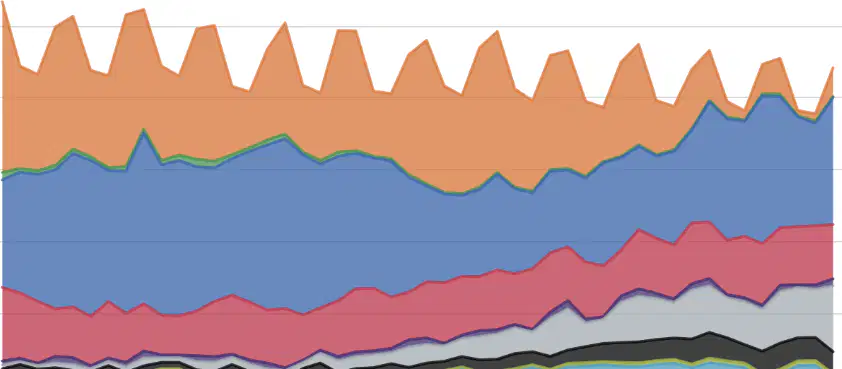
The chart shows the trend of electricity generation in the UK over the years.
An increase in renewable energy sources
A decrease in fossil fuel usage
Stable nuclear energy production
All of the above
The main reason for the decrease in reliance on coal for electricity generation in the UK over the past 10 years is:
Increased use of renewable energy sources
Government regulations
Economic factors
Technological advancements
Which type of power plant uses a combined cycle gas turbine (CCGT) to produce steam to drive the generating turbines?
Nuclear power plant
Hydroelectric power plant
Coal-fired power plant
Combined cycle power plant
What is the main advantage of using natural gas as a fossil fuel generator?
It is more environmentally friendly compared to coal and oil.
It is the cheapest fossil fuel available.
It is the most abundant fossil fuel.
It requires no processing before use.
Low carbon fuels are those that either produce very little carbon dioxide (CO2) or only release the amount of CO2 that the plants once took in during their life.
True
False
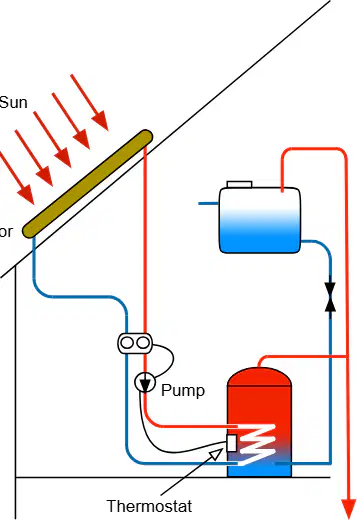
During the summer months, how much energy does the sun deliver per square meter for solar thermal systems?
1000 watts
500 watts
750 watts
250 watts
What are the two different types of solar collectors mentioned in the text?
Fill in the blank: The heat is transferred by conduction to a water/glycol filled _______.
radiator
pipe
container
tank
Which component is specifically used to circulate the water/glycol mix from the solar collector to the hot water storage vessel?
The purpose of the control system in plumbing is to:
regulate water flow and pressure
heat the water
filter impurities
connect pipes
The control system incorporates which of the following components?
A) Pump, flow meter, pressure gauge, thermometer, and thermostat
B) Pump, flow meter, pressure gauge, thermometer, and valve
C) Pump, flow meter, pressure gauge, valve, and thermostat
D) Pump, flow meter, valve, thermometer, and thermostat
Fill in the blank: Biomass is classified as a carbon neutral fuel as it only releases the CO2 that the biomass contains. It does not produce excess CO2 like ________.
fossil fuels.
solar energy.
wind energy.
hydroelectric power.
Which type of biomass boiler produces less CO2?
Batch fuelled
Continuously fired
The primary function of a biomass boiler is to:
generate electricity
provide heating
cool down spaces
purify water
Hydrogen fuel cells use two elements, Hydrogen and Oxygen, to convert them into _______.
water
electricity
carbon dioxide
methane
What is formed during the process of electricity generation in hydrogen fuel cells?
Water
Oxygen
Carbon Dioxide
Nitrogen
Heat pumps use a process called the (a) to produce heat.
Which of the following is a characteristic of heat pumps?
They are inefficient
They use a high amount of energy
They are environmentally friendly
They have a CoP of 2:1
What is the purpose of a special coiled heat exchanger known as a captor or 'slinky'?

