
 Worksheets
Indian Removal chapter 5-6
Total questions: 43
Worksheet time: 22mins
The Five Tribes were known as civilized because
They established formal governments
They adopted white lifestyles
They learned English
All of the above
Traditionalists were most likely to
Resist change
Sign treaties giving away lands
Adapt easily to white ways
Start businesses
Which tribe experienced the smoothest removal?
Seminole
Cherokee
Chickasaw
Creek
Which of the following tribes shared land together in Indian Territory until 1855?
Creek and Chickasaw
Seminole and Cherokee
Chickasaw and Creek
Choctaw and Chickasaw
Jefferson's original policy was civilization: the tribes would be absorbed into American society. This is known as...
assimilation
progressivism
traditionalism
indoctrination
The President most associated with Indian Removal was
Hamilton
Monroe
Jackson
Jefferson
Which tribe had the most difficult time adjusting to life in Indian Territory?
Cherokee
Choctaw
Creek
Seminole
The Cherokee embraced education. They (thanks to Sequoyah) were the first to create a system of writing in the Cherokee language. This was called the
syllabary
abacus
alphabet
abjad
The Cherokee and Seminole removals were similar in that
Both tribes fought a war against the government
Both tribes resisted removal
Both tribes had treaties declared invalid
Both tribes were united about the removal decision
The Cherokee and Seminole removals were different in that
The Seminole fought a physical war and the Cherokee used legal measures
The Cherokee fought back physically in war and the Seminole used the law
The Cherokee tribe was united in its decision to move west and the Seminole were divided
The Seminole readily agreed to a Treaty and the Cherokee resisted.
The following tribes were from Mississippi
Cherokee and Choctaw
Choctaw and Chickasaw
Seminole and Creek
Cherokee and Seminole
Most tribes felt they had no choice but to move if they wanted to preserve their governments. Why?
States like Georgia, Miss. and Alabama passed extension laws
The tribes would become subjects of the state if they remained.
The tribes would remain as sovereign nations in their new territory.
None of these are true
All of these are true
What was the significance of the Worcester vs. Georgia Supreme court case?
The Cherokee won the case and were able to keep much of their lands
The Cherokee lost and their government was abolished
The Cherokee won the case but it was too late.
The Cherokee won the case, but President Jackson and Georgia ignored the ruling
Which of the following is true concerning tribal removal?
The Chickasaw were the first to move and had no experience with the process
The Cherokee were placed in detention camps (stockades) before removal and lost thousands during the trip
The Seminole had a steamboat explosion killing hundreds
The Choctaw were the last to move and were taken in chains.
How did the Cherokee tribe deal with the anger and resentment they felt over the removal experience?
The brought another lawsuit against the state of Georgia
They enacted the Blood Law, assassinating the leaders that signed the Treaty.
They united as a tribe and worked to rebuild.
They kicked several leaders out of the Council
After removal, nearly all of the tribes
Established capitals
Published Newspapers
Wrote constitutions
All of the these are true
How were the Seminole and Creek removals similar?
Both tribes experienced disasters with steamboats
Both tribes were removed forcefully with many bound in chains
Both tribes had to share lands with other tribes and lose their sovereign governments.
Both tribes were unanimous in their decision to negotiate treaties.
Several leaders of the tribes were assassinated for signing treaties. The tribes were justified in their actions against these leaders because
A tribal law, the blood law, permitted it
it was negotiated within the terms of the treaties
of the lack of a written law system among the tribes
the tribes were sovereign and could not be punished by the US government.
Which three tribes enacted the blood law?
Choctaw, Chickasaw, and Cherokee
Creek, Seminole, and Choctaw
Cherokee, Creek, and Seminole
Chickasaw, Creek and Seminole
Why did the Cherokee sign a petition against the Treaty of New Echota?
They found the terms unacceptable and refused to sign
They wanted to fight for more land in the negotiation
They believed it to be invalid as the signers were not authorized by the tribe to sign
They felt the Treaty was unnecessary after winning the Supreme Court case.
What disease caused the death of thousands during the removals?
smallpox
measles
cholera
typhus
Were taken from homes, placed into stockades, suffered sickness, blizzards, starvation
Cherokee
Creek
Seminole
Choctaw
Fought against settlers when cheated out of lands, forced out in chains, suffered heavy losses
Seminole
Choctaw
Creek
Chickasaw
Fought 2 wars against the US, 3,000 forced into removal after war.
Chickasaw
Seminole
Creek
Choctaw
Paid for own removal, suffered less loss, had spoiled food and sickness
Chickasaw
Seminole
Creek
Cherokee
First to move, suffered blizzards, boat explosion, starvation, sickness
Chickasaw
Seminole
Cherokee
Choctaw
Traditionalists were
Full-blood families who were typically against change
Mixed-blood families who were typically against change
Full-blood families who embraced change
Mixed-blood families who embraced change
Progressives were
Full-blood families who were typically against change
Mixed-blood families who were typically against change
Full-blood families who embraced change
Mixed-blood families who embraced change
The intent/ purpose of the Indian Removal Act of 1830 was to
Help Indians buy land east of the Mississippi River.
Negotiate treaties to remove Indians from the southeastern United States.
Remove Indians to reservations in the eastern part of the United States.
To civilize Indians and destroy their way of life.
In the Treaty of New Echota, leaders (without authority) signed away Georgia lands without consent.
Choctaw
Cherokee
Creek
Seminole
This tribe ceded lands in Alabama and Georgia. The Treaty of Indian Springs led to death of a leader and was declared invalid.
Creek
Seminole
Choctaw
Chickasaw
This tribe ceded Mississippi lands in 1830. They were they first tribe to negotiate under the Indian Removal Act.
Choctaw
Seminole
Creek
Cherokee
This tribe ceded lands in Florida. The Treaty of Payne's Landing gave them 3 years to find land. One leader said his signature was forged.
Cherokee
Creek
Chickasaw
Seminole
This tribe would cede their lands in Mississippi and move when suitable lands were found or in 3 years. They agreed to sell their lands and pay for own removal.
Chickasaw
Creek
Cherokee
Seminole
He fought fiercely against removal in the 2nd Seminole War
Opothleyahola
John Ross
William McIntosh
Osceola
He authored the Cherokee constitution, became Chief, and fought against Cherokee removal
John Ross
William McIntosh
Major Ridge
Osceola
These three leaders signed a controversial treaty that led to their death. Include three answers.
John Ross
John Ridge
Major Ridge
Elias Boudinot
He was assassinated after signing over Lower Creek lands against the wishes of the tribe.
Roley McIntosh
Osceola
William McIntosh
Opothleyahola
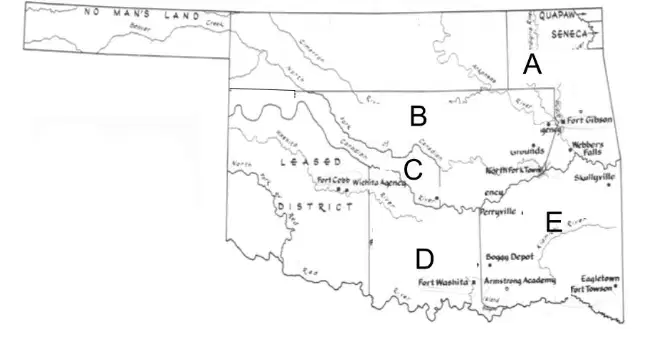
Which tribe settled in location A?
Cherokee
Creek
Chickasaw
Seminole
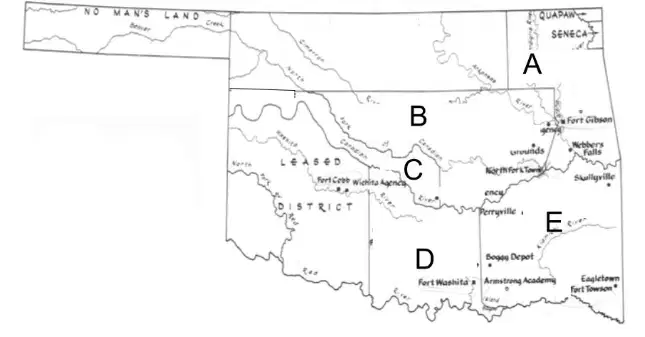
Which tribe settled in location B?
Choctaw
Creek
Seminole
Chickasaw
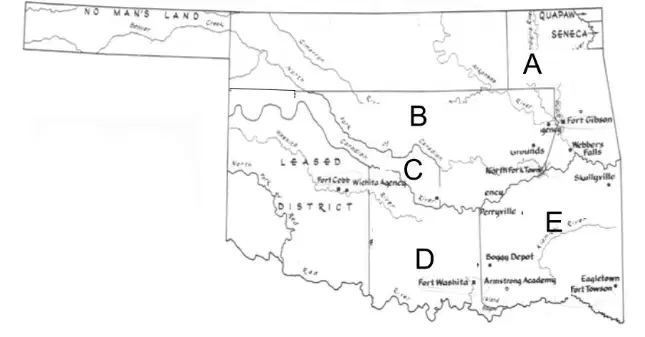
Which tribe settled in location C?
Cherokee
Seminole
Creek
Choctaw
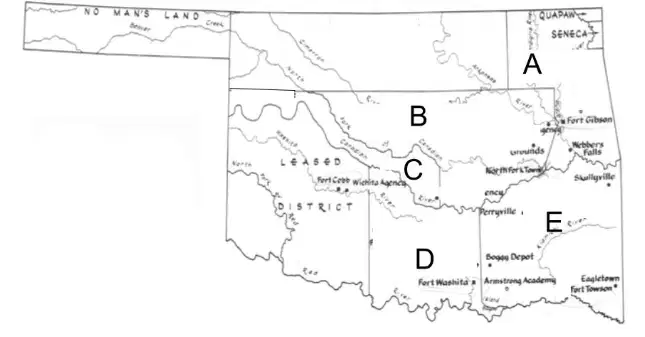
Which tribe settled in location D?
Creek
Choctaw
Cherokee
Chickasaw
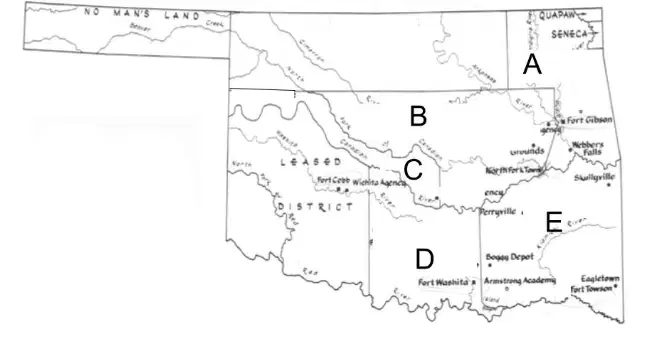
Which tribe settled in location E?
Creek
Cherokee
Choctaw
Seminole

