
 Worksheets
Buddhism Quiz Part 1
Total questions: 60
Worksheet time: 30mins
Who is referred to as "the awakened or enlightened one" in Buddhism?
Dharma
Karma
Buddha
Nirvana
What are the teachings of the Buddha called?
Karma
Dharma
Samsara
Nirvana
What term describes the forces that influence people's fortune and future rebirth?
Samsara
Karma
Dharma
Nirvana
What is the continual process of life, death, and rebirth known as?
Nirvana
Karma
Samsara
Dharma
Who is someone that lives a life of simplicity and self-denial?
Bhikkhu
Ascetic
Brahmin
Missionary
What is a Buddhist monk called?
Brahmin
Bhikkhu
Ascetic
Missionary
What is the state of being awakened to the truth about life?
Meditation
Enlightenment
Nirvana
Samsara
Where did Siddhartha meditate under a Bodhi tree and become the Buddha?
Bodh Gaya
Nirvana
Samsara
Dharma
Who were the priests in ancient India that interpreted Queen Maya’s dream?
Bhikkhus
Brahmins
Ascetics
Missionaries
What are the four things seen by Siddhartha when leaving the royal grounds?
Four Noble Truths
Four Sights
Eightfold Path
Three Poisons
What forms the basis of the Buddha’s teachings?
Eightfold Path
Four Noble Truths
Five Precepts
Three Poisons
What are the five rules that all Buddhists are expected to follow?
Eightfold Path
Four Noble Truths
Five Precepts
Three Poisons
What are the eight instructions taught by the Buddha to help people overcome suffering?
Four Noble Truths
Eightfold Path
Five Precepts
Three Poisons
What is the lifestyle between luxury and having nothing at all?
Middle Way
Meditation
Nirvana
Samsara
Who are the people that spread a religious message to different countries?
Brahmins
Bhikkhus
Missionaries
Ascetics
What is the practice of focusing the mind called?
Meditation
Enlightenment
Nirvana
Samsara
What is the state of bliss experienced by those who have found enlightenment?
Samsara
Nirvana
Karma
Dharma
What are the three poisons in Buddhism?
Greed, hatred, and delusion
Love, peace, and joy
Anger, fear, and jealousy
Pride, envy, and gluttony
What are religious texts in Buddhism called?
Scriptures
Sutras
Vedas
Psalms
What is the main sacred text for many Buddhists?
Dhammapada
Pali Canon
Vedas
Sutras
What is the main theme of Buddha's resolution?
Adventure
Enlightenment
Wealth
Power
What did Buddha hope to achieve by meditating?
Fame
Enlightenment
Riches
Friendship
What did Buddha do to find the truth about life?
He became a king
He meditated
He built a temple
He wrote a manuscript
What did Buddha's meditation symbolize?
A quest for power
A journey to enlightenment
A search for wealth
A desire for fame
Enlightenment involves gaining which of the following?
Material possessions
Knowledge, wisdom, or understanding
Political influence
Social status
Who became the Buddha after achieving enlightenment?
Ashoka
Mahavira
Siddhartha
Confucius
What did Siddhartha go on to found after his enlightenment?
Hinduism
Buddhism
Jainism
Taoism
What did Buddha discover through enlightenment?
The secret to immortality
The key teachings of Buddhism
The path to wealth
The art of war
What was Buddha named when he was born?
Siddhartha Gautama
Ashoka
Mahavira
Chandragupta
What was his name?
Siddhartha Gautama.
Mahavira.
Confucius.
Laozi.
What inspired Siddhartha to become a holy man?
The luxury of his father's palace
The Four Sights
The wealth of his family
The teachings of his friends
How long did Siddhartha live an ascetic lifestyle?
Three years
Six years
Nine years
Twelve years
What did Siddhartha realize about the ascetic lifestyle?
It was the only way to find truth
It did not help him find the truth
It was more luxurious than palace life
It was the best way to gain wealth
Where did Siddhartha sit to meditate until he reached enlightenment?
Under a mango tree
Under a Bodhi tree
In a cave
On a mountain top
What was Siddhartha known as after achieving enlightenment?
The Great Teacher
The Enlightened One
The Wise King
The Holy Sage
What is another name for Siddhartha's enlightenment?
The Great Journey
The Great Awakening
The Great Discovery
The Great Realization
What did Buddha do after achieving enlightenment?
Returned to palace life
Became a traveling preacher
Lived in isolation
Wrote many books
What was the purpose of living an ascetic life according to the text?
To gain wealth
To avoid worldly distractions
To become famous
To learn new skills
How did Siddhartha's appearance change after enlightenment?
He looked much older
There was no obvious change
He became very thin
He grew a long beard
What did Siddhartha understand after his enlightenment?
The secrets of the universe
The world clearly and fully
The art of war
The history of his people
What is the main learning objective related to the Four Sights?
To explain the Four Sights and how they affected the Buddha.
To describe the life of the Buddha.
To list the teachings of Buddhism.
To understand the Eightfold Path.
Which of the following is a success criteria for learning about the Four Sights?
I can describe what the Four Sights are.
I can list the Four Noble Truths.
I can explain the concept of Nirvana.
I can identify the Eightfold Path.
Why did Buddha want to leave the palace?
He wanted to find a new palace.
He was frustrated living in luxury.
He wanted to meet new people.
He was looking for treasure.
Who did Buddha persuade to take him out of the palace?
His father
His friend
His chariot driver
His teacher
What is the first sight that Buddha sees outside the palace?
A young child
A sick person
An old person
A wealthy merchant
What realization does Buddha have after seeing the first sight?
Youth is eternal
Old age is unavoidable
Wealth is the key to happiness
Everyone remains healthy forever
What did the Buddha see as the second sight that shocked him?
An ill person
A wealthy person
A happy child
A beautiful garden
What realization did the Buddha have after seeing the second sight?
Wealth is the key to happiness
Suffering is part of life
Illness can be avoided
Happiness is eternal
What did Buddha see as the Third Sight that made him realize the inevitability of death and the impermanence of life?
A sick person
An old man
A dead body
A monk
What did the Buddha see as the Fourth Sight?
A wealthy merchant
A sick person
A holy man
A king
What realization did the Buddha have after seeing the holy man?
Wealth is the key to happiness
Living a simple life may resolve human suffering
Power can solve all problems
Fame is the ultimate goal
What decision did the Buddha make as a result of the Four Sights?
To become a king
To abandon his life of luxury and become a holy man
To travel the world
To build a palace
What should be included in the diary entry from the perspective of Buddha just after the Four Sights?
Details of the Four Sights, Buddha's life in the palace, and how it affected him.
Buddha's favorite foods and hobbies.
A list of Buddha's friends and family members.
The weather conditions during Buddha's travels.
What is the main learning objective related to the Four Sights in Buddhism?
To memorize the names of the Four Sights.
To explain the Four Sights and how they affected the Buddha.
To list the Four Sights in chronological order.
To compare the Four Sights with other religious teachings.
Which of the following is a success criteria for understanding the Four Sights?
I can describe what the Four Sights are.
I can list the Four Sights in alphabetical order.
I can draw a diagram of the Four Sights.
I can memorize the Four Sights.
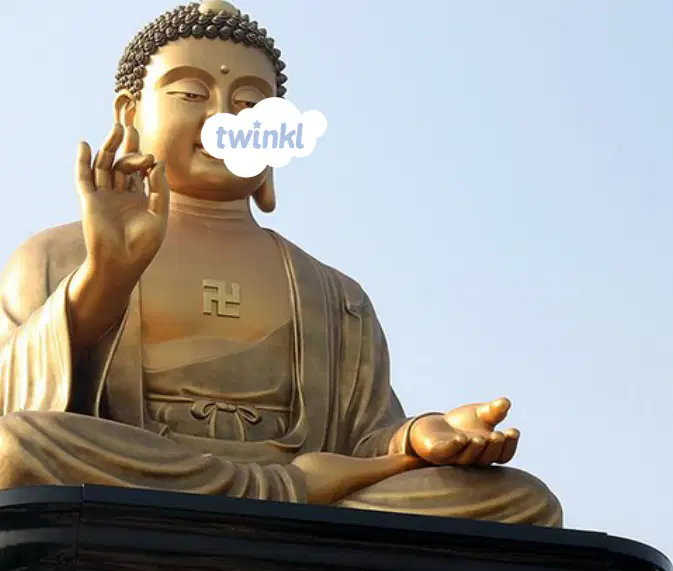
What is the statue in the image commonly known as?
The Great Buddha
The Statue of Liberty
Christ the Redeemer
The Sphinx


