
 Worksheets
SOC7 Ch. 7 Test "A More Perfect Union"
Total questions: 26
Worksheet time: 18mins
After the American Revolution, most states allowed only white men who were at least 21 years old to vote.
True
False
Slavery was a major source of labor in the North.
True
False
The delegates at the Constitutional Convention included Native Americans, African Americans, and women.
True
False
The first three articles of the Constitution describe the structure of the federal government.
True
False
Anti-Federalists supported the Constitution.
True
False
Which law helped stop the spread of slavery to the West?
Confederation Law
Morris Ordinance
Northwest Ordinance
Ordinance of 1785
The Articles of Confederation had to be approved by how many states?
7
9
11
13
Who was the presiding officer at the Constitutional Convention?
Benjamin Franklin
George Washington
John Adams
Thomas Jefferson
Under the federal system of government, what or who is the final authority?
Constitution
court system
president
states
The movement that influenced the Constitution’s architects was
Age of Science
Enlightenment
Ideas Period
Reason Era
This description of the “firm league of friendship” of states is a quotation from the
Articles of Association
Articles of Confederation
Constitution of the Republic
Declaration of Federation
What does a “firm league of friendship” imply for the relationship of the states?
A. States can help one another only in desperate situations.
B. States can pick which states they want to help.
C. States can rely on another state only when it is beneficial for the states involved.
D. States must unite together to protect each other for their mutual well-being.
Which uprising occurred when please from Massachusetts farmers, like in the quote, went unanswered?
"Your Honours are not strangers to the distresses of the people but know that many of our good inhabitants are now confined in jail for debt and taxes"
Boston Massacre
Greenwich Revolt
Shays’s Rebellion
Springfield’s Uprising
"Every man has property in his own person. This no body has any right but to himself"
The English philosopher John Locke is stating in this excerpt his belief in
the right to vote.
freedom of choice.
the natural rights of people.
the right to trade enslaved people.
"The executive Power shall be vested in a President of the United States of America. He shall hold his Office during the Term of four Years, and together with the Vice President chosen for the same Term, be elected, as follows"
According to this excerpt, for how long does the vice president hold office?
for life
four years
six years
two terms
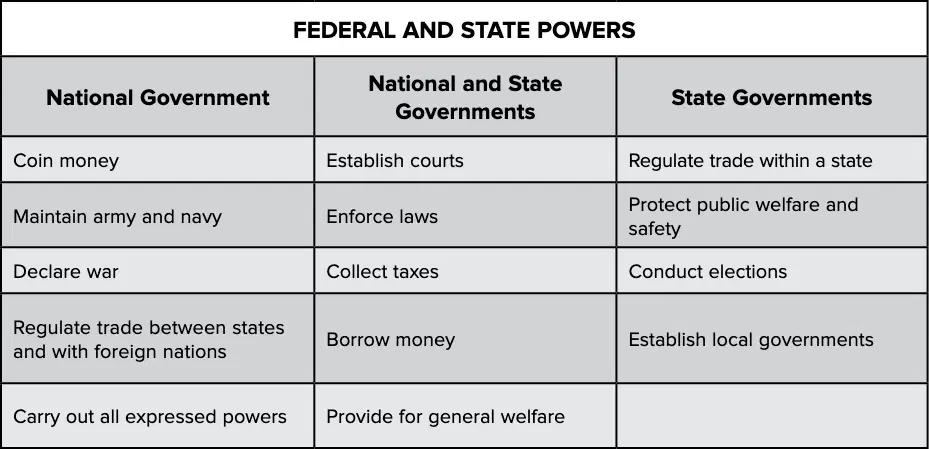
The role of the executive branch is to:
make laws
interpret and question laws
carry out laws and policies of nation
help the legislature
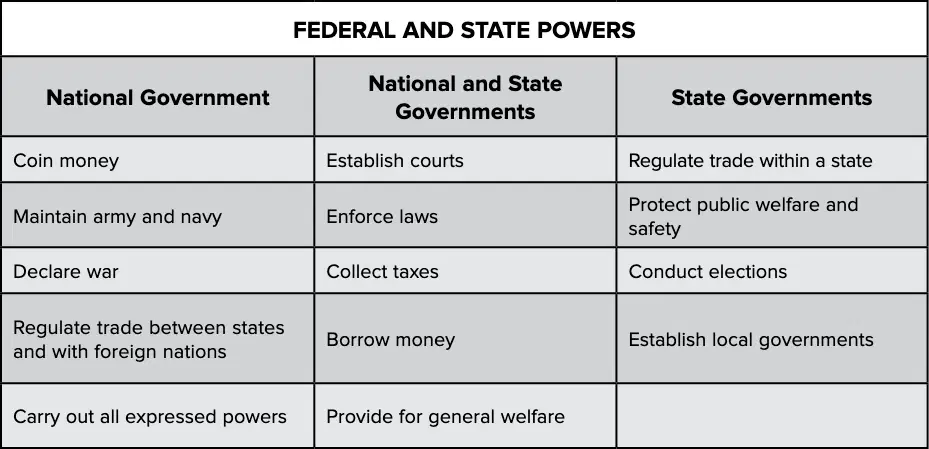
According to the chart, who held the power to create money?
The National Government
The Central Bank
Private Banks
The State Governments
"There is no declaration of rights; and, the laws of the general government being paramount to the laws and constitutions of the several states, the declarations of rights in the separate states are no security."
Based on the excerpt, what was George Mason’s view of individual states’ bills of rights?
He believed they were essential for protecting individual liberties.
He thought they were unnecessary and redundant.
He felt they should be standardized across all states.
He was indifferent to their existence.
The Constitutional Convention was organized to address the problems of the weak central government that existed under the Articles of Confederation. How was it organized?
By a single state
By a group of states
By the federal government
By the Continental Congress
What were the differences between the North and the South over slavery?
The North was industrial and anti-slavery, while the South was agricultural and pro-slavery.
The North was agricultural and pro-slavery, while the South was industrial and anti-slavery.
Both the North and South were industrial and anti-slavery.
Both the North and South were agricultural and pro-slavery.
Manumission is...
having 2 separate lawmaking chambers
the freeing of individual slaves
a government based on a contract
when something falls in value
Bicameral means...
having 2 slaves being freed at a time
having 2 ways to compromise
having 2 cameras watching history
having 2 separate lawmaking chambers
John Locke...
was an Anti-Federalist that didn't support the Constitution
said government should be a contract between people and a ruler
Was a Federalist that supported the Constitution
proposed the Great Compromise
To depreciate means...
to approve a document
to fall in value
to disapprove a domcument
to raise in value
If we ratify the Constitution it means we are...
rejecting it
approving it
If we are amending the Constitution it means we are...
changing or adding something to it
overthrowing the current government

