
Font size
S
M
L
XL
 Worksheets
Civics Q3 Exam
Total questions: 45
Worksheet time: 23mins
Name
Class
Date
1.
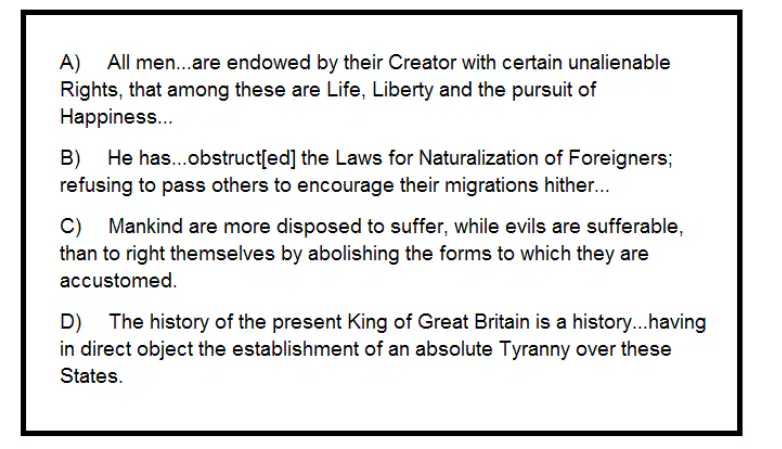
Which statement reflects the Enlightenment ideas of natural law as expressed by Locke?
a)
A
b)
B
c)
C
d)
D
2.
What did many American colonists use Thomas Paine's Common Sense to justify?
a)
Acts of sabotage against British merchants
b)
Declaring independence from Britain
c)
Joining the army instead of the militia
d)
Supporting the British monarchy
3.
What was the rallying cry for the American Revolution?
a)
Remember the Alamo!
b)
No Taxation without Representation!
c)
We want a King!
d)
Fifty Four - Forty or Fight!
4.
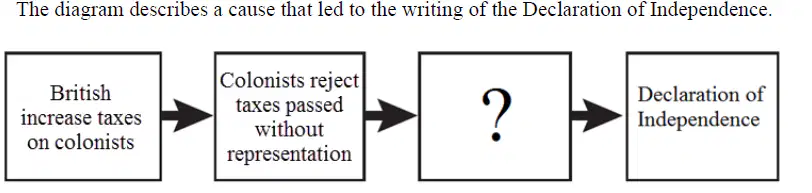
Which action completes the diagram?
a)
British eliminate all taxes on colonists
b)
Colonists vote to elect new member of Parliament
c)
British ignore colonist grievances
d)
Colonist send troops to Britain in protest
5.
The Declaration of Independence included these complaints: Taxation without representation, Limiting judicial powers, Quartering Troops, Dissolving legislature. Which complaint should be added to this list?
a)
Requiring colonists to send representation to Parliament
b)
Suspending trial by jury in many cases
c)
Ordering colonists to move from Native American land
d)
Allowing the wealthy to avoid local laws
6.
How many grievances were in the Declaration of Independence?
a)
15
b)
20
c)
27
d)
32
7.
Which of the following was a weakness of the Articles of Confederation?
a)
The government did not have a separate judicial branch.
b)
The states could not print their own currency.
c)
The president was able to spend taxes freely.
d)
The government had too much power over trade.
8.
Which weakness of the Articles of Confederation led to Shays's Rebellion?
a)
lack of executive branch
b)
lack of the ability to tax
c)
lack of a judicial branch
d)
required unanimous consent for amendments
9.
How did the U.S. Constitution address the problem under the Articles of Confederation that Congress had no power to ensure its laws were followed by the states?
a)
It created an executive branch to enforce laws.
b)
It gave each state sovereign authority over its laws.
c)
It required the president to resolve disputes between states.
d)
It required unanimous consent of states to create new laws.
10.
What does the phrase "insure domestic tranquility" in the Preamble of the Constitution mean?
a)
Give land to the homeless
b)
Fight wars on foreign soil
c)
Keep the homeland at peace
d)
Provide citizens with insurance
11.
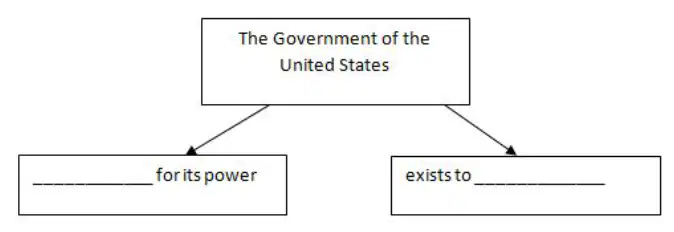
Which phrases complete the diagram?
a)
depends on people; serve the people
b)
depends on law; maintain the law
c)
depends on legislators; serve legislators
d)
depends on liberty; maintain those liberties
12.
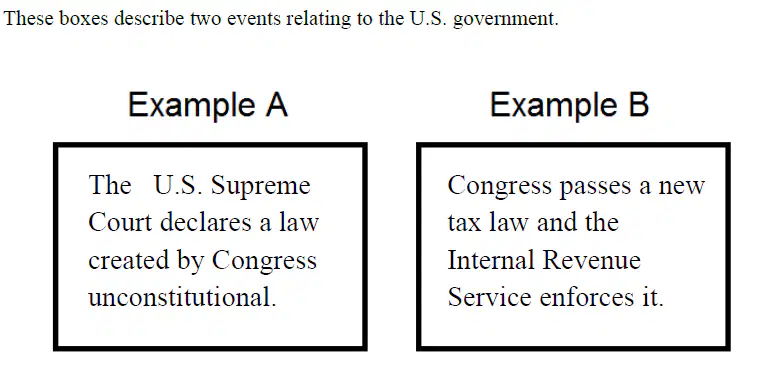
What constitutional principles are demonstrated in examples A and B?
a)
Example A: checks and balances; Example B: separation of powers
b)
Example A: checks and balances; Example B: judicial review
c)
Example A: separation of powers; Example B: individual rights
d)
Example A: separation of powers; Example B: checks and balances
13.
The executive branch is responsible for enforcing the laws, so it created the Internal Revenue Service (IRS) to deal with taxes. Is this an example of check and balances or separation of powers?
a)
checks and balances
b)
separation of powers
14.

Which constitutional principle does Madison describe in the passage?
a)
Popular sovereignty
b)
Judicial review
c)
Checks and balances
d)
Separation of powers
15.
Which viewpoint was common among Anti-Federalists?
a)
There is no need for a separate Bill of Rights.
b)
The Constitution does not give enough power to the states.
c)
The Constitution will not strengthen the government.
d)
A strong national government will protect the people in times of crisis.
16.
What was the compromise between Federalists and Antifederalists?
a)
Bill of Rights
b)
Great Compromise
c)
3/5th Compromise
d)
Constitution
17.
How does rule of law affect U.S. government officials and institutions?
a)
It holds government officials and institutions accountable to the law.
b)
It requires government officials and institutions to create new laws.
c)
It prevents government officials and institutions from making their work public.
d)
It ensures government officials and institutions are exempt from laws.
18.
What is a government that is run by the people, either directly or indirectly?
a)
Democracy
b)
Oligarchy
c)
Autocracy
d)
Communism
19.
What are the freedoms listed in the first amendment? (Choose all that apply)
a)
religion
b)
speech
c)
liberty
d)
petition
e)
press
20.
The 9th Amendment was important to include because it provided protection to the people. What was the main idea of this amendment?
a)
unenumerated rights - we have more rights than are listed in the constitution
b)
reserved powers - anything not given to the federal government is left for the states
c)
enumerated rights - the powers of the legislative branch listed in the constitution
d)
due process - fair legal procedures
21.
What is the term used in the Fourteenth Amendment to describe persons who are born or naturalized in the United States?
a)
Aliens
b)
Citizens
c)
Immigrants
d)
Residents
22.
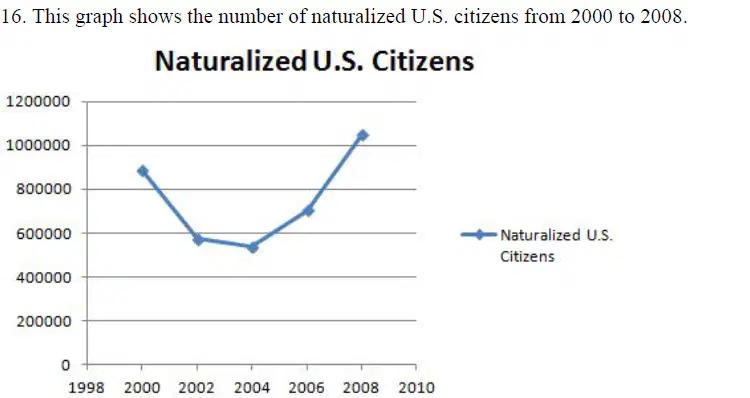
Which of the following statements can be inferred from this graph?
a)
Naturalization has become less popular than it was in the past.
b)
Naturalization has steadily increased voter turnout.
c)
Naturalization laws have become increasingly strict over time.
d)
Naturalization leads to a larger pool of voters.
23.
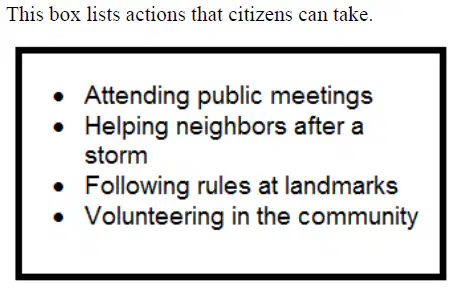
What will happen if a citizen does NOT perform these actions?
a)
The democracy will fail.
b)
The common good will suffer.
c)
The citizen will be charged with a crime.
d)
The citizen will be fined.
24.
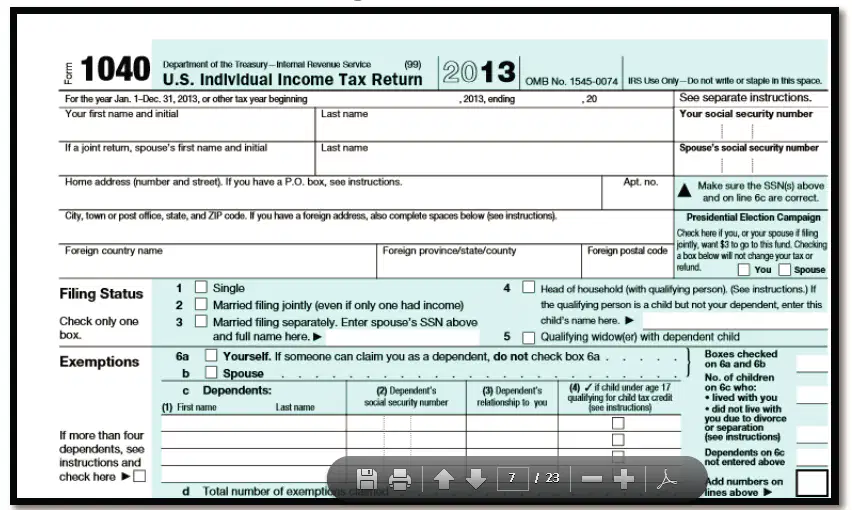
Which of the following is one reason why citizens are required to file such documents with the government?
a)
To ensure that students can go to private schools
b)
To ensure the operation of international trade
c)
To provide a fair report of business practices
d)
To provide social programs for needy citizens
25.
Peter Brown has lived in his home since he was a child. Now the department of parks and recreation wants to tear down his neighborhood to build a park. A government official comes to visit Peter and offers to buy the house from him. Peter refuses. The official says that the government will now seize the property under the constitutional power of "eminent domain."According to the U.S. Constitution, under what circumstances would Peter win his fight to keep his home?
a)
If Peter could prove that he had paid the full price of the house already
b)
If Peter was born as a citizen of the United States, not a naturalized citizen or resident
c)
If the government did not make a reasonable effort to build the park in an uninhabited area
d)
If the government did not offer him fair market price for his home
26.
Ben was prosecuted and convicted in state court for speaking out publicly against the governor. During his trial, he was denied the counsel of a lawyer. Two years later, the U.S. Supreme Court overturned his conviction, explaining that the state had not guaranteed Ben’s constitutional rights. Which amendments apply to this case?
a)
Amendment I (free speech) and Amendment VI (due process)
b)
Amendment I (free press) and Amendment IV (search and seizure)
c)
Amendment IX (unenumerated rights) and Amendment VI (due process)
d)
Amendment IX(unenumerated rights) and Amendment IV (search and seizure)
27.
Slander and libel are two restrictions on what two individual rights?
a)
unreasonable searches and seizures
b)
freedom of speech and due process
c)
freedom of the press and voting rights
d)
freedom of speech and freedom of the press
28.
Anne Tracy works as a journalist for The Daily Mouth. She wrote a story about how Senator Jones cheated on a law school exam. She interviewed witnesses who saw the senator cheating.The story ran on the front page. Senator Jones denied the charges. Then he resigned from office.He plans to sue The Daily Mouth for damages. Under what circumstances could he sue the paper and win his lawsuit?
a)
He could sue the paper for libel and could win the case if he proved that Tracy had a grudge against him
b)
He could sue the paper for slander and could win the case if he proved that Tracy had a grudge against him.
c)
He could sue the paper for libel and could win the case if he proved that the accusations were untrue and his reputation was hurt.
d)
He could sue the paper for slander and could win the case if he proved that the accusations were untrue and his reputation was hurt.
29.
The constitutional guarantee of a free press has resulted in
a)
a government more likely to hide its actions from the people
b)
a government more responsive to the needs of the people
c)
the establishment of English as the official language of the United States
d)
the establishment of government-run news organizations
30.
A more informed society has resulted from which constitutional protection?
a)
Trial by jury
b)
Free press
c)
Right to bear arms
d)
Due process
31.
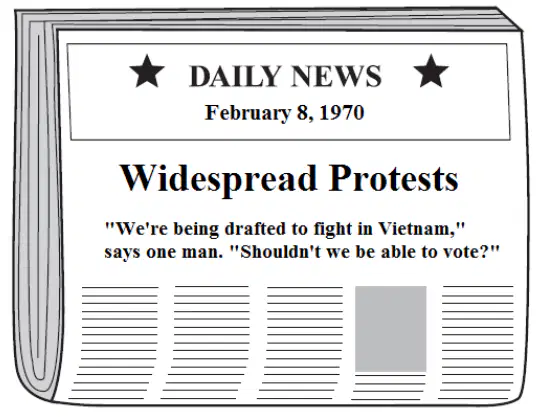
How did opinions like the one shown in this news story affect the political process in the United States?
a)
It led to the Fifteenth Amendment, allowing racial minorities to vote.
b)
It led to the Nineteenth Amendment, allowing women to vote.
c)
It led to the Twenty-Sixth Amendment, allowing 18-year-olds to vote.
d)
It led to the Twenty-Sixth Amendment, allowing 21-year-olds to vote.
32.

How did passage of this legislation affect the political process in the United States?
a)
It enforced the Fifteenth Amendment, protecting the right of racial minorities to vote.
b)
It enforced the Nineteenth Amendment, protecting the right of women to vote.
c)
It extended suffrage to U.S. citizens, allowing 18-year-olds to vote.
d)
It extended suffrage to U.S. citizens, allowing 21-year-olds to vote.
33.
What happened in American schools after the 1954 U.S. Supreme Court decision in Brown v. Board of Education?
a)
States could continue segregation as long as facilities were separate but equal.
b)
Individuals of different races voluntarily stopped all forms of school segregation.
c)
The federal government ordered that states desegregate classes.
d)
Desegregation was ordered for only high schools.
34.
Following the 1966 Supreme Court decision in Miranda v. Arizona, police began informing people placed under arrest that they "have the right to remain silent." What basic freedom is this meant to protect, and how does it affect arrested individuals?
a)
The right to freedom of speech; it provides them with the ability to speak to their attorneys without fear of incrimination.
b)
The protection against self-incrimination; it informs them that speaking to law enforcement could incriminate them.
c)
The protection of due process; it prevents convicted offenders from receiving cruel and unusual punishments.
d)
The right to freedom of assembly; it prevents law enforcement from asking them questions without the presence of an attorney.
35.
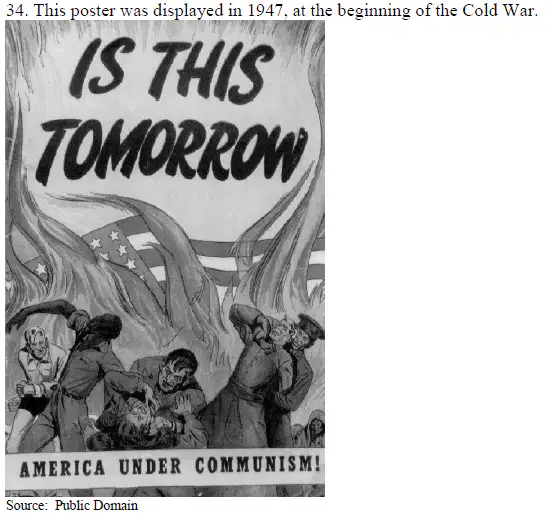
How can the information on this poster best be categorized?
a)
Advertisement
b)
Entertainment
c)
Factual
d)
Propaganda
36.
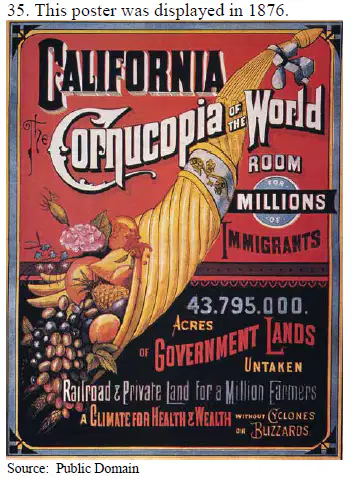
What is primary goal of this propaganda poster?
a)
To encourage people to move to government lands
b)
To discourage people from moving to government lands
c)
To encourage people to move to California
d)
To discourage people from moving to California
37.
Fred is a homeowner interested in conserving the desert surrounding his home. Michaela is a nurse at the local children's hospital with three children of her own. Carlos is the owner of a medical supply company active in the local running club. Gina is a community college student who will soon be transferring to the local university to complete her degree. Which person would be most likely to vote “yes” to raise local taxes to pay for construction of a new hospital?
a)
Fred, because he wants the vacant lot near him to be used for construction
b)
Michaela, because public funding would be split between two hospitals
c)
Carlos, because he will profit from supplying the new business
d)
Gina, because she will need to find work when she graduates
38.
As commander in chief, the President is responsible for what?
a)
the people
b)
the military
c)
the citizens
d)
the government
39.

Which international action is President Johnson justifying with this speech?
a)
Sending troops to stabilize a region
b)
Using sanctions against a country
c)
Sending humanitarian aid to a country
d)
Using nuclear weapons to end a war
40.
What is the term for a type of government in which one person possesses unlimited power?
a)
Socialism
b)
Communism
c)
Democracy
d)
Autocracy
41.
What is an example of an autocratic government today?
a)
Canada
b)
United States
c)
Great Britain
d)
North Korea
42.
Kayla sat in the meeting hall and listened to the different candidates for her state's open Senate seat. The candidates debated about their positions on issues. When Election Day came along, she voted for the candidate she thought would best serve her community’s interests. What form of government does Kayla have?
a)
Direct democracy
b)
Representative democracy
c)
Oligarchy
d)
Monarchy
43.
Who has the most power in a unitary system?
a)
Central government
b)
Local government
c)
State government
d)
Regional government
44.
What is the primary purpose of the legislative branch in the United States government?
a)
To enforce laws
b)
To adjudicate disputes
c)
To interpret laws
d)
To create laws
45.
What is the main function of the judicial branch in the United States?
a)
To create laws
b)
To enforce laws
c)
To interpret laws
d)
To amend the Constitution
Reset

