wayground logo

Free Printable Worksheets

Font size

S
M
L
XL
Worksheets

Zoology 9 Weeks Exam SG

Total questions: 49

Worksheet time: 25mins

Name
Class
Date
1.
Which phylum contains earthworms?
a)
Annelida
b)
Platyhelminthes
c)
Nematoda
2.
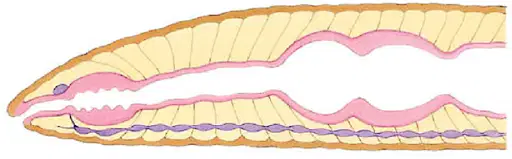
What is the correct order of the earthworm digestive system?
a)
mouth, esophagus, pharynx, crop, gizzard, intestine
b)
mouth, pharynx, esophagus, crop, gizzard, intestine
c)
mouth, pharynx, esophagus, gizzard, crop, intestine
d)
mouth, esophagus, pharynx, gizzard, crop, intestine
3.
The body region which produces mucus and gives rise to the cocoon is called the
a)
pygidium
b)
gonad
c)
clitellum
d)
seminal vesicle
4.
The science of classifying living organisms
a)
cryptozoology
b)
ecology
c)
parasitology
d)
genetics
e)
taxonomy
5.
Which word does NOT correctly describe animals?
a)
multicellular
b)
heterotrophic
c)
prokaryotic
d)
all terms correctly describe animals
6.
Which of the following is NOT a goal of a systematic zoologist?
a)
to discover all species of animals
b)
to save all species of animals from extinction
c)
to reconstruct their evolutionary relationships
d)
to communicate those relationships by constructing an informative taxonomic system
7.
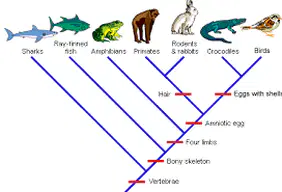
Which trait evolved first (earliest)?
a)
vertebrae
b)
eggs with shells
c)
hair
d)
bony skeleton
8.
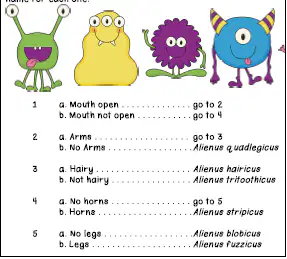
What is the scientific name of the first alien?
a)
Alienus hairicus
b)
Alienus quadlegicus
c)
Alienus stripicus
d)
Alienus fuzzicus
9.
Cells used by a sponge to create an incoming current
a)
amoebocytes
b)
choanocytes
c)
pinacocytes
d)
spicules
10.
The exit opening on a sponge where water and wastes leave
a)
ostia
b)
osculum
c)
spongocoel
d)
mesohyl
11.
Sponges have what type of symmetry?
a)
bilateral
b)
radial
c)
asymmetry
d)
antiparallel
12.
What two compounds make up spicules?
a)
sand and glass
b)
Calcium carbonate and silica
c)
silica and glass
13.
An organism that are capable of motion at any time
a)
sedentary
b)
motile
c)
sessile
14.
An asexual reproductive structure that lies dormant in a sponge's body to preserve the species when environmental conditions are more favorable
a)
gemmule
b)
spongin
c)
choanocyte
d)
spicule
15.
Cnidarians have what type of body symmetry?
a)
radial
b)
asymmetry
c)
bilateral
16.
What is the basic form of a cnidarian that attaches to a substrate, anchoring the organism in a permanent location?
a)
polyp
b)
medusa
17.
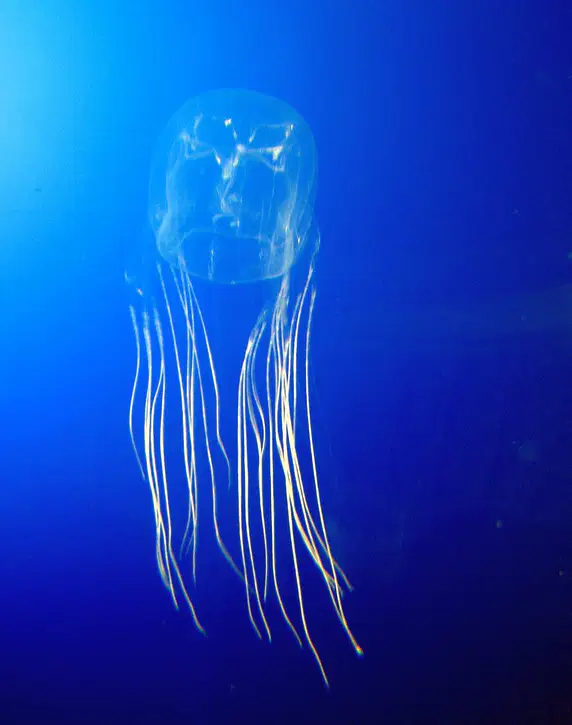
Box jellies belong to which class of cnidarians?
a)
Anthozoa
b)
Cubozoa
c)
Hydrozoa
d)
Scyphozoa
18.
How are box jellies different from true jellyfish?
a)
Box jellies have eyes and can see images as opposed to only detecting light.
b)
Box jellies have a mouth and anus while true jellies have only a mouth.
c)
Box jellies have no known predators which true jellies are food to many marine animals.
d)
All of the above are true.
19.
Cnidarian stinging cells
a)
calyx
b)
cnidocil
c)
cnidocytes
d)
ocelli
20.
Which class of flatworms do tapeworms belong to?
a)
Turbellaria
b)
Trematoda
c)
Monogenea
d)
Cestoda
21.
Which term best describes a tapeworm's digestive system:
a)
absent
b)
branched
c)
complex
d)
dorsal
22.
How are humans often infected by filarial worms?
a)
mosquitos
b)
swimming, standing, or bathing in infected water
c)
ingested with infected, undercooked meat
d)
bedding, on toilets, in sandboxes
23.
A thick, muscular sac-like organ of the annelid digestive system that grinds food into small pieces
a)
esophagus
b)
crop
c)
gizzard
d)
intestine
24.
Sponges are broken down into different classes based on:
a)
spicule composition
b)
choanocyte arrangement
c)
location in the ocean
d)
food source
25.
Class that contains 95% of all living species, including freshwater sponges:
a)
Hexactinellida
b)
Demospongiae
c)
Calcarea
d)
Scyphozoa
26.
Giant barrel sponges are nicknamed "the ______ of the reef."
a)
oil drum
b)
redwood
c)
pyramids
d)
pine
27.
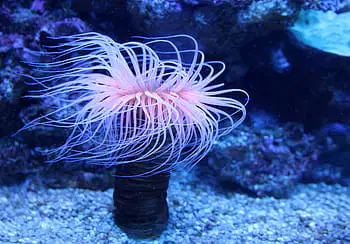
Sea anemones belong to which class?
a)
Anthozoa
b)
Scyphozoa
c)
Cubozoa
d)
Hydrozoa
28.
What is the correct order of the taxonomic levels from the most specific to the most broad?
a)
Domain, Kingdom, Phylum, Class, Order, Family, Genus, Species
b)
Species, Genus, Family, Order, Class, Phylum, Kingdom, Domain
c)
Species, Domain, Genus, Kingdom, Family, Class, Order, Phylum
d)
Domain, Kingdom, Phylum, Class, Order, Family, Species, Genus
29.
Which type of coral are best known for building reefs?
a)
stony, shallow water coral
b)
soft, shallow water coral
c)
stony, deep water coral
d)
soft, deep water coral
30.
The most common coral reefs which form borders around shorelines and islands:
a)
Fringing reefs
b)
Barrier reefs
c)
Atolls
31.
How are animals in Phylum Ctenophora different from animals in Phylum Cnidaria
a)
Ctenophores have stinging cells and a medusa stage, while Cnidarians have ciliary plates for movement.
b)
Ctenophores are exclusively marine, while Cnidarians can be found in both marine and freshwater environments.
c)
Ctenophores reproduce asexually, whereas Cnidarians reproduce sexually only.
d)
Ctenophores have ciliary plates for movement and lack cnidocytes, while Cnidarians have stinging cells and a polyp stage.
32.
Which would be the most closely related?
a)
wood frog (Rana sylvatica), bullfrog (Rana catesbeiana)
b)
eastern toad (Bufo boreas), spadefoot toad (Scaphiopus hammondi)
c)
anole lizard (Anolis carolinensis), eastern narrowmouth toad (Gastrophryne carolinensis)
33.
Which two taxonomic groups are used to write a scientific name?
a)
family, genus
b)
genus, species
c)
species, class
d)
domain, kingdom
34.
What are the characteristics on the side of a cladogram called:
a)
derived characters
b)
traits
c)
features
d)
attributes
35.
How are cryptic species usually discovered?
a)
By analyzing fossil records and historical data.
b)
Through genetic analysis and morphological studies.
c)
Using satellite imagery and remote sensing techniques.
d)
Through behavioral observations and field studies.
36.

Cells which carry nutrients to other parts of the sponge are called:______________

a)
amoebocytes
b)
spicules
c)
choanocytes
d)
epithelial cells
37.

What complexity level do the sponges reside in the animal kingdom?

a)
Sponges are the most complex organisms in the animal kingdom.
b)
Sponges are classified as mammals in the animal kingdom.
c)
Sponges have a complex nervous system and organ systems.
d)
Sponges reside at the simplest complexity level in the animal kingdom.
38.

An organism that remains attached to a surface for its entire life and doesn't move is called__________.

a)
migratory organism
b)
floating organism
c)
mobile organism
d)
sessile organism
39.

What is the basic form of a cnidarian that allows mobility?

a)
Medusa
b)
Polyp
40.

Which class do true jellyfish belong to?

a)
Cnidaria
b)
Anthozoa
c)
Hydrozoa
d)
Scyphozoa
41.

Which class do Portuguese Man-o-War belong to?

a)
Cnidaria
b)
Scyphozoa
c)
Hydrozoa
d)
Anthozoa
42.

Which class do Coral belong to?

a)
Anthozoa
b)
Mollusca
c)
Echinodermata
d)
Cnidaria
43.

Which organ do most tapeworms prefer to live in?

a)
Intestines
b)
Heart
c)
Liver
d)
Stomach
44.

What is the most common worm infestation in the US?

a)
Hookworms
b)
Pinworms
c)
Tapeworms
d)
Roundworms
45.

What type of circulatory system do earthworms have?

a)
open circulatory system
b)
semi-closed circulatory system
c)
lymphatic circulatory system
d)
closed circulatory system
46.

When typing a scientific name, what font setting should be used?

a)
Bold font
b)
Underlined font
c)
Italicized font
d)
Regular font
47.

To which class do glass sponges belong to?

a)
Hexactinellida
b)
Sclerospongiae
c)
Demospongiae
d)
Calcarea
48.

To which class do tapeworms belong to?

a)
Nematoda
b)
Annelida
c)
Arthropoda
d)
Cestoda
49.

What is the difference between a monogenetic fluke and a digenetic fluke?

a)
Monogenetic flukes have one host; digenetic flukes have multiple hosts.
b)
Monogenetic flukes can infect multiple hosts.
c)
Digenetic flukes only live in freshwater environments.
d)
Monogenetic flukes are larger than digenetic flukes.