wayground logo

Free Printable Worksheets

Font size

S
M
L
XL
Worksheets

Photosynthesis, Respiration, and Cycles Review 2024

Total questions: 50

Worksheet time: 37mins

Name
Class
Date
1.
Which of the following are forms of energy?
a)
light
b)
heat
c)
chemical
d)
all of the above
2.
Cells make ATP from glucose breakdown because
a)
ATP gives off more energy
b)
glucose is too small a molecule
c)
glucose does not burn as well
d)
glucose is too big to use efficiently
3.
Cells use ATP as their basic source of energy. Which of the following is an example that a cell would use ATP for?
a)
sunlight
b)
chloroplast
c)
muscle contraction
4.
Where does the mass of a plant come from?
a)
sunlight
b)
carbon dioxide
c)
soil
5.
Which color is NOT absorbed by chlorophyll?
a)
green
b)
purple
c)
blue
d)
yellow
6.
What is the main pigment in plants?
a)
chlorophyll
b)
melanin
c)
carotenoid
7.
Photosynthesis occurs in the ____________ of plants.
a)
mitochondria
b)
chloroplast
c)
cytoplasm
8.
_____________ is the process by which the energy of glucose is released in the cell to be used in life processes.
a)
photosynthesis
b)
movement
c)
respiration
9.
Respiration occurs in ________ cells.
a)
all
b)
only plant
c)
only animal
d)
only bacterial
10.
Aerobic respiration requires ______________.
a)
plants
b)
carbon dioxide
c)
oxygen
11.
__________ is produced in the muscles during rapid exercise when the body cannot supply enough oxygen to the tissues and causes a burning sensation in muscles.
a)
lactic acid
b)
glucose
c)
ATP
12.
Coal, natural gas, petroleum are examples of
a)
biospheres
b)
hydrospheres
c)
geospheres
d)
fossil fuels
13.
Carbon in the form of glucose in a plant is stored in the
a)
biosphere
b)
geosphere
c)
hydrosphere
d)
atmosphere
14.
What are organisms that obtain energy from the food they eat?
a)
autotrophs
b)
heterotrophs
c)
producers
d)
plants
15.
Which of the following is NOT a reactant of photosynthesis?
a)
light
b)
oxygen
c)
carbon dioxide
d)
water
16.
Which type of respiration makes more ATP?
a)
aerobic cellular respiration
b)
anaerobic cellular respiration
c)
fermentation
17.
What are the reactants (input) of photosynthesis?
a)
O2, H2O, sunlight
b)
CO2, H2O, O2
c)
CO2, H2O, sunlight, chlorophyll
18.
What is the overall equation of respiration?
a)
water + oxygen -------> sugar (glucose) + carbon dioxide
b)
oxygen + sugar (glucose) -------> water + carbon dioxide
c)
carbon dioxide + sugar (glucose) ---------> oxygen + water
19.
What process in the water cycle gets water from lakes to the atmosphere?
a)
evaporation
b)
precipitation
c)
transpiration
20.
What is the primary way that carbon in the atmosphere gets back into the biosphere (living things)?
a)
respiration
b)
photosynthesis
c)
fermentation
21.
Explain why mitochondria are found in all cells and chloroplasts are only found in plants cells.
4 lines
22.
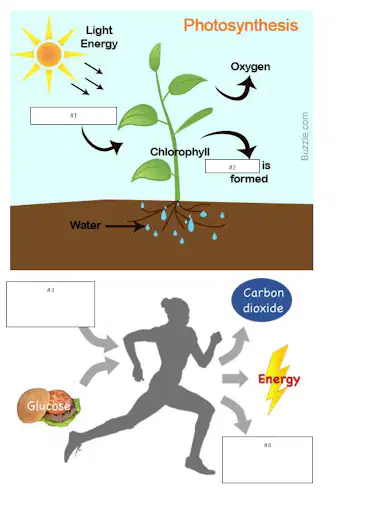
What is #1 in the picture?
a)
carbon dioxide
b)
glucose
c)
oxygen
d)
water
23.
What is #2 in the picture?
a)
carbon dioxide
b)
glucose
c)
oxygen
d)
water
24.
What is #3 in the picture?
a)
carbon dioxide
b)
glucose
c)
oxygen
d)
water
25.
What is #4 in the picture?
a)
carbon dioxide
b)
glucose
c)
oxygen
d)
water
26.

Which process converts light energy into chemical energy in plants?

a)

Respiration

b)

Photosynthesis

c)

Fermentation

27.

What is the primary gas released by plants during photosynthesis?

a)

Oxygen

b)

Carbon Dioxide

c)

Nitrogen

28.

Which molecule is the main energy carrier in cells?

a)

Glucose

b)

ATP

c)

NADH

29.

🌱Photosynthesis 🌱

Carbon dioxide ​ (a)   + Water ​ (b)   + ☼ → Glucose ​ (c)   + Oxygen gas ​ (d)  

Choose from the below words
(CO₂)
(H₂O)
(C₆H₁₂O₆)
(O₂)
30.

Cellular Respiration

Glucose ​ ​ ​ (a)   + Oxygen ​ (b)   --> ​ (c)   + Water (d)   + Carbon Dioxide ​ (e)  

Choose from the below words
Solar energy
ATP energy
(C6H12O6)
(O2)
(H2O)
(CO2)
31.

Label which side is the Reactants and Products of Cellular Respirations

32.

Cellular respiration occurs in the ​ (a)  

Choose from the below words
mitochondria
chloroplasts
3rd trophic level
33.

​ (a)   reactions require oxygen.

Choose from the below words
Aerobic
Anaerobic
34.

​ (a)   is a series of chemical reactions that break down glucose to produce ATP.

Choose from the below words
Cellular respiration
Photosynthesis
Osmosis
Enzyme Denaturation
35.

In Cellular Respiration, glucose is a ​ (a)   that is converted into ​ (b)   .

Choose from the below words
reactant
ATP (Energy)
Product
Oxygen
36.

Mason is learning about energy molecules in biology class. An (a)   molecule is made up of the base adenine, a ribose sugar, and three phosphate groups. Breaking the bond between the second and third phosphate groups of an (b)   molecule releases usable energy and forms an (c)   molecule.

Choose from the below words

ATP

ADP

NADP

FADH2

37.

An ​ (a)   molecule is made up of the base adenine, a ribose sugar, and three phosphate groups. Breaking of the bond between the second and third phosphate groups of an ​ (b)   molecule releases usable energy and forms an ​ (c)   molecule.

Choose from the below words
ATP
ADP
NADP
FADH2
38.

Cells release energy stored in ATP by ​ (a)   chemical bonds.

Choose from the below words
breaking
storing
moving
reforming
39.

What is this

a)

precipitation

b)

evaporation

c)

condensation

40.

What is this?

a)

precipitation

b)

evaporation

c)

condensation

41.

What is this?

a)

evaporation

b)

precipitation

c)

condensation

42.

When water evaporates, it changes from a solid to a gas.

a)

True

b)

False

43.

The image shows various stages in the water cycle. During which stage does water flow back towards the sea as runoff?

a)

W

b)

X

c)

Y

d)

Z

44.

Identify the cycle illustrated in the diagram.

a)

Nitrogen Cycle

b)

Water Cycle

c)

Phosphorus Cycle

d)

Carbon Cycle

45.

What process removes carbon from the atmosphere?

a)

Water

b)

Air

c)

Photosynthesis

d)

Nothing

46.
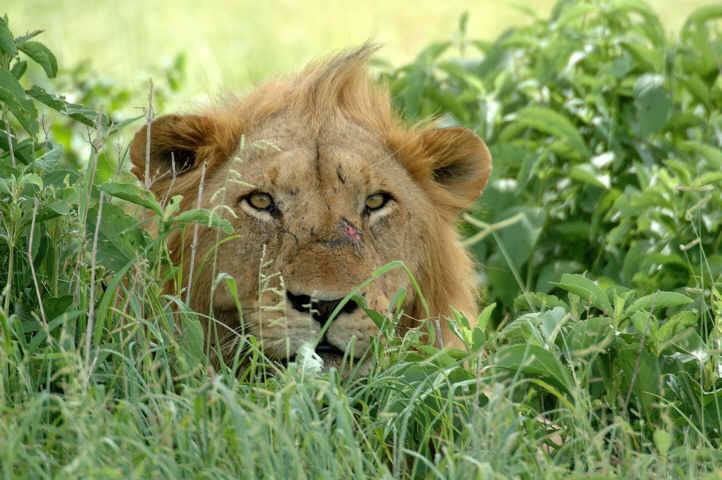
How does the carbon in grass become part of a lion?
a)
The lion eats the grass
b)
Carbon from grass doesn't end up in a lion. 
c)
The carbon ends up in the lion's food chain. 
d)
The lion breathes in carbon given out by the plant
47.
oxygen is a gas produced by _ and used by  _ 
a)
plants and animals 
b)
photosynthesis and carbon dioxide 
c)
animals and plants 
d)
carbon dioxide and photosynthesis
48.
What does NOT produce carbon dioxide?
a)
Photosynthesis
b)
Burning Fossil Fuels
c)
Animal respiration
d)
Plants decaying
49.
Organisms that do not decompose can be buried and become what?
a)
water
b)
nutrients
c)
air
d)
fossil fuels
50.
How do living organisms return carbon to the atmosphere in the carbon cycle?
a)
respiration and photosynthesis
b)
 decomposition and respiration