
 Worksheets
Ch 19 Chemical Reactions Review
Total questions: 50
Worksheet time: 25mins
Name
Class
Date
1.
A change in which one or more substances are converted into a new substance is called a ______ reaction.
a)
chemical
b)
inhibitor
c)
catalyst
2.
The loss of electrons from the atoms of a substance in a chemical reaction is ______.
a)
oxidation
b)
reduction
3.
If a precipitate, water, or gas forms when two ionic compounds in a solution are combined the reaction is a(n) ________ reaction.
a)
double-displacement
b)
synthesis
c)
single-displacement
d)
decomposition
4.
A substance that prevents/slows certain chemical reactions is a(n) __________.
a)
catalyst
b)
inhibitor
c)
precipitate
5.
When two or more simple substances combine in a chemical reaction to form another more complex substance, a(n) ________ reaction has taken place.
a)
double-displacement
b)
synthesis
c)
decomposition
d)
single-displacement
6.
The breakdown of a substance into two or more simpler substances is a(n) ________ reaction.
a)
double-displacement
b)
decomposition
c)
synthesis
d)
single-displacement
7.
In a chemical equation, the substances that react are called _________.
a)
products
b)
reduction
c)
reactants
8.
______ is the gaining of e- by the atoms of a substance in a chemical reaction.
a)
reduction
b)
oxidation
9.
A substance that speeds up a chemical reaction without itself being permanently changed is a(n) _______.
a)
inhibitor
b)
catalyst
10.
A reaction that requires (absorbs) energy in the form of heat is a(n) __________ reaction.
a)
exothermic
b)
endothermic
11.
_________ is the minimum amount of energy that is needed to start a chemical reaction.
a)
chemical
b)
catalyst
c)
activation energy
12.
When one element replaces another in a compound, a(n) ________________ reaction has occurred.
a)
double-displacement
b)
synthesis
c)
single-displacement
d)
combustion
13.
If the energy is released in a chemical reaction is primarily in the form of heat, it is a(n) ____________ reaction.
a)
exothermic
b)
endothermic
14.
Numbers in front of the symbols and formulas in an equation are called ____________.
a)
coefficients
b)
products
c)
inhibitors
15.
If the number of atoms of each element on the left side of the equation is equal to the number of atoms of each element on the right side of the equation, the equation is ___________.
a)
synthesis
b)
balanced
c)
chemical
16.
In a chemical equation, the substances that are produced are called _________.
a)
reactants
b)
products
c)
catalysts
17.
An insoluble solid that forms when two ionic compounds in a solution are combined is a(n) _____________.
a)
precipitate
b)
oxidation
c)
catalyst
18.
The __________ states that the total mass of the products equals the total mass of the reactants.
a)
activation energy
b)
coefficients
c)
law of conservation of mass
19.
The nucleus of an atom is not affected by a chemical reaction.
a)
True
b)
False
20.
Each substance to the right of the arrow in a chemical equation is a _______.
a)
Catalyst
b)
Precipitate
c)
Reactant
d)
Product
21.
Which of the following processes is endothermic?
a)
Iron rusting
b)
Burning wood
c)
Exploding dynamite
d)
Mixing Epsom salt into water
22.
In which type of reaction is less energy required to break the original bonds than is released when new bonds form?
a)
endergonic
b)
exergonic
c)
all of the above
d)
none of the above
23.

Which substance is the precipitate in the following reaction:
a)
a
b)
b
c)
c
d)
d
24.
Which of the following types of reactions is the opposite of a synthesis reaction?
a)
combustion
b)
decomposition
c)
single-displacement
d)
reversible
25.
Food preservatives are an example of what?
a)
inhibitor
b)
catalyst
c)
oxidized
d)
reduced
26.

An example of a balanced chemical equation is ______.
a)
A
b)
B
c)
C
d)
D
27.
Which type of reaction requires more energy to break bonds than is released when new ones are made?
a)
endergonic
b)
exergonic
28.
According to the law of conservation of mass, how does the mass of the products in a chemical reaction compare with the mass of the reactants?
a)
the mass of the products is greater
b)
the mass of the reactants is greater
c)
there is no relationship
d)
the masses are equal
29.

What type of reaction is shown in the equation
a)
synthesis
b)
decomposition
c)
single-displacement
d)
double-displacement
30.
Molecules must collide for a chemical reaction to occur.
a)
true
b)
false
31.
Catalysts change the amount of product in a chemical reaction & cannot be recovered.
a)
true
b)
false
32.
According to the law of conservation of mass, if two atoms of hydrogen are used as a reactant, how many atoms of hydrogen must be part of the product?
a)
two
b)
zero
c)
one
d)
four
33.
A high activation energy indicates that __ energy is needed for a chemical reaction to occur.
a)
more (a lot)
b)
less (a little)
c)
no
d)
none of the above
34.
Granular sugar dissolves faster than a cube of sugar due to what?
a)
greater surface area
b)
less surface area
c)
there is less of it
d)
not enough info
35.
Which type of energy is stored in compounds?
a)
kinetic
b)
gravitational
c)
chemical potential
d)
energy isn't stored in bonds
36.
What is required to form new bonds?
a)
energy
b)
a precipitate
c)
a coefficient
d)
a subscript
37.
If a precipitate is produced, which type of reaction most likely occurred?
a)
synthesis
b)
decomposition
c)
single-displacement
d)
double-displacement
38.
Which type of reaction requires energy (heat, light, electricity) in order to occur?
a)
synthesis
b)
decomposition
c)
single-displacement
d)
double-displacement
39.
Many times a combustion reaction fits in the same category as other reactions, such as synthesis.
a)
true
b)
false
40.
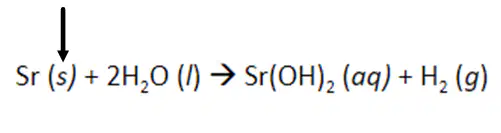
a)
solid
b)
liquid
c)
gas
d)
aqueous
e)
coefficient
41.
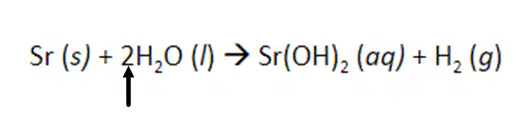
a)
coefficient
b)
solid
c)
liquid
d)
gas
e)
aqueous
42.
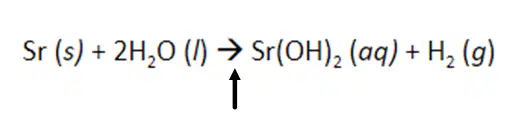
a)
yields/makes/produces
b)
solid
c)
liquid
d)
gas
e)
aqueous
43.
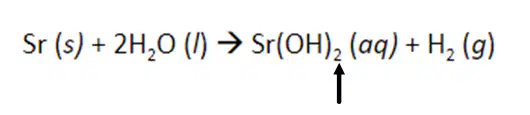
a)
subscript
b)
solid
c)
liquid
d)
gas
e)
aqueous
44.
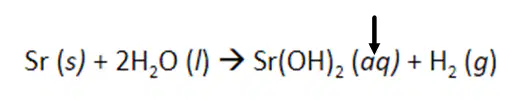
a)
aqueous
b)
solid
c)
liquid
d)
gas
e)
coefficient
45.
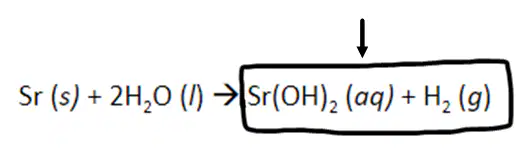
a)
products
b)
solid
c)
liquid
d)
gas
e)
aqueous
46.
If the temperature of the reaction is increased, what will happen to the rate of reaction?
a)
increase
b)
decrease
c)
stay the same
47.
If the concentration of the reactants in a chemical reaction were decreased, what would happen to the rate of reaction?
a)
increase
b)
decrease
c)
stay the same
48.
If the surface area of the reactants in a chemical reaction were increased, what would happen to the rate of reaction?
a)
increase
b)
decrease
c)
stay the same
49.
If the pressure of a chemical reaction was decreased, what would happen to the rate of reaction?
a)
increase
b)
decrease
c)
stay the same
50.
If you agitated a chemical reaction more quickly, what would happen to the rate of reaction?
a)
increase
b)
decrease
c)
stay the same
100 %

