wayground logo

Free Printable Worksheets

Font size

S
M
L
XL
Worksheets

Heating and Cooling Curve of Matter

Total questions: 50

Worksheet time: 5hrs 5mins
Name
Class
Date
1.
The temperature at which the liquid and gas phases of matter can exist at the same time is called its
a)
boiling point
b)
melting point
c)
kinetic molecular theory
d)
freezing point
2.
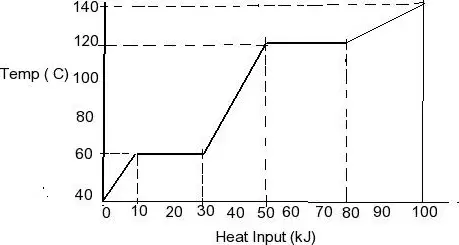
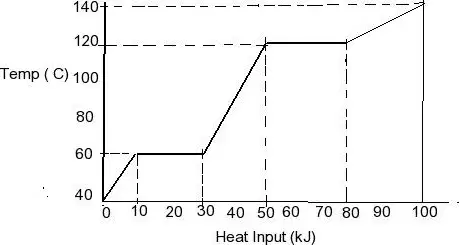
The Heating Curve of an unknown substance is shown below. What is the boiling point of the substance?
a)
120 decrees C
b)
60 degrees C
c)
140 degrees C
d)
40 degrees C
3.
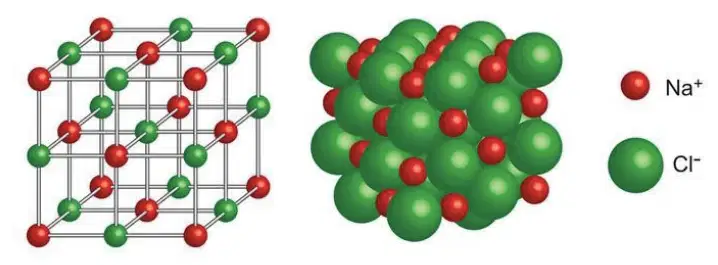
The picture of how atoms are arranged in the below substance represents a ______________________ solid.
a)
Cyrstalline
b)
Amorphous
c)
Singular
d)
Perfect
4.
Using the picture below, what is the main reason that explains why the paper clip can float on the liquid?
a)
Surface Tension
b)
Density
c)
Viscosity
d)
Fluidity
5.
The Heating Curve of an unknown substance is shown below. What is the melting point of the substance?
a)
60 degrees C
b)
120 degrees C
c)
140 degrees C
d)
40 degrees C
6.
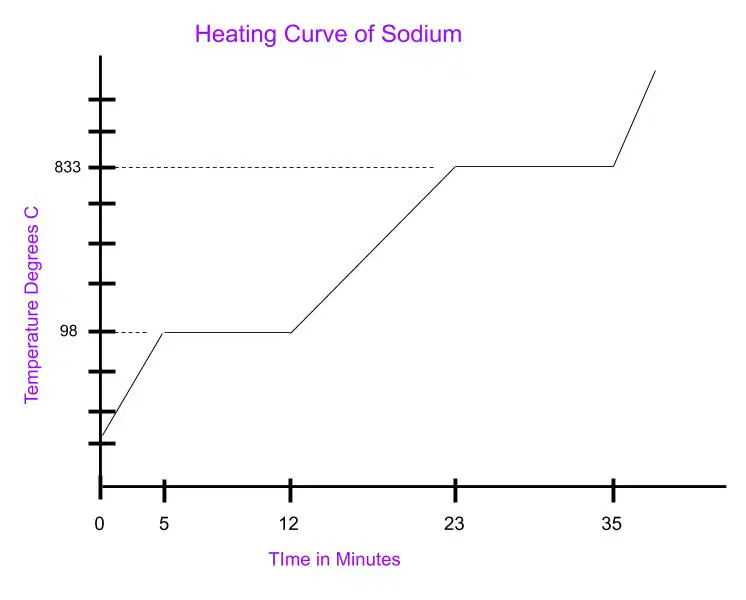
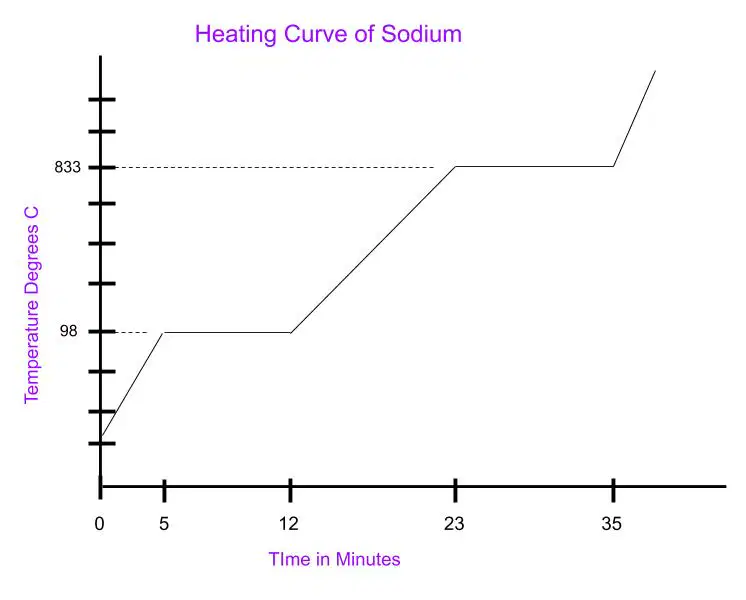
After heating sodium metal for 19 minutes, which phase of matter is present?
a)
Liquid and Gas
b)
Solid
c)
Solid and Gas
d)
Gas
e)
Liquid
7.
What phase of matter is present at 45 degrees C?
a)
Liquid and Gas
b)
Solid
c)
Solid and Gas
d)
Gas
e)
Liquid
8.
Which substance will have the GREATEST viscosity?
a)
Honey (Cold)
b)
Water (50 degrees C)
c)
Vegetable Oil (Hot)
d)
Vinegar (Room Temperature - 21 degrees C)
9.
This curve indicates what about the heat energy?
a)
heat energy is being added or absorbed
b)
heat energy is being removed
10.

NaCl(s) was heated up starting at an initial temperature of 0°C. The heating curve is shown in the picture. What is the melting point of this substance?

a)

0°C

b)

801°C

c)

1000°C

d)

1465°C

11.

This curve indicates what about the heat energy?

a)

Heat energy is being added or absorbed

b)

Heat energy is being released

12.

What is the freezing point of the substance?

a)

0oC

b)

60oC

c)

120oC

d)

180oC

13.

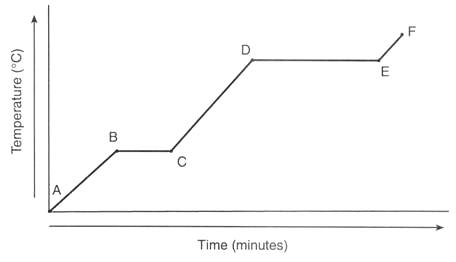
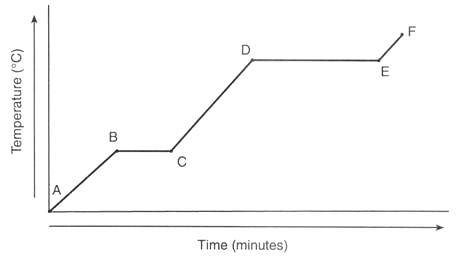
From point A to point F, the sample is going through an __________ process by __________.

a)

exothermic, releasing heat to the surroundings

b)

exothermic, absorbing heat from the surroundings

c)

endothermic, releasing heat to the surroundings

d)

endothermic, absorbing heat from the surroundings

14.

Given the heating curve of a solid being heated at a constant rate, what is the boiling point of this substance?

a)

20°C

b)

50°C

c)

110°C

d)

170°C

15.
Between which points is the substance changing its state of matter?
a)
A-B only. 
b)
A-B, C-D, E-F
c)
B-C only. 
d)
B-C, D-E
16.
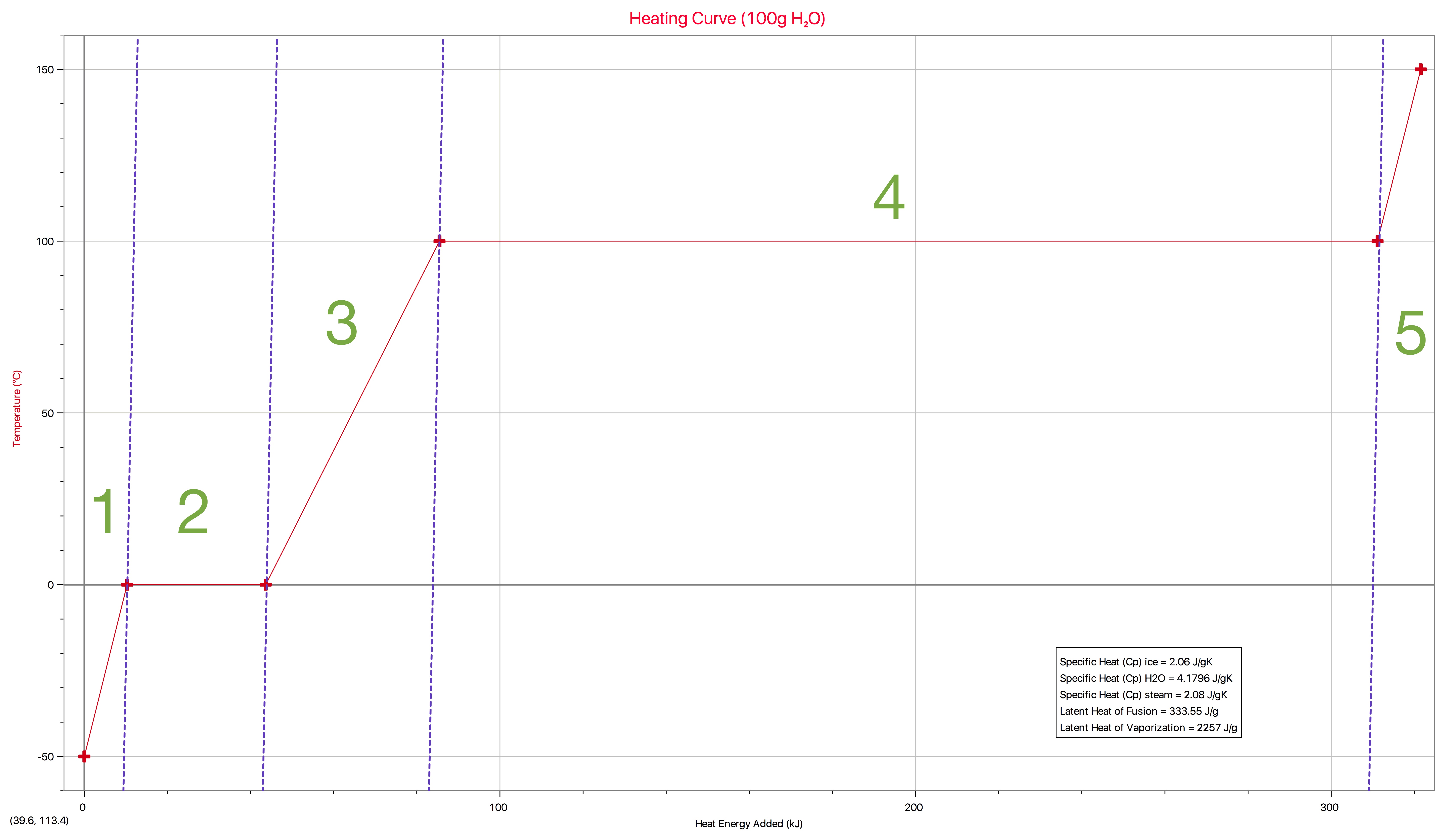
In which region(s) of the graph does melting take place?
a)
Region 2
b)
Region 3
c)
Region 4
d)
Region 5
17.
In which region(s) of the graph does boiling take place?
a)
Region 2
b)
Region 3
c)
Region 4
d)
Region 5
18.
In which region(s) of the graph would the substance be a gas only?
a)
Region 2
b)
Region 3
c)
Region 4
d)
Region 5
19.
In which region(s) of the graph would the substance be a liquid and a gas?
a)
Region 2
b)
Region 3
c)
Region 4
d)
Region 5
20.
In which region(s) of the graph would the substance be a liquid only?
a)
Region 1
b)
Region 2
c)
Region 3
d)
Region 4
21.
In which region(s) of the graph would the substance be a solid and a liquid?
a)
Region 1
b)
Region 2
c)
Region 3
d)
Region 4
22.
In which region(s) of the graph would the substance be a solid only?
a)
Region 1
b)
Region 2
c)
Region 3
d)
Region 4
23.
In which region(s) of the graph would the substance only be in one phase?
a)
Region 1, 3, & 5
b)
Region 2 & 4
c)
Region 1 only
d)
Region 1 & 2
24.
In which region(s) of the graph does a phase change occur?
a)
Region 1, 3, & 5
b)
Region 2 & 4
c)
Region 1 only
d)
Region 1 & 2
25.
In which region(s) does temperature increase?
a)
Region 1, 3, & 5
b)
Region 2 & 4
c)
Region 1 only
d)
Region 1 & 2
26.
In which region(s) does temperature remain constant?
a)
Region 1, 3, & 5
b)
Region 2 & 4
c)
Region 1 only
d)
Region 1 & 2
27.
Describe the substance between letters C and D. 
a)
Gas
b)
Liquid
c)
Melting
d)
Evaporating
28.
True or false: melting and freezing occur at the same temperature.
a)
True
b)
False
29.
Describe the substance between letters A and B. 
a)
Solid
b)
Liquid
c)
Melting
d)
Evaporating
30.
Describe what is happening between letters D and E. 
a)
Gas
b)
Liquid
c)
Melting
d)
Evaporating
31.
Describe the substance between letters E and F. 
a)
Gas
b)
Liquid
c)
Melting
d)
Evaporating
32.

The melting point of the sample is

a)

-60 ºC

b)

-100 ºC

c)

60 ºC

d)

100 ºC

33.

From point A to point E, the sample is going through an

a)

exothermic process by releasing heat to the surroundings

b)

exothermic process by absorbing heat from the surroundings

c)

endothermic process by releasing heat to the surroundings

d)

endothermic process by absorbing heat from the surroundings

34.
A substance's heating curve is shown in the graph.  What is its boiling point?
a)
100 C
b)
60 C
c)
80 C
d)
20 C
35.

Describe how the energy is changing in this graph:

a)

Increasing

b)

decreasing

c)

stays the same

36.

Which segments of this graph show a phase change occurring?

a)

A, C, & E

b)

B & D

c)

A, B, & C

d)

D & E

37.

What state of matter/phase change is occurring during line segment B on the graph?

a)

Gas

b)

Condensation

c)

Liquid

d)

Freezing

e)

Solid

38.

What state of matter/phase change is occurring during line segment D on the graph?

a)

Gas

b)

Condensation

c)

Liquid

d)

Freezing

e)

Solid

39.

At what temperature does the substance in the graph melt?

a)

0°C

b)

1500°C

c)

2800°C

d)

3500°C

40.

At what temperature does the substance in the graph boil/vaporize?

a)

0°C

b)

1500°C

c)

2800°C

d)

3500°C

41.

What happens to the temperature of a substance when it is going through a phase change?

a)

stays the same

b)

increases

c)

decreases

42.

Which state of matter has the greatest attraction between particles?

a)

Solid

b)

Liquid

c)

Gas

43.

Which state of matter has the weakest attraction between particles?

a)

Solid

b)

Liquid

c)

Gas

44.

Particles close together, that are touching and uniformed can be found in which state?

a)

Liquid

b)

Gas

c)

Solid

45.

Particles that are touching, but can flow over each other can be found in which state?

a)

Liquid

b)

Gas

c)

Solid

46.

Particles that are not touching and have lots of energy can be found in which state?

a)

Liquid

b)

Gas

c)

Solid

47.

If a state changes from Liquid to Gas what has occurred?

a)

Melted

b)

Froze

c)

Vaporization

d)

Condensed

48.

If a state changes from Liquid to Solid what has occurred?

a)

Melted

b)

Froze

c)

Vaporization

d)

Condensed

49.

If a state changes from Solid to Liquid what has occurred?

a)

Melted

b)

Froze

c)

Vaporization

d)

Condensed

50.

If a state has changed from Gas to Liquid what has occurred?

a)

Melted

b)

Froze

c)

Vaporization

d)

Condensed