
 Worksheets
AH- Ch. 8 Review
Total questions: 51
Worksheet time: 26mins
Name
Class
Date
1.
Which event turned the United States' attention away from war with Mexico?
a)
the economic drain
b)
war raging in Europe
c)
fighting in Cuba
d)
building the Panama Canal
2.
Panamanians successfully revolted against Colombia with help from
a)
France
b)
Mexico
c)
Spain
d)
US
3.
Whose visit to Japan led to the Treaty of Kanagawa?
a)
William H. Taft
b)
Matthew Perry
c)
John Hay
d)
George Dewey
4.
Events in what country triggered the Spanish-American War?
a)
Mexico
b)
Cuba
c)
Puerto Rico
d)
Guam
5.
The United States and which country split Samoa between them?
a)
France
b)
US
c)
Germany
d)
Britain
6.
An American empire that dominated the Caribbean, Central America, and the Pacific was the goal of
a)
Theodore Roosevelt.
b)
Emilio Aguinaldo.
c)
William H. Seward.
d)
William H. Taft.
7.
Where was the defeat that ended Spanish resistance in Cuba?
a)
Havana
b)
Manila
c)
San Juan Hill
d)
Santiago
8.
What agreement set up a new Puerto Rican government in 1900?
a)
the Foraker Act
b)
Platt Amendment
c)
Treaty of Paris
d)
Spanish-American armistice
9.
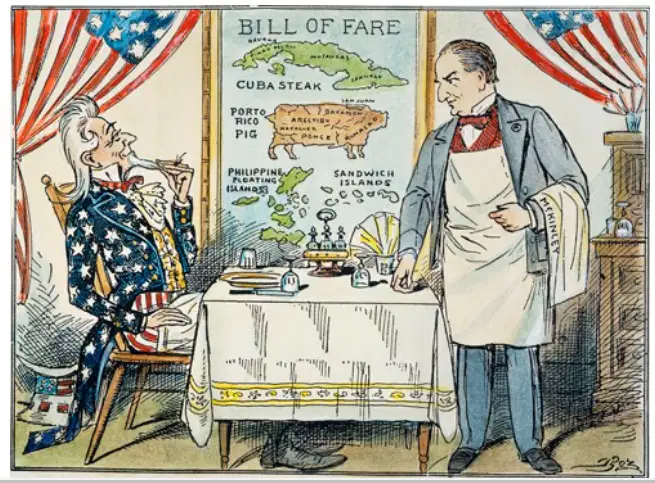
What does Uncle Sam's menu represent?
a)
What island to bomb 1st
b)
What island to carve out a sphere of influence with
c)
What country to leave alone
d)
What island to take over
10.
For centuries, the people of Cuba lived under the rule of
a)
Mexico
b)
Spain
c)
Russia
d)
Britain
11.
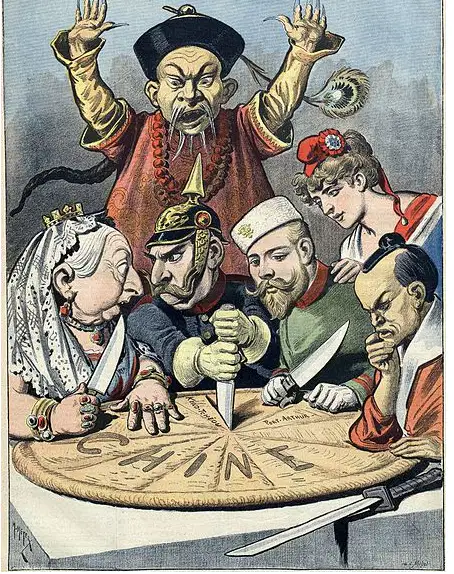
What is taking place in this political cartoon?
a)
isolationism
b)
provisional government
c)
spheres of influence
d)
armistice
12.
Where did the United States first apply the Roosevelt Corollary?
a)
Mexico
b)
Puerto Rico
c)
the Dominican Republic
d)
Cuba
13.
What was the reason for the US wanting to annex Hawaii.
a)
To carve out a spheres of influence
b)
So sugar planters wouldn't have to pay tariffs
c)
Set up Christian missionaries
d)
Set up a policy of isolationism
14.
Check the boxes for the reasons for the US buying Alaska.
a)
Great bargain for a territory twice the size of Texas
b)
Has a huge supply of natural resources
c)
To set up a stopping point for the Navy on the way to China
d)
Set up a policy of isolationism
15.
The first action of the Spanish-American War took place in
a)
Cuba
b)
Puerto Rico.
c)
the Philippines.
d)
Guam
16.

This editorial plea for U.S. intervention in Cuba is an example of
a)
imperialism
b)
yellow journalism.
c)
isolationism
d)
malpractice.
17.
Who said, "Sea power is essential to the greatness of every splendid people"?
a)
John Hay
b)
William H. Seward
c)
Theodore Roosevelt
d)
Alfred Thayer Mahan
18.
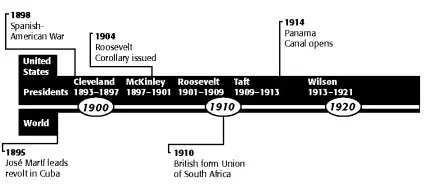
In what year was the Roosevelt Corollary issued?
a)
1901
b)
1904
c)
1909
d)
1910
19.
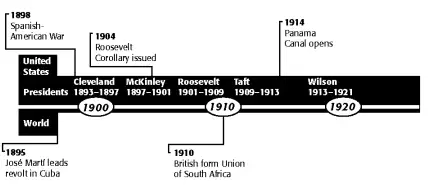
Who was president when the Panama Canal opened?
a)
Wilson
b)
Roosevelt
c)
Taft
d)
McKinley
20.
Which incident led to Congress's declaring war on Spain?
a)
explosion of the Maine
b)
arrest of José Martí
c)
Spanish ships in Santiago
d)
capture of San Juan Hill
21.
Out of the Boxer Rebellion came a second
a)
annexation
b)
Treaty of Portsmouth.
c)
Gentlemen's Agreement.
d)
Open Door policy.
22.
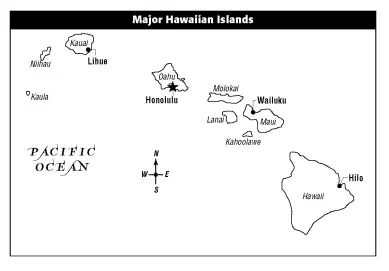
Based on the map, on which Hawaiian island is the state capital located?
a)
Hawaii
b)
Maui
c)
Honolulu
d)
Oahu
23.
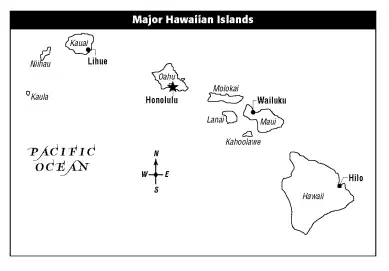
Which major island in the Hawaiian island chain is the farthest east?
a)
Kaula
b)
Kauai
c)
Hawaii
d)
Hilo
24.
President Theodore Roosevelt helped end the Russo-Japanese War with the
a)
Gentlemen's Agreement.
b)
spheres of influence.
c)
Great White Fleet.
d)
Treaty of Portsmouth.
25.
Noninvolvement in world affairs is called
a)
expansionism
b)
isolationism
c)
imperialism.
d)
annexation
26.
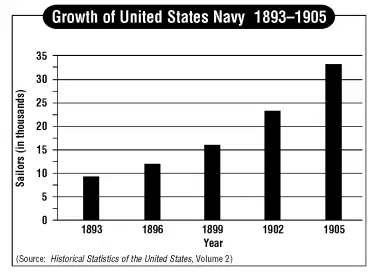
Based on the bar graph, in which of the following years would the U.S. Navy have been about twice the size it was in 1893?
a)
1895
b)
1898
c)
1900
d)
1904
27.

If the U.S. was to increase its naval power as the twentieth century approached, which of these was most important?
a)
creating new designs for uniforms for sailors and naval officers
b)
finding more money from Congress to build more sailing ships
c)
acquiring secure overseas bases to refuel, resupply, and repair warships
d)
building a large fleet of merchant ships for international trading
28.
Which leader wanted Hawaiians to regain economic control of their islands?
a)
Queen Liliuokalani
b)
King Kamehameha I
c)
William H. Seward
d)
Grover Cleveland
29.
Whose belief in expansionism led to the building of the Panama Canal?
a)
William H. Seward
b)
Francisco Madero
c)
William Gorgas
d)
Theodore Roosevelt
30.
Which rebels helped the Americans capture Manila from the Spanish?
a)
Puerto Ricans
b)
Hawaiians
c)
Filipinos
d)
Cubans
31.
Which place is a chain of 8 large and 100 or so smaller islands?
a)
Hawaii
b)
Guam
c)
Puerto Rico
d)
Philippines
32.
16 gleaming white battleships that cruised around the world
a)
Pago Pago
b)
Rough Riders
c)
Great White Fleet
d)
Alaska
e)
Francisco "Pancho" Villa
33.
United States naval base in Samoa
a)
Pago Pago
b)
Rough Riders
c)
Great White Fleet
d)
Alaska
e)
Francisco "Pancho" Villa
34.
purchased from Russia
a)
Pago Pago
b)
Rough Riders
c)
Great White Fleet
d)
Alaska
e)
Francisco "Pancho" Villa
35.
captured San Juan Hill
a)
Pago Pago
b)
Rough Riders
c)
Great White Fleet
d)
Alaska
e)
Francisco "Pancho" Villa
36.
Mexican rebel
a)
Pago Pago
b)
Rough Riders
c)
Great White Fleet
d)
Alaska
e)
Francisco "Pancho" Villa
37.
proposed Open Door policy
a)
James G. Blaine
b)
Guantanamo Bay
c)
imperialism
d)
John Hay
e)
Pearl Harbor
38.
site of U.S. naval base in Hawaii
a)
James G. Blaine
b)
Guantanamo Bay
c)
imperialism
d)
John Hay
e)
Pearl Harbor
39.
helped foster Pan-American Union
a)
James G. Blaine
b)
Guantanamo Bay
c)
imperialism
d)
John Hay
e)
Pearl Harbor
40.
United States naval base in Cuba
a)
James G. Blaine
b)
Guantanamo Bay
c)
imperialism
d)
John Hay
e)
Pearl Harbor
41.
a nation exercises political or economic control over a smaller or weaker nation
a)
James G. Blaine
b)
Guantanamo Bay
c)
imperialism
d)
John Hay
e)
Pearl Harbor
42.
temporary government
a)
B. Provisional Government
b)
A. Expansionism
c)
C. Protectorate
d)
D. Dollar Diplomacy
e)
E. Isthmus
43.
A policy of joining the business interest of a country with its diplomatic interests abroad
a)
D. Dollar Diplomacy
b)
A. Expansionism
c)
B. Provisional Government
d)
C. Protectorate
e)
E. Isthmus
44.
A national policy of avoiding involvement in world affairs
a)
J. Isolationism
b)
A. Expansionism
c)
B. Provisional Government
d)
C. Protectorate
e)
D. Dollar Diplomacy
45.
Peace Agreement
a)
I. Armistice
b)
A. Expansionism
c)
B. Provisional Government
d)
C. Protectorate
e)
D. Dollar Diplomacy
46.
the actions used by one nation to exercise political or economic control over smaller or weaker nations
a)
H. Imperialism
b)
A. Expansionism
c)
B. Provisional Government
d)
C. Protectorate
e)
D. Dollar Diplomacy
47.
section of a country where one foreign nation enjoys special rights and powers
a)
F. Sphere of Influence
b)
A. Expansionism
c)
B. Provisional Government
d)
C. Protectorate
e)
D. Dollar Diplomacy
48.
A policy that calls for expanding a nation’s boundaries
a)
A. Expansionism
b)
B. Provisional Government
c)
C. Protectorate
d)
D. Dollar Diplomacy
e)
E. Isthmus
49.
Type of sensational, biased, and often false reporting
a)
G. Yellow Journalism
b)
A. Expansionism
c)
B. Provisional Government
d)
C. Protectorate
e)
D. Dollar Diplomacy
50.
An independent country that is under the control of another country
a)
C. Protectorate
b)
A. Expansionism
c)
B. Provisional Government
d)
D. Dollar Diplomacy
e)
E. Isthmus
51.
A narrow strip of land connecting two larger bodies of land
a)
E. Isthmus
b)
A. Expansionism
c)
B. Provisional Government
d)
C. Protectorate
e)
D. Dollar Diplomacy
100 %

