
Font size
 Worksheets
(Savvas 17.3) Ch 17.3 Behavior of Waves
Total questions: 16
Worksheet time: 9mins
What happens when a wave reflects off a fixed boundary?
The reflected wave will be turned upside down.
The amplitude will double as it strikes the surface.
The speed of the wave will decrease.
The frequency of the wave will decrease.
Refraction occurs when a wave enters a new medium at an angle because
the wave changes speed in the new medium.
the wave's frequency changes.
the wave's amplitude increases.
the wave is absorbed by the new medium.
A wave diffracts more if its wavelength is small compared to the size of an opening or obstacle.
True
False
At certain wavelengths, interference between a wave and its reflection can produce a(n) ______.
standing wave.
traveling wave.
diffraction pattern.
amplitude modulation.
If a standing wave occurs in a medium at a given wavelength, another standing wave will occur if this wavelength is doubled.
True
False
Which one of these is an example of a common standing wave?
The vibrations you can see when plucking a stringed instrument.
The sound of a car engine running smoothly.
The light from a flashlight.
The flow of water in a river.
Match the examples to the behavior of the waves.
refraction
Water waves bending around a rock
diffraction
An echo heard in a canyon
reflection
Noise cancelling headphones
interference
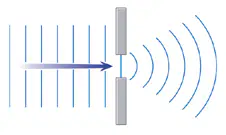
This diagram represents a series of waves that curve as they pass through a small space. Which wave behavior is represented in this diagram?
reflection
refraction
diffraction
interference
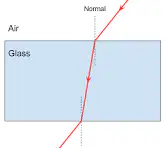
The red arrow in this diagram represents a light ray as it passes from one medium to another medium.
Which wave behavior is represented in this diagram?
reflection
refraction
diffraction
interference
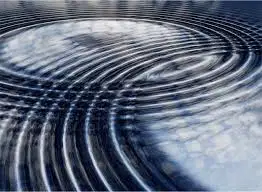
This diagram represents the combination of more than one wave. Which wave behavior is represented in this diagram?
reflection
refraction
diffraction
interference
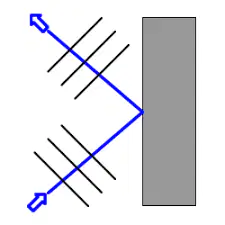
This diagram represents a series of waves as they bounce off an obstacle. Which wave behavior is represented in this diagram?
reflection
refraction
diffraction
interference
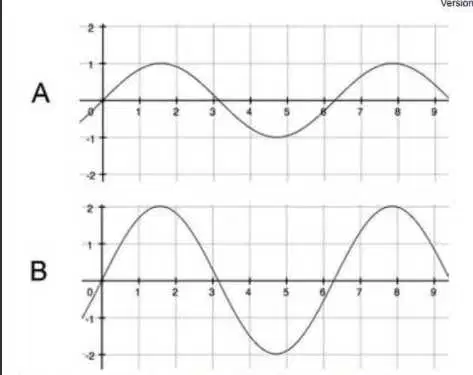
If wave A and wave B were to combine, which of the following accurately describes the wave that would be produced?
The resultant wave would have an amplitude of 2.
The resultant wave would have an amplitude of 3.
The resultant wave would have an amplitude of 1.
No resultant wave would form because the waves would cancel each other out.

This standing wave has how many nodes?
2 nodes
3 nodes
4 nodes
5 nodes
This standing wave has how many antinodes?
2 nodes
3 nodes
4 nodes
5 nodes
A point of maximum displacement due to constructive interference in a standing wave is called an antinode.
True
False

In the figure shown, the light waves change direction as a result of _____.
absorption
refraction
reflection
diffraction

