
 Worksheets
AP 6 Thermochemistry Question Bank
Total questions: 206
Worksheet time: 3hrs 27mins
In an exothermic reaction, the sign of ΔH is ____ and the reaction feels ______
(-), hot
(+), hot
(-), cold
(+), cold
Freezing is an _________________________ process
Endothermic
Exothermic
Vaporizing is an _________________________ process
Endothermic
Exothermic
Breaking bonds is _________________. Forming bonds is ______________________
endothermic, exothermic
exothermic, endothermic
ΔHrxn = ΔH_________________ − ΔH_________________
products, reactants
reactants, products
If a reaction is exothermic, then the bonds formed in the products are ___________________ than the reactant bonds.
stronger/more stable
weaker/less stable
If a reaction is endothermic, then the bonds formed in the products are ___________________ than the reactant bonds.
stronger/more stable
weaker/less stable
According to Hess' Law, if you double the coefficients of a reaction, ΔH will ________________________
Stay the same
Double
Quadruple
Halve
According to Hess' Law, if you reverse a reaction, ΔH will ________________________
Change signs
Double
Be inversed
Halve

_____ Hydrogen-Hydrogen single bond/s are broken and _____ Carbon-Hydrogen single bond/s formed
6; 8
2; 8
2; 10
6; 10
_____ Carbon-Carbon single bond/s are formed
6
2
3
10
Bond enthalpy is the amount of energy is takes to break __________ of a bond.
one mole
one gram
the activation energy
the binding energy
What are the units of ΔHrxn?
kJ
J
kJ/mol
J/mol
Endothermic
absorb energy
release energy
Exothermic
absorb energy
release energy
In the dissolution process, the increase in separation between ions in the solute is
endothermic
exothermic
In a system, the energy lost by the reacting species must be ________________ the energy gained by the surrouding
greater than
less than
equal to
On a potential energy diagram for an endothermic reaction,
the potential energy of the reactants is greater than the potential energy of the products
the potential energy of the reactants is less than the potential energy of the products
the potential energy of the reactants is equal to the potential energy of the products
A temperature is placed in a calorimeter. A solid is dissolved in water in the calorimeter and the temperature of the thermometer increases. The dissolution reaction must be
endothermic
exothermic
Using bond energies to solve for enthalpy,
ΔH = Bond broken - bonds formed
undefined = Bond formed- bonds broken
undefined = products - reactants
undefined = reactants- products
The enthalpy of formation for a lone element is
a number
zero
For a classroom demonstration, a chemistry teacher puts samples of two different pure solid powders in a beaker. The teacher places the beaker on a small wooden board with a wet surface, then stirs the contents of the beaker. After a short time the students observe that the bottom of the beaker is frozen to the wood surface. The teacher asks the students to make a claim about the observation and to justify their claims. Which of the following is the best claim and justification based on the students’ observation?
An exothermic chemical change occurred because heat flowed from the contents of the beaker to the room.
An exothermic physical change occurred because heat flowed from the contents of the beaker and the water on the board to the room.
An endothermic physical change occurred because the freezing of water is an endothermic process.
An endothermic chemical change occurred because the temperature of the beaker and the water on the board decreased as heat was absorbed by the reaction.

The dissolution of an ionic solute in a polar solvent can be imagined as occurring in three steps, as shown in the figure above. In step 1, the separation between ions in the solute is greatly increased, just as will occur when the solute dissolves in the polar solvent. In step 2, the polar solvent is expanded to make spaces that the ions will occupy. In the last step, the ions are inserted into the spaces in the polar solvent. Which of the following best describes the enthalpy change, ΔH, for each step?
All three steps are exothermic.
All three steps are endothermic.
Steps 1 and 2 are exothermic, and the final step is endothermic.
Steps 1 and 2 are endothermic, and the final step is exothermic.
Which of the following phase changes involves the transfer of heat from the surroundings to the system?
CH4(g)→CH4(l), because CH4 molecules in the gas phase must absorb energy in order to move closer together, thereby increasing the intermolecular attractions in the solid state.
CO2(g)→CO2(s), because CO2 molecules in the gas phase must absorb energy in order to move closer together, thereby increasing the intermolecular attractions in the liquid state.
H2O(l)→H2O(s), because H2O molecules in the liquid phase must absorb energy in order to create a crystalline structure with strong intermolecular attractions in the solid state.
NH3(l)→NH3(g), because NH3 molecules in the liquid phase must absorb energy in order to overcome their intermolecular attractions and become free gas molecules.
In the spring, blossoms on cherry trees can be damaged when temperatures fall below −2°C. When the forecast calls for air temperatures to be below −5°C for a few hours one night, a farmer sprays his blossoming cherry trees with water, claiming that the blossoms will be protected by the water as it freezes. Which of the following is a correct scientific justification for spraying water on the blossoms to protect them from temperatures below −2°C?
Water on the blossoms will not freeze unless the air temperature falls significantly below −5°C
Water is a good thermal conductor that transfers heat from the cold air to the blossoms, keeping the blossoms from going below −2°C
The freezing of water is an endothermic process; thus, water that freezes on the blossoms absorbs heat from the atmosphere, which in turn keeps the blossoms above 0°C
The freezing of water is an exothermic process; thus, water that freezes on the blossoms releases heat to keep the blossoms at or above −2°C

K(s)+21Cl2(g)→KCl(s) ΔH°=−437kJ/molrxn The elements K and Cl react directly to form the compound KCl according to the equation above. Which of the values of ∆Ho for a process in the table is (are) less than zero (i.e., indicate(s) an exothermic process)?
z only
y and z only
x, y, and z only
w, x, y, and z

A chemical reaction occurs, as evidenced by the volume of the resultant mixture being less than the total volume of the initial components.
A chemical change occurs, as evidenced by the formation of new covalent bonds releasing more energy than is absorbed by the breaking of the existing covalent bonds.
A physical change occurs, and the solvation process is exothermic.
A physical change occurs, and the solvation process is endothermic.
Which of the following best helps to explain why the value of ΔH° for the dissolving of CaF2 in water is positive?
CaF2(s) is insoluble in water.
CaF2(s) dissolves in water to form CaF2(aq) particles.
Ca2+ ions have very strong ion-ion interactions with F- ions in the crystal lattice.
Ca2+ ions have very strong ion-dipole interactions with water molecules in the solution.

XY2→X+Y2 The equation represents the decomposition of a compound XY2. The diagram shows two reaction profiles. Which of the following best describes the flow of heat when 1.0 mol of XY2 decomposes?
50 kJ of heat is transferred to the surroundings.
50 kJ of heat is transferred from the surroundings.
100 kJ of heat is transferred to the surroundings.
100 kJ of heat is transferred from the surroundings.
A reaction profile shows....
the relative difference in temperature of reactants and products
the relative difference in amounts of reactants and products
the relative difference in energy of reactants and products
the relative difference in volume of reactants and products

Which letter represents the transition state?
A
B
C
D
E

Which letter represents the potential energy of the products?
A
B
C
D
E

Which letter represents the potential energy of the reactants?
A
B
C
D
E

Which letter shows the enthalpy of the reaction?
A
B
C
D
E

What does 'X' represent in the energy profile shown here?
Potential Energy
Kinetic Energy
Enthalpy
Reaction progess (time)

What does 'Z' represent in the energy profile shown here?
Reactants Energy of Formation
Kinetic Energy
Activation Energy
Products Energy of Formation

What does 'W' represent in the energy profile diagram shown?
Kinetic Energy
Reactants Energy of Formation
Products Energy of Formation
Activation Energy

What does 'Q' represent in the energy profile shown here?
Potential Energy
Reaction Progression (time)
Reactants Energy of Formation
Activation Energy
Which of these physical changes is endothermic?
Condensation
Freezing
Evaporation
Deposition


In an energy profile diagram, what does the difference between the energy of the reactants and the energy of the products represent?
Activation Energy
Enthalpy Change
Potential Energy
Kinetic Energy
A 1.0mol sample of He(g) at 25°C is mixed with a 1.0mol sample of Xe(g) at 50°C. Which of the following correctly predicts the changes in average kinetic energy and the average speed of the Xe(g) atoms that will occur as the mixture approaches thermal equilibrium?
Average Kinetic Energy of Xe Atoms will INCREASE;
Average Speed of Xe Atoms will INCREASE
Average Kinetic Energy of Xe Atoms will INCREASE;
Average Speed of Xe Atoms will decrease
Average Kinetic Energy of Xe Atoms will decrease;
Average Speed of Xe Atoms will INCREASE
Average Kinetic Energy of Xe Atoms will decrease;
Average Speed of Xe Atoms will decrease
A 100g sample of a metal was heated to 100oC and then quickly transferred to an insulated container holding 100g of water at 22oC. The temperature of the water rose to reach a final temperature of 35oC. Which of the following can be concluded?
The metal temperature changed more than the water temperature did; therefore the metal lost more thermal energy than the water gained.
The metal temperature changed more than the water temperature did, but the metal lost the same amount of thermal energy as the water gained.
The metal temperature changed more than the water temperature did; therefore the heat capacity of the metal must be greater than the heat capacity of the water.
The final temperature is less than the average starting temperature of the metal and the water; therefore the total energy of the metal and water decreased.
A 100 g sample of a metal was heated to 100oC and then quickly transferred to an insulated container holding 100 g of water at 22oC. The temperature of the water rose to reach a final temperature of 35oC. Which of the following can be concluded?
The metal temperature changed more than the water temperature did; therefore the metal lost more thermal energy than the water gained.
The metal temperature changed more than the water temperature did, but the metal lost the same amount of thermal energy as the water gained.
The metal temperature changed more than the water temperature did; therefore the heat capacity of the metal must be greater than the heat capacity of the water.
The final temperature is less than the average starting temperature of the metal and the water; therefore the total energy of the metal and water decreased.
A 30.g sample of Al(s) is heated to 50°C and placed in a calorimeter containing 150g of water at 20°C. As the system approaches thermal equilibrium, energy is transferred
from the Al(s) to the water and the temperature of the water decreases
from the Al(s) to the water and the temperature of the Al(s) decreases
from the water to the Al(s) and the temperature of the water increases
from the water to the Al(s) and the temperature of the Al(s) increases
A piece of Fe(s) at 25°C is placed into H2O(l) at 75°C in an insulated container. A student predicts that when thermal equilibrium is reached, the Fe atoms, being more massive than the H2O molecules, will have a higher average kinetic energy than the H2O molecules. Which of the following best explains why the student’s prediction is incorrect?
At thermal equilibrium, the less massive H2O molecules would have a higher average kinetic energy than the Fe atoms because they are more free to move than are the Fe atoms.
At thermal equilibrium, the collisions between the Fe atoms and the H2O molecules would cease because the average kinetic energies of their particles would have become the same.
At thermal equilibrium, the movement of both the Fe atoms and the H2O molecules would cease; thus, the average kinetic energy of their particles would have to be the same.
At thermal equilibrium, the average kinetic energy of the Fe atoms cannot be greater than that of the H2O molecules; the average kinetic energies must be the same according to the definition of thermal equilibrium.

The graphs above show Maxwell-Boltzmann distributions for one-mole samples of Ar(g). Graph 1 shows the distribution of particle energies at 300K and graph 2 shows the distribution of particle energies at 600K. A student predicts that if the samples are combined in an insulated container and thermal equilibrium is attained, then the most probable particle energy will be between the most probable energy shown in graph 1 and the most probable energy shown in graph 2. Which of the following is the best justification for the student’s claim?
When the samples are combined, the gas particles will collide with one another, with the net effect being that the speed of the lowest energy particles decreases while the speed of the highest energy particles increases, leaving the average speed of the particles in the original samples unchanged.
When the samples are combined, the gas particles from each sample will collide with the gas particles from the other sample until every particle in the mixture has the same speed, which is between the average speed of the particles in the hotter sample and the average speed of the particles in the cooler sample.
When the samples are combined, the gas particles collide with one another until every particle in the mixture has the same kinetic energy, which is between the average kinetic energy of the particles in the hotter sample and the average kinetic energy of the particles in the cooler sample.
When the samples are combined, the gas particles will collide with one another, with the net effect being that energy will be transferred from the more energetic particles to the less energetic particles until a new distribution of energies is achieved at a temperature between 300K and 600K.

A student adds 50.0g of liquid water at 25.0°C to an insulated container fitted with a temperature probe. The student then adds 10.0g of ice at 0.0°C, closes the container, and measures the temperature at different intervals. Part of the data is shown in the graph above. The student predicts that the temperature will continue to decrease then level out to a constant temperature. Which of the following best explains why the student’s prediction is correct?
The H2O molecules initially in the ice and the molecules initially in the liquid will have the same average kinetic energy.
The transfer of energy between the H2O molecules in the ice and liquid water stops once all the molecules are in the liquid phase.
Once all of the H2O molecules are in the liquid phase, the individual molecular speeds either increase or decrease until all the particles have the same speed.
Once all of the H2O molecules are in the liquid phase, collisions between them virtually stop as they reach an equilibrium distance from their neighboring molecules.
When you heat up an object, the particles in the object move _________.
faster
the same speed
slower
The condition where two substances in physical contact with each other exchange no heat energy. They are said to be the same temperature.
Thermal Energy
Cooler to Warmer
Energy Transfer
Thermal Equilibrium
Two objects have different temperatures. Object A has a temperature of 42 degrees and Object B is 37 degrees. Which direction should the energy transfer between Objects A and B?
From Object A to Object B
From Object B to Object A
Energy will not transfer
Energy will transfer both directions

What happens to the temperature if I add ice cubes to a glass of soda
The heat transfers from the coke to the ice
The heat transfers from the ice to the coke
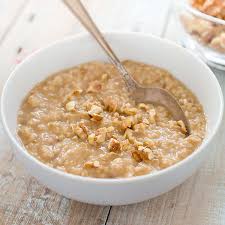
You leave your cold spoon in a hot bowl of oatmeal. What happens after an hour?
The temperature of both the oatmeal and the spoon stay the same
The spoon and the oatmeal become the same temperature
Only the temperature of the oatmeal will change
Only the temperature of the spoon will change
Heating will continue until what is reached?
Energizers
Equilibrium
Equality
Energy


Which statement is correct when V and W are at thermal equilibrium?
A 1.0 g sample of a cashew was burned in a calorimeter containing 1000. g of water, and the temperature of the water changed from 20.0°C to 25.0°C. In another experiment, a 3.0 g sample of a marshmallow was burned in a calorimeter containing 2000. g of water, and the temperature of the water changed from 25.0°C to 30.0°C. Based on the data, which of the following can be concluded about the energy content for 1.0 g of each of the two substances? (The specific heat of water is 4.2 J/(g⋅°C).)
The combustion of 1.0 g of cashew releases less energy than the combustion of 1.0 g of marshmallow.
The combustion of 1.0 g of cashew releases the same amount of energy as the combustion of 1.0 g of marshmallow.
The combustion of 1.0 g of cashew releases more energy than the combustion of 1.0 g of marshmallow.
No comparison can be made because the two systems started with different masses of food, different masses of water, and different initial temperatures.
NaOH(aq)+HCl(aq)→H2O(l)+NaCl(aq) A student is trying to determine the heat of reaction for the acid-base neutralization reaction represented above. The student uses 0.50 M NaOH and 0.50 M HCl solutions. Which of the following situations, by itself, would most likely result in the LEAST error in the calculated value of the heat of reaction?
The thermometer was incorrectly calibrated and read 0.5 Celsius degree too high during the procedure.
The volume of the acid solution added to the calorimeter was actually 1.0 mL less than what was recorded.
The calorimeter was poorly insulated, and some heat escaped to the atmosphere during the procedure.
The actual molarity of the base solution was 0.53 M but was recorded as 0.50 M.
Substance Specific Heat (J/(g⋅C∘)) Mass of Sample (g)
Fe(s) 0.46 1.0
Al(s) 0.91 1.0
Samples of Fe and Al are heated from 25∘C to 75∘C. Based on the information in the table above, the change in the average kinetic energy of the atoms in the samples is
higher for the Fe sample, because with its lower specific heat it absorbs more energy
higher for the Al sample, because with its higher specific heat it absorbs more energy
the same for both metal samples, because the initial and final temperatures are the same
the same for both metal samples, because the masses are equal
Which of the following is a list of the minimum amount of data needed for determining the molar enthalpy of solution of KCl(s) in pure H2O(l) ? (Assume that the KCl(aq) has the same specific heat capacity as pure water and that the initial temperatures of the KCl(s) and the water are the same.)
Mass of KCl(s), initial temperature of the water, and final temperature of the solution
Mass of H2O, initial temperature of the water, and final temperature of the solution
Mass of KCl(s), mass of H2O, initial temperature of the water, and final temperature of the solution
Mass of KCl(s), mass of H2O, initial temperature of the water, final temperature of the solution, and atmospheric pressure
Q= m c ∆T
The units for specific heat are:

If two objects have different temperatures when they come in contact, heat will flow from the warmer object to the cooler one UNTIL ____________
one reaches a temperature of zero
they both have an equal temperature
one runs out of energy
If the specific heat of water is 4.18 J/g∙°C, how much heat is required to increase the temperature of 1.2 kg of water from 23 °C to 39 °C? (show your work)
-80,256 J
80.256 J
80,256 J
-80.256 J
For a skillet, used for cooking, do you want a high or low specific heat
High, so that it will need more energy to heat up
Low, so that it will change temperature quickly
A piece of metal with a mass of 32.8 g is heated to 100.5°C and dropped into 138.2 g of water at 20.0°C. The final temperature of the system is 30.2°C. What is the specific heat capacity of the metal? (show your work)
What does "q" mean?
A measure of heat energy
A change in heat energy
A measure of kinetic energy
A change in temperature

What is the temperature of the metal cube when thermal equilibrium is achieved between the cube and the liquid?
The specific heat of water is 4.18 J/g°C.
If 980. J of energy is added to 6.20 g of water at 18.0 °C, what is the final temperature of the water?
37.8 °C
-19.8 °C
19.8 °C
55.8 °C
What does "ΔT" mean?
A change in health
A change in heat
A change in height
A change in temperature
In an experiment a student mixes a 50.0 mL sample of 0.100 M AgNO3(aq) with a 50.0 mL sample of 0.100 M NaCl(aq) at 20.0°C in a coffee-cup calorimeter. Which of the following is the enthalpy change of the precipitation reaction represented above if the final temperature of the mixture is 21.0°C? (Assume that the total mass of the mixture is 100. g and that the specific heat capacity of the mixture is 4.2 J/(g °C).) AgNO3+NaCl→AgCl(s)+NaNO3
−84 kJ/molrxn
−0.42 kJ/molrxn
0.42 kJ/molrxn
84 kJ/molrxn

The heating curve for a sample of pure ethanol is provided above. The temperature was recorded as a 50.0 g sample of solid ethanol was heated at a constant rate. Which of the following explains why the slope of segment T is greater than the slope of segment R?
The specific heat capacity of the gaseous ethanol is less than the specific heat capacity of liquid ethanol.
The specific heat capacity of the gaseous ethanol is greater than the specific heat capacity of liquid ethanol.
The heat of vaporization of ethanol is less than the heat of fusion of ethanol.
The heat of vaporization of ethanol is greater than the heat of fusion of ethanol.
In an insulated cup of negligible heat capacity, 50. g of water at 40.°C is mixed with 30. g of water at 20.°C. The final temperature of the mixture is closest to
22°C
27°C
30.°C
33°C
A pen lying on a table possesses potential energy.
TRUE
FALSE
If a person weighing 645 N climbs up a ladder to a height of 4.55 m, then what is the increase in gravitational potential energy?
2,935 J
645 J
45 J
28,790 J
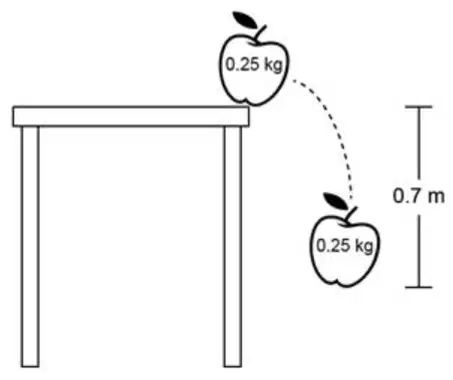
What is the change in gravitational potential energy of the apple if it falls the amount shown? Use g=9.81m/s² and round to the nearest hundredth.
1.72 J
0.70 J
0.25 J
0.18 J
If a monkey of mass 8 kg climbs up a tree and the tree is 10 meters high, then the potential energy of the monkey at the top of the tree will be 784 J.
TRUE
FALSE
A ball falls down 30 meters from the top of a building. If the ball weighed 1.2 kg, what is the gravitational potential energy lost by the ball? Estimate g as 9.81.
456 J
525 J
300 J
100 J
353 J
A stretched rubber band has potential energy.
TRUE
FALSE
If the length of a steel wire increases by 0.2 cm on stretching it with a force of 20 N, then the work done in stretching the wire is (a) .
Sasha lifts a couch from the ground floor of her house to the attic. If the couch has a mass of 120 kg and is lifted 8.2 m, then what is the energy gained by the couch?
9650 J
11856 J
1200 J
1000 J
If Sara has a mass of 60 kg and lives on the fifth floor of her apartment 18 m above the ground, then what is her gravitational potential energy?
177 J
589 J
10595 J
1000 J
The ability to move an electric charge from one point to another is
electrical kinetic energy
potential energy
electric potential energy
kinetic energy
What is the unit of measurement for potential energy?
Watts
Joules
Newtons
Meters
The acceleration due to gravity (on Earth) is _____
98 m/s2
9.8 m/s2
9.8 m/s
0.98 m/s
Which picture is NOT an example of Chemical PE?

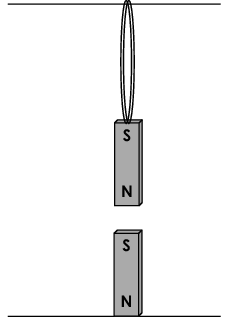
The upper magnet is hung from the top of a box with a rubber band.
The bottom magnet is held in place at the bottom of a box.
What THREE potential energies are affecting this attraction in the picture?
Gravitational, Electrical, Chemical
Gravitational, Elastic, Chemical
Magnetic, Elastic, Chemical
Gravitational, Magnetic, Elastic
How could you increase the gravitational potential energy of an object without changing its mass and gravity?
Make the object larger
Lower the object towards the ground
Raise the object farther off the ground
Allow the object to roll on the ground
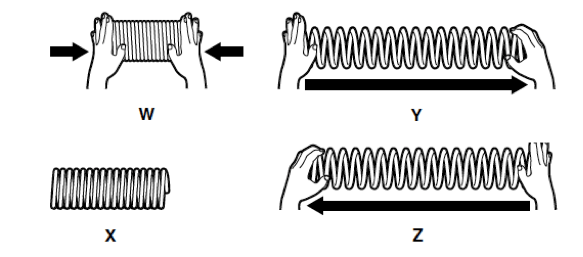
Elastic potential energy is energy stored in an object, such as a spring, due to the object being stretched or compressed. In which position is it most likely that the spring has lost its elastic potential energy?
W
Y
X
Z
Which 2 items does gravitational pull depend on?
Mass (weight)
Speed
Height / Distance from the ground
Force
True / False: The heavier an object is, the more potential energy the object has.
True
False

At which position does the child on the swing have the most gravitational potential energy?
W
X
Y
Z
Which object has elastic potential energy?
a hanging leaf
a burning coal
a rolling ball
a stretched bow

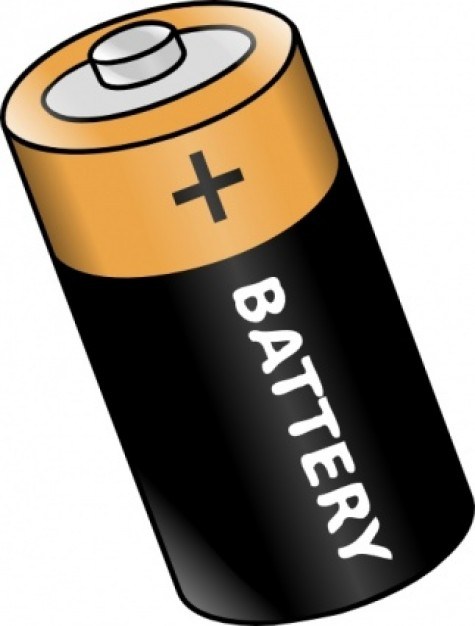
What type of potential energy does this automobile battery contain?
gravitational potential energy
elastic potential energy
chemical potential energy
kinetic potential energy
Explain what happens to the potential energy of a rock as it falls off the side of a cliff.
The kinetic energy decreases as the potential energy increases.
The kinetic energy decreases as the potential energy increases.
The potential energy decreases as the kinetic energy increases.
The potential energy decreases as the kinetic energy decreases.

How much energy is required to melt 64 g of methane at 90 K? (The molar mass of methane is 16 g/mol.)
0.24 kJ
3.8 kJ
33 kJ
60. kJ

A sample of CHCl3(s) was exposed to a constant source of heat for a period of time. The graph above shows the change in the temperature of the sample as heat is added. Which of the following best describes what occurs at the particle level that makes segment D longer than segment B?
The specific heat capacity of the liquid is significantly higher than that of the solid, because the particles in the liquid state need to absorb more thermal energy to increase their average speed.
The specific heat capacity of the solid is significantly higher than that of the gas, because the particles in the solid state need to absorb more thermal energy to increase their average speed.
The enthalpy of fusion is greater than the enthalpy of vaporization, because separating molecules from their bound crystalline state requires more energy than separating molecules completely from the liquid state.
The enthalpy of vaporization is greater than the enthalpy of fusion, because separating molecules completely from the liquid to form a gas requires more energy than separating molecules from their bound crystalline state to a liquid state.

A 2.00mol sample of C2H5OH undergoes the phase transition illustrated in the diagram above. The molar enthalpy of vaporization, ΔHvap, of C2H5OH is +38.6kJ/mol. Which of the following best identifies the change in enthalpy in the phase transition shown in the diagram?
+19.3kJ
+77.2kJ
−19.3kJ
−77.2kJ

The graph shows the temperature of a pure substance as it is heated at a constant rate in an open vessel at 1.0 atm pressure. The substance changes from the solid to the liquid to the gas phase. The substance is at its normal freezing point at time
t1
t2
t3
t4
t5
The graph shows the temperature of a pure substance as it is heated at a constant rate in an open vessel at 1.0 atm pressure. The substance changes from the solid to the liquid to the gas phase. Which of the following best describes what happens to the substance between t4 and t5?
The molecules are leaving the liquid phase.
The solid and liquid phases coexist in equilibrium.
The vapor pressure of the substance is decreasing.
The average intermolecular distance is decreasing.
The temperature of the substance is increasing.

The diagram above represents the melting of H2O(s). A 2.00mole sample of H2O(s) at 0°C melted, producing H2O(l) at 0°C. Based on the diagram, which of the following best describes the amount of heat required for this process and the changes that took place at the molecular level?
3.01 kJ of heat was absorbed to decrease the average speed of the water molecules in the liquid, which decreases the distance between molecules.
6.02 kJ of heat was absorbed to increase the number of hydrogen bonds between water molecules in the liquid compared to the solid.
12.0 kJ of heat was absorbed to decrease the polarity of the water molecules, which increases the density of the liquid compared to the solid.
12.0 kJ of heat was absorbed to overcome some of the hydrogen bonding forces holding the water molecules in fixed positions in the crystalline structure.
A molecular solid coexists with its liquid phase at its melting point. The solid-liquid mixture is heated, but the temperature does not change while the solid is melting. The best explanation for this phenomenon is that the heat absorbed by the mixture
is lost to the surroundings very quickly
is used in overcoming the intermolecular attractions in the solid
is used in breaking the bonds within the molecules of the solid
causes the nonbonding electrons in the molecules to move to lower energy levels
causes evaporation of the liquid, which has a cooling effect

The cooling curve above shows how the temperature of a sample varies with time as the sample goes through phase changes. The sample starts as a gas, and heat is removed at a constant rate. At which time does the sample contain the most liquid?
t1
t2
t3
t4
t5
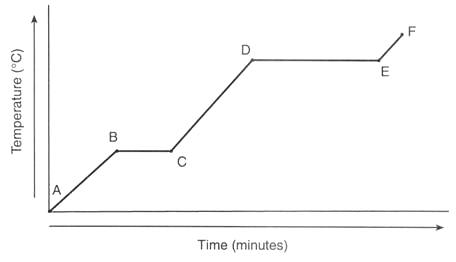
Between which points is the temperature of the substance remaining constant?
A-B only
A-B, C-D, and E-F
B-C only
B-C and D-E

The melting point of the sample is
-60 ºC
20 ºC
60 ºC
100 ºC

Which letter indicates where water is in both the solid and liquid phase at the same time?
A
B
C
D
E

In which region(s) does temperature increase?
Region C only
Regions B and D
Regions A, C, and E
Regions A and B
In a heating curve, diagonal lines indicate temperature is __________, while flat lines indicate temperature is __________.
Constant, changing
Changing, constant
Heat __________ depend on the amount of substance, while temperature __________.
Does not, does
Does, does not

NaCl was heated starting at an initial temperature of 0°C. The heating curve is shown in the picture. What is the melting point of this substance?
0°C
801°C
1000°C
1465°C

The reaction represented goes essentially to completion. The reaction takes place in a rigid, insulated vessel that is initially at 600 K
Which of the following statements about the bonds in the reactants and products is most accurate?
The sum of the bond enthalpies of the bonds in the reactant is greater than the sum of the bond enthalpies of the bonds in the products.
The sum of the bond enthalpies of the bonds in the reactant is less than the sum of the bond enthalpies of the bonds in the products.
The length of the bond between carbon and oxygen in CH3OH is shorter than the length of the bond between carbon and oxygen in CO.
All of the bonds in the reactant and products are polar.
Which of the following statements must be true for the combustion of CH4(g), represented by the equation? CH4(g)+2 O2(g)→CO2(g)+2 H2O(g) ΔH°<0
The bond dissociation energy between O atoms in O2 is greater than the sum of the bond dissociation energies of the two O−H bonds in H2O.
More bonds are formed in the products than are broken in the reactants.
The sum of the bond dissociation energies of the product molecules is EQUAL to the sum of the bond dissociation energies of the reactant molecules.
The sum of the bond dissociation energies of the product molecules is GREATER than the sum of the bond dissociation energies of the reactant molecules.
CO(g) + 2 H2(g) ⇄ CH3OH(g) ΔH < 0
The synthesis of CH3OH(g) from CO(g) and H2(g) is represented by the equation above. The value of Kc for the reaction at 483 K is 14.5.
Which of the following statements is true about bond energies in this reaction?
The energy absorbed as the bonds in the reactants are broken is greater than the energy released as the bonds in the product are formed.
The energy released as the bonds in the reactants are broken is greater than the energy absorbed as the bonds in the product are formed.
The energy absorbed as the bonds in the reactants are broken is less than the energy released as the bonds in the product are formed.
The energy released as the bonds in the reactants are broken is less than the energy absorbed as the bonds in the product are formed.

The oxidation of carbon monoxide can be represented by the chemical equation 2CO(g)+O2(g)→2CO2(g) . The table above provides the average bond enthalpies for different bond types. Based on the information in the table, which of the following mathematical expressions is correct for the estimated enthalpy change for the reaction?
ΔHrxn=[2(1072 molkJ)+(498 molkJ)]−2(799 molkJ)
ΔHrxn=[2(1072 molkJ)+(498 molkJ)]−4(799 molkJ)
ΔHrxn=[2(799molkJ)+(142molkJ)]−4(360molkJ)
ΔHrxn=[2(799molkJ)+(142molkJ)]−2(360molkJ)

Shown above are the equation representing the decomposition of H2O2(l) and a table of bond enthalpies. On the basis of the information, which of the following is the enthalpy of decomposition of 2 mol of H2O2(l) ?
−349kJ
−203kJ
203kJ
349kJ

An equation representing the dissociation of O2(g) and a table of bond enthalpies are shown above. Based on the information, which of the following is the enthalpy of dissociation for O2(g)?
−641kJ/mol
−495kJ/mol
495kJ/mol
641kJ/mol
CH4(g) + Cl(g) → CH3(g) + HCl(g) ΔH° = -14 kJ/molrxn
NH3(g) + Cl(g) → NH2(g) + HCl(g) ΔH° = -36 kJ/molrxn
H2O(g) + Cl(g) → OH(g) + HCl(g) ΔH° = + 40 kJ/molrxn
Based on the data above, what can be concluded regarding the strength of the C-H, N-H, and O-H bonds in the molecules shown?
The C-H bond is the strongest.
The N-H bond is the strongest.
The O-H bond is the strongest.
Nothing can be concluded without knowing the strength of the H- Cl bond.

A mixture of NO2(g) and N2O4(g) is placed in a glass tube and allowed to reach equilibrium at 70°C, as represented above.
Which of the following statements about ∆H° for the reaction is correct?
ΔH° < 0 because energy is released when the N−N bond breaks.
ΔH° < 0 because energy is required to break the N−N bond.
ΔH° > 0 because energy is released when the N−N bond breaks.
ΔH° > 0 because energy is required to break the N−N bond.

Based on the bond energies shown in the table above, which of the following diagrams best represents the change in energy as the reaction represented below proceeds?
H2(g)+ Cl2(g)→2HCl(g)


_____ Hydrogen-Hydrogen single bond/s are broken and _____ Carbon-Hydrogen single bond/s formed
6; 8
2; 8
2; 10
6; 10
_____ Carbon-Carbon single bond/s are formed
6
2
3
10
Bond enthalpy is the amount of energy is takes to break __________ of a bond.
one mole
one gram
the activation energy
the binding energy
Using bond energies to solve for enthalpy,
ΔH = Bond broken - bonds formed
undefined = Bond formed- bonds broken
undefined = products - reactants
undefined = reactants- products
H-H = 436
Cl-Cl = 242
H-Cl = 431
What is the enthalpy change for the decomposition of hydrogen chloride?
2 HCl --> H2 + Cl2

The average bond enthalpies for O-O and O=O are 146kJ/mol and 496kJ/mol respectively. Calculate the enthalpy change for the reaction shown.
-102kJ
+102kJ
+146kJ
-248 kJ
Breaking bonds is _________________. Forming bonds is ______________________
endothermic, exothermic
exothermic, endothermic


Using the reaction & table above, determine the change in energy and whether or not the reaction is endothermic or exothermic:
-2054 kJ endothermic
2023 kJ endothermic
-2023 kJ exothermic
2023 kJ exothermic

Use the bond energy data below to find the ΔH for
2H2O(g) ⟶ 2H2(g) + O2(g)
+480 kJ
-480 kJ
-440 kJ
+ 440 kJ
An equation representing the dissociation of O2(g) into two oxygen atoms, and a table of bond enthalpies are shown above. Based on the information, which of the following is the enthalpy of dissociation for O2(g)?
−641kJ/mol
−495kJ/mol
495kJ/mol
641kJ/mol
3 C2H2(g) → C6H6(g)
What is the standard enthalphy change ΔHo, for the reaction represented above?
(ΔHof of C2H2(g) is 230 kJ mol-1;
(ΔHof of C6H6(g) is 83 kJ mol-1;)
-607 kJ
-147 kJ
-19 kJ
+19 kJ
+773 kJ
A skier starts from rest at the top of a 45.0 m hill and coasts down a 30° slope into a valley, then continues up to the top of a 40.0 m hill. Assuming no friction, how fast will the skier be moving at the top of the 40.0 m hill?
4.6 m/s
9.9 m/s
2.5 m/s
3.6 m/s
The Law of Conservation of Energy states that the total energy of a system is always conserved. Is this statement:
TRUE
FALSE
A 0.5 kg ball is at the top of a ramp which is 8 meters high. How much kinetic energy does the ball have at the bottom of the ramp?
40 J
4 J
10 J
400 J
If an object is dropped from a certain height, does the total energy of that object keep decreasing until it becomes zero once it strikes the ground?
TRUE
FALSE
How fast will the skier be moving on the valley floor between two hills of heights 45.0 m and 40.0 m, assuming no friction and no effort into the motion?
24.8 m/s
12.4 m/s
9.9 m/s
4.6 m/s
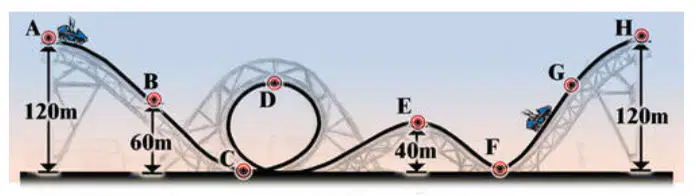
A roller coaster begins at rest 120 m above the ground, as shown in the diagram. Assuming no friction from the wheels and air, and that no energy is lost to heat, sound, and so on, the radius of the loop is 40 m. Is the speed of the roller coaster at points H close to zero?
TRUE
FALSE
If the velocity of an airplane is doubled, then its kinetic energy will increase by a factor of ____.
8
It will remain the same
4
2
If a 2.00 kg ball is thrown straight upward and its maximum height is 25.51 m, approximately how much potential energy does the ball possess when it reaches its maximum height?
200 J
500 J
100 J
400 J
A basketball player was falling to the ground after dunking the winning basket. At the end of her fall, she was falling at 4 m/s. If she was 60 kg, how much potential energy did she have at the top of her jump?
240 J
480 J
960 J
1200 J
What is the law of conservation of energy?
Energy can be transferred or transformed, but the total amount of energy remains constant.
Energy can be created and destroyed in chemical reactions.
Energy is always lost as heat in any transformation.
Energy can be stored indefinitely without any losses.

What energy transformations are occurring in this picture?
gravitational potential --> sound --> thermal
chemical potential --> mechanical --> elastic potential --> gravitational
electrical --> sound --> thermal --> radiant
chemical potential --> radiant --> thermal
The sum of kinetic and potential energy in an object that is used to do work.
Elastic Energy
Sound Energy
Magnetic Energy
Mechanical Energy

Which of the following best explains why an explosive charge in a cannon can cause a cannonball to fly out of the cannon with a high velocity?
because chemical potential energy can convert to gravitational potential energy
because chemical potential energy can convert to kinetic energy
because chemical potential energy can convert to sound energy
because chemical potential energy can convert to electric potential energy
As an object falls in a gravitational field, its speed increases. This is an example of potential energy transforming into what?
A.chemical potential energy
electrical potential energy
elastic potential energy
kinetic energy
Photosynthesis goes through two energy transformations. What are the transformations?
radiant
chemical
chemical
radiant
electrical
nuclear
radiant
sound
A hot air ballon goes through three energy transformations. What are the transformations?
chemical
thermal
mechanical
mechanical
thermal
chemical
chemical
mechanical
thermal
thermal
chemical
mechanical

What energy transformation occurs in the chameleon as it quickly launches its tongue to catch an insect?
Radiant --> Chemical
Thermal --> Chemical
Chemical --> Mechanical
Mechanical --> Chemical

Based on the information for two different reactions given above, which of the following gives the quantities needed to calculate the enthalpy change for the reaction represented by the overall equation below?
2NO(g)+O2(g)→N2O4(g)
ΔH1+ΔH2
ΔH1+(−ΔH2)
(−ΔH1)+ΔH2
ΔH1+(2×ΔH2)
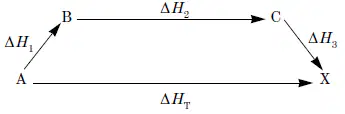
A → X
The enthalpy change for the reaction represented above is ΔHT. This reaction can be broken down into a series of steps as shown in the diagram:
A relationship that must exist among the various enthalpy changes is...
ΔHT – ΔH1 – ΔH2 – ΔH3 = 0
ΔHT + ΔH1 + ΔH2 + ΔH3 = 0
ΔH3 – (ΔH1 + ΔH2) = ΔHT
ΔH2 – (ΔH3 + ΔH1) = ΔHT
ΔHT + ΔH2 = ΔH1 + ΔH3
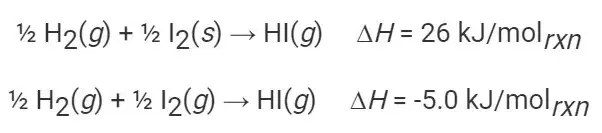
What is the enthalpy change for the sublimation of iodine, represented below?
I2(s) → I2(g)
15 kJ/molrxn
21 kJ/molrxn
31 kJ/molrxn
42 kJ/molrxn
62 kJ/molrxn

H2(g) + Cl2(g) ⇄ 2 HCl(g) Kp = 2 × 1030 at 298 K
HCl(g) can be synthesized from H2(g) and Cl2(g) as represented above. A student studying the kinetics of the reaction proposes the pictured mechanism.
What is the value of the enthalpy change per mole of HCl(g) produced?
−93 kJ
−121 kJ
−186 kJ
−242 kJ
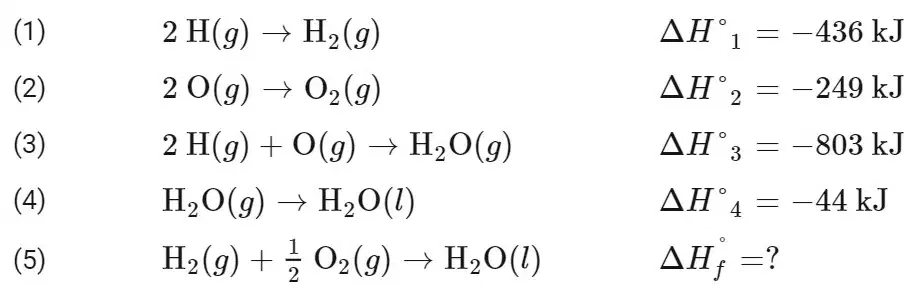
Based on the chemical equations and their associated enthalpy changes shown above, which of the following identifies the quantities needed to calculate ΔH°f, the standard enthalpy of formation of H2O(l), in kJ/mol?
2(−ΔH°1) + (−ΔH°2) + 2(ΔH°3) + 2(ΔH°4)
(−ΔH°1) + 1/2(−ΔH°2) + (ΔH°3) + (ΔH°4)
(−ΔH°1) + 1/2(ΔH°2) + (ΔH°3)
(ΔH°1) + 1/2(ΔH°2) + (ΔH°3) + (ΔH°4)
CS2(l)+2H2O(l)→CO2(g)+2H2S(g) ΔH°rxn=?
Which of the following combinations represents the individual reactions and the quantities needed to determine ΔH° for the overall reaction represented by the chemical equation above?


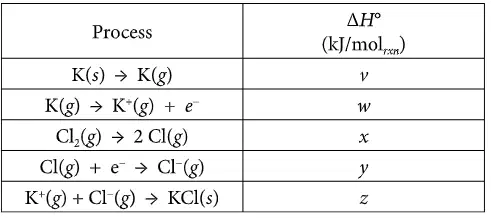
K(s)+ ½ Cl2(g) → KCl(s) ΔH° = -437kJ/molrxn
The elements K and Cl react directly to form the compound KCl according to the equation above. Refer to the information above and the table to answer the questions that follow.
Cl2(g) + 2e- → 2Cl-(g)
Which of the following expressions is equivalent to ΔHo for the reaction represented above?
x + y
x - y
x + 2y
x2−y
Using the equations below:
C(s) + O2(g) → CO2(g) ∆H = –390 kJ
Mn(s) + O2(g) → MnO2(s) ∆H = –520 kJ
what is ∆H (in kJ) for the following reaction?
MnO2(s) + C(s) → Mn(s) + CO2(g)
910
130
-130
-910
Using the equations below
Cu(s) + 1/2O2(g) → CuO(s) ∆H = –156 kJ
2Cu(s) + O2(g) → Cu2O(s) ∆H = –170 kJ
what is the value of ∆H (in kJ) for the following reaction?
2CuO(s) → Cu2O(s) + 1/2O2(g)
142
15
-15
-142
Consider the following equations.
Mg(s) + O2(g) → MgO(s) ∆H = –602 kJ
H2(g) + O2(g) → H2O(g) ∆H = –242 kJ
What is the ∆H value (in kJ) for the following reaction?
MgO(s) + H2(g) → Mg(s) + H2O(g)
-844
-360
+360
+844
The following equations show the oxidation of carbon and carbon monoxide to carbon dioxide.
C(s) +O2(g) → CO2(g) ΔH = –x kJ mol–1
CO(g) + O2(g) → CO2(g) ΔH = –y kJ mol–1
What is the enthalpy change, in kJ mol–1, for the oxidation of carbon to carbon monoxide?
C(s) + O2(g) → CO(g)
x + y
-x - y
y - x
x - y
Which of the following statements are true for the reaction:
SO2(g) + 1/2O2(g) ↔ SO3(g)
ΔH = –92 kJ mol-1
Where ↔ indicates that the reaction can proceed in the forward and the reverse direction.
The forward and reverse reaction both produce 92 kJ of energy.
Oxidizing 2 moles of SO2 would produce twice as much energy.
The reverse reaction has an enthalpy of +92 kJ mol-1.
Collecting the SO3 produced in the liquid state would not change the measured enthalpy.
The standard enthalpy change of formation values of two oxides of phosphorus are:
P4(s) + 3O2(g) → P4O6(s) ΔHf = –1600 kJ mol–1
P4(s) + 5O2(g) → P4O10(s) ΔHf = –3000 kJ mol–1
What is the enthalpy change, in kJ mol–1, for the reaction below?
P4O6(s) + 2O2(g) → P4O10(s)
+4600
+1400
–1400
–4600
The enthalpies of combustion of C(s), H2(g) and C4H9OH(l) (in kJmol-1) are as follows C(s) + O2(g) ---> CO2(g) ∆H=a H2(g) + ½O2(g) ---> H2O(l) ∆H=b C4H9OH(l) + 6O2(g) ---> 4CO2(g) + 5H2O(l) ∆H=c
What is the enthalpy change for the reaction shown below? 4C(g) + 5H2(l) + ½O2(g) ---> C4H9OH(l)
If N2 (g) + 2O2 (g) ⟶ 2NO2(g) has a ΔHrxn = 68, then what is the ΔHrxn if you reverse the reaction?
86 kJ
- 86 kJ
68 kJ
-68 kJ

How much energy is required to turn 1 mole of N2O4(g) into 2 moles N & 4 moles O(g)?
1933 kJ
-1875 kJ
- 1933 kJ
1875 kJ
Using the equations below:
C(s) + O2(g) → CO2(g) ∆H = –400 kJ
Mn(s) + O2(g) → MnO2(s) ∆H = –500 kJ
what is ∆H (in kJ) for the following reaction?
MnO2(s) + C(s) → Mn(s) + CO2(g) ∆H = ??? kJ
-900 kJ
900 kJ
–100 kJ
100 kJ
Using the equations below
Cu(s) + 1/2O2(g) → CuO(s) ∆H = –156 kJ
2Cu(s) + O2(g) → Cu2O(s) ∆H = –170 kJ
what is the value of ∆H (in kJ) for the following reaction?
CuO(s) → Cu(s) + 1/2O2(g) ∆H = ???? kJ
156 kJ
170 kJ
326 kJ
14 kJ
The standard enthalpy change of formation values of two oxides of phosphorus are:
P4(s) + 3O2(g) → P4O6(s) ΔHf = –1600 kJ mol–1
P4(s) + 5O2(g) → P4O10(s) ΔHf = –3000 kJ mol–1
What is the enthalpy change, in kJ mol–1, for the reaction below?
P4O6(s) + 2O2(g) → P4O10(s)
+4600
+1400
–1400
–4600
The following equations show the oxidation of carbon and carbon monoxide to carbon dioxide.
C(s) +O2(g) → CO2(g) ΔH = –x kJ mol–1
CO(g) + O2(g) → CO2(g) ΔH = –y kJ mol–1
What is the enthalpy change, in kJ mol–1, for the oxidation of carbon to carbon monoxide?
C(s) + O2(g) → CO(g)
x + y
-x - y
y - x
x - y
From the following data,
H2 (g) + Cl2 (g) → 2HCl(g) ΔH° = -185 kJ,
2H2 (g) + O2 (g) →2H2O(g) ΔH° = -484 kJ
calculate ΔH° for the following reaction.
4HCl(g) + O2 (g) →2Cl2 (g) + 2H2O(g)
299 kJ
-114 kJ
-299 kJ
114 kJ
Using the equation below:
C(s) + O2(g) → CO2(g) ∆H = –400 kJ
what is ∆H (in kJ) for the following reaction?
CO2(g) → C(s) + O2(g) ∆H = ?? kJ
+400 kJ
–400 kJ
4001 kJ
–800 kJ
Using the equations below:
Mn(s) + O2(g) → MnO2(s) ∆H = –500 kJ
what is ∆H (in kJ) for the following reaction?
MnO2(s) → Mn(s) + O2(g) ∆H = ??? kJ
+500 kJ
–500 kJ
5001 kJ
−5001 kJ
Using the equations below:
Mn(s) + O2(g) → MnO2(s) ∆H = –500 kJ
what is ∆H (in kJ) for the following reaction?
3 MnO2(s) → 3 Mn(s) + 3 O2(g) ∆H = ??? kJ
+ 500 kJ
–500 kJ
–1500 kJ
+ 1500 kJ
Using the equation below:
C(s) + O2(g) → CO2(g) ∆H = –400 kJ
what is ∆H (in kJ) for the following reaction?
4 CO2(g) → 4 C(s) + 4 O2(g) ∆H = ?? kJ
+400 kJ
–400 kJ
–1600 kJ
+ 1600 kJ
Consider the following equation:
2 Mg(s) + O2(g) → 2 MgO(s) ∆H = –1200 kJ
What is the ∆H value (in kJ) for the following reaction?
4 Mg(s) + 2 O2(g) → 4 MgO(s) ∆H = ??? kJ
-2400 kJ
+2400 kJ
-4800 kJ
4800 kJ
Using the equations below:
C(s) + O2(g) → CO2(g) ∆H = –400 kJ
Mn(s) + O2(g) → MnO2(s) ∆H = –500 kJ
what is ∆H (in kJ) for the following reaction?
MnO2(s) + C(s) → Mn(s) + CO2(g) ∆H = ??? kJ
-900 kJ
900 kJ
–100 kJ
100 kJ
Using the equations below
Cu(s) + 1/2O2(g) → CuO(s) ∆H = –156 kJ
2Cu(s) + O2(g) → Cu2O(s) ∆H = –170 kJ
what is the value of ∆H (in kJ) for the following reaction?
CuO(s) → Cu(s) + 1/2O2(g) ∆H = ???? kJ
156 kJ
170 kJ
326 kJ
14 kJ
The standard enthalpy change of formation values of two oxides of phosphorus are:
P4(s) + 3O2(g) → P4O6(s) ΔHf = –1600 kJ mol–1
P4(s) + 5O2(g) → P4O10(s) ΔHf = –3000 kJ mol–1
What is the enthalpy change, in kJ mol–1, for the reaction below?
P4O6(s) + 2O2(g) → P4O10(s)
+4600
+1400
–1400
–4600
The following equations show the oxidation of carbon and carbon monoxide to carbon dioxide.
C(s) +O2(g) → CO2(g) ΔH = –x kJ mol–1
CO(g) + O2(g) → CO2(g) ΔH = –y kJ mol–1
What is the enthalpy change, in kJ mol–1, for the oxidation of carbon to carbon monoxide?
C(s) + O2(g) → CO(g)
x + y
-x - y
y - x
x - y
From the following data,
H2 (g) + Cl2 (g) → 2HCl(g) ΔH° = -185 kJ,
2H2 (g) + O2 (g) →2H2O(g) ΔH° = -484 kJ
calculate ΔH° for the following reaction.
4HCl(g) + O2 (g) →2Cl2 (g) + 2H2O(g)
299 kJ
-114 kJ
-299 kJ
114 kJ
Using the equation below:
C(s) + O2(g) → CO2(g) ∆H = –400 kJ
what is ∆H (in kJ) for the following reaction?
CO2(g) → C(s) + O2(g) ∆H = ?? kJ
+400 kJ
–400 kJ
4001 kJ
–800 kJ
Using the equations below:
Mn(s) + O2(g) → MnO2(s) ∆H = –500 kJ
what is ∆H (in kJ) for the following reaction?
MnO2(s) → Mn(s) + O2(g) ∆H = ??? kJ
+500 kJ
–500 kJ
5001 kJ
−5001 kJ
Using the equations below:
Mn(s) + O2(g) → MnO2(s) ∆H = –500 kJ
what is ∆H (in kJ) for the following reaction?
3 MnO2(s) → 3 Mn(s) + 3 O2(g) ∆H = ??? kJ
+ 500 kJ
–500 kJ
–1500 kJ
+ 1500 kJ
Using the equation below:
C(s) + O2(g) → CO2(g) ∆H = –400 kJ
what is ∆H (in kJ) for the following reaction?
4 CO2(g) → 4 C(s) + 4 O2(g) ∆H = ?? kJ
+400 kJ
–400 kJ
–1600 kJ
+ 1600 kJ
Using the equations below:
Mn(s) + O2(g) → MnO2(s) ∆H = –500 kJ
what is ∆H (in kJ) for the following reaction?
3 Mn(s) + 3 O2(g) → 3 MnO2(s) ∆H = ??? kJ
+ 500 kJ
–500 kJ
–1500 kJ
+ 1500 kJ
Consider the following equation:
2 Mg(s) + O2(g) → 2 MgO(s) ∆H = –1200 kJ
What is the ∆H value (in kJ) for the following reaction?
4 Mg(s) + 2 O2(g) → 4 MgO(s) ∆H = ??? kJ
-2400 kJ
+2400 kJ
-4800 kJ
4800 kJ
Consider the following equation:
2 Mg(s) + O2(g) → 2 MgO(s) ∆H = –1200 kJ
What is the ∆H value (in kJ) for the following reaction?
2 MgO(s) → 2 Mg(s) + O2(g) ∆H = ??? kJ
-1200 kJ
+ 1200 kJ
12001 kJ
−12001kJ
Consider the following equation.
2 H2(g) + O2(g) → 2 H2O(g) ∆H = –500 kJ
What is the ∆H value (in kJ) for the following reaction?
4 H2(g) + 2 O2(g) → 4 H2O(g) ∆H = ??? kJ
–1000 kJ
+1000 kJ
+5001kJ
−5001kJ
Using the equations below:
C(s) + O2(g) → CO2(g) ∆H = –400 kJ
Mn(s) + O2(g) → MnO2(s) ∆H = –500 kJ
what is ∆H (in kJ) for the following reaction?
Mn(s) + CO2(g) → MnO2(s) + C(s) ∆H = ??? kJ
-900 kJ
900 kJ
–100 kJ
100 kJ

