wayground logo

Free Printable Worksheets

Font size

S
M
L
XL
Worksheets

CFA #3 Cell Transport & Homeostasis (16.3 & 16.4)

Total questions: 14

Worksheet time: 13mins
Name
Class
Date
1.
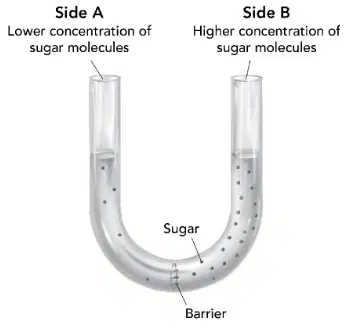
Elizabeth is conducting an investigation to study how molecules are transported into and out of a cell. Elizabeth builds a model of a cell using a U-shaped tube. A barrier, which is permeable to water, but not sugar, is placed on the bottom of the tube to model the cell membrane. Elizabeth adds two different solutions to each side of the tube. The solute in each solution is sugar and the solvent is water. The initial levels of solution in Side A and Side B are equal. The concentration of sugar in Side A is lower than the concentration of sugar in Side B. What is Elizabeth likely to observe?
a)
Water molecules will move from Side A to Side B. The solution level on Side A will fall and the solution level on Side B will rise.
b)
Water molecules will move from Side B to Side A. The solution level on Side A will rise and the solution level on Side B will rise.
c)
Sugar molecules will move from Side A to Side B. The solution level on Side A will fall and the solution level on Side B will rise.
d)
Sugar molecules will move from Side B to Side A. The solution level on Side A will rise and the solution level on Side B will fall.
2.
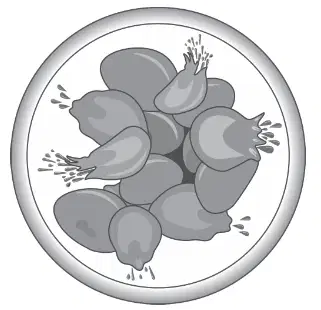
Wes places red blood cells in a petri dish with pure water and observes them under a microscope. He drew a model to illustrate his observations. What is the most likely explanation for Wes's observations?
a)
The red blood cells were placed into an isotonic solution. Water moved into and out of the cells to maintain homeostasis.
b)
The red blood cells were placed into an isotonic solution. Water moved into the cells until the cells burst.
c)
The red blood cells were placed in a hypertonic solution. Water moved from the inside of the cells to the outside of the cells to maintain homeostasis.
d)
The red blood cells were placed in a hypotonic solution. Water moved from the outside of the cells to the inside of the cells until the cells burst.
3.
The movement of matter across a cell membrane against a concentration difference is called ___________, and it requires (aquaporins / energy / homeostasis / osmotic pressure).
a)
active transport
b)
passive transport
c)
facilitated diffusion
d)
osmosis
4.
The movement of matter across a cell membrane against a concentration difference is called (active transport / passive transport / facilitated diffusion / osmosis), and it requires ____________.
a)
aquaporins
b)
energy
c)
homeostasis
d)
osmotic pressure
5.
Which represents the hierarchical organization of a multicellular organism, from least complex level to most complex level?
a)
cell, organ, organ system, tissue
b)
tissue, cell, organ, organ system
c)
cell, tissue, organ, organ system
d)
organ, cell, tissue, organ system
6.
In the human nervous system, the brain is an example of what level of organization?
a)
cell
b)
tissue
c)
organ system
d)
organ
7.
Cells in a large multicellular organism communicate with each other by chemical signals. These signals are passed from one cell to another. To receive and respond to a chemical signal, a cell must have a ____________ for that chemical.
a)
transmitter
b)
neuron
c)
receptor
d)
enzyme
8.
In the human digestive system, the stomach, pancreas, and intestines work together. Which of the following is an example of a tissue in the digestive system?
a)
the stomach
b)
smooth muscle that lines the stomach
c)
nerve cells in the stomach
d)
enzyme molecules in the stomach
9.
Osmosis is the movement of _____ across a membrane.
a)
food
b)
energy
c)
oxygen
d)
water
10.
Which cell is placed into a hypotonic environment? 
a)
A
b)
B
c)
C
d)
D
11.

You are a doctor. A patient comes in dehydrated. What type of solution would be best to place into their IV?

a)

A hypotonic solution to allow the cells to rehydrate.

b)

A slightly hypertonic solution to allow the cells to rehydrate.

c)

An isotonic solution to increase fluid in the body without causing harm to the cells.

d)

An isotonic solution to decrease fluid in the body without causing harm to the cells.

12.

Which red blood cell is in an isotonic solution?

a)

The one on the left

b)

The one on the right

c)

The one in the middle

d)

Each solution is isotonic

13.

Which cell is in a hypotonic solution?

a)

The one on the left

b)

The one on the right

c)

The one in the middle

d)

Each solution is hypotonic

14.

In which cell is the concentration of solute greater on the inside of the cell?

a)

The one on the left

b)

The one on the right

c)

The one in the middle

d)

The concentration of solute is the same for each solution