
 Worksheets
6.13 Analysis, calculation and results.
Total questions: 79
Worksheet time: 53mins
What is the purpose of understanding how material testing results are interpreted?
To improve material quality
To choose suitable materials for engineering applications
To reduce costs
To increase production speed
Material testing results are interpreted by plotting ______ graphs for different materials.
temperature/pressure
stress/strain
velocity/time
mass/volume
What is the act of applying a force to a material known as?
Stress
Loading
Strain
Deformation
Fill in the blank: The five forms of loading are compression, tension, shear, torsion, and _______.
Bending
Twisting
Stretching
Breaking
Which of the following is a reason for understanding how material testing results are interpreted?
To improve aesthetic design
To choose suitable materials for engineering applications
To reduce manufacturing costs
To increase product weight.
Fill in the blank: The force represented by the number 4 in the visualization is known as ______.
Compression
Tension
Shear
Torsion
Who discovered Hooke's Law?
Isaac Newton
Albert Einstein
Robert Hooke
Galileo Galilei
Hooke's Law states that the size or displacement of the deformation is directly proportional to the ______.
mass
volume
deforming force or load
temperature
What does Hooke's law mathematically express?
A) F = kX
B) F = -kX
C) F = k/X
D) F = X/k
In Hooke's law, the term 'k' represents the ______.
A) force
B) elongation
C) spring constant
D) mass
What is Young's modulus?
A measure of a material's elasticity
A type of metal
A unit of force
A method of testing temperature
Young's modulus is named after which eighteenth-century English physician and physicist?
Isaac Newton
Thomas Young
Michael Faraday
James Clerk Maxwell
What is Young's modulus a measure of?
The ability of a material to withstand changes in length under tension or compression
The ability of a material to conduct electricity
The ability of a material to resist heat
The ability of a material to absorb water.
Fill in the blank: The stress is the quotient of the tensile force divided by the ________.
cross-sectional area
volume
mass
density
What is the formula for Young's modulus?
stress/strain
force/area
mass/volume
velocity/time
Fill in the blank: The units of Young's modulus in the metric system are ______.
pounds per square inch
newtons per square metre
kilograms per cubic meter
joules per second
What is the formula for stress in materials?
σ=F/A
σ=A/F
σ=F*A
σ=F-A
Stress is defined as the ratio of the applied force to the cross-sectional area of the material it is applied to. Fill in the blank: Stress (σ) = ___ / A.
Force (F)
Area (A)
Pressure (P)
Volume (V)
What is strain defined as in material testing?
The change in dimension to the initial dimension
The initial dimension to the change in dimension
The ratio of the change in dimension to the initial dimension
The ratio of the initial dimension to the change in dimension.
Fill in the blank: The formula for calculating strain is ε=(l-__)/lo.
lo
l
ε
o
What is the first stage of a stress-strain curve for ductile materials?
Strain hardening region
Necking region
Linear elastic region
Fracture region
In the stress-strain curve, the strain hardening region occurs when the specimen is subjected to the maximum stress it can sustain, also known as the _______.
Yield strength
Ultimate tensile strength
Elastic limit
Fracture point
What is the most common method for plotting a stress-strain curve?
Using a tensile test
Using a compression test
Using a bending test
Using a shear test
In a tensile test, the force applied and the strain produced are recorded until a ______ occurs.
fracture
bend
twist
compression
What is the purpose of plotting stress/strain graphs for different materials?
To understand material properties
To determine color of materials
To measure temperature
To calculate weight
Fill in the blank: The original length of the material specimen used in the tensile test is ____ mm.
10
60
100
600
What is the point called where the material transitions from elastic to plastic behavior on a stress-strain curve?
Proportional limit
Yield point
Ultimate tensile strength
Fracture point
Fill in the blank: The point on the stress-strain curve where the material can withstand the maximum stress before necking is called the ________.
Proportional limit
Yield point
Ultimate tensile strength
Fracture point
What does the straight line on a stress-strain graph indicate about the material's behavior?
It follows Hooke's law
It exhibits plasticity
It has reached ultimate strength
It is at the rupture point.
The material exhibits plasticity beyond the ______.
yield strength
elastic limit
rupture point
ultimate strength
What is the purpose of plotting stress/strain graphs for different materials?
To determine the color of the material
To understand the material's elasticity
To choose suitable materials for engineering applications
To measure the weight of the material.
Fill in the blank: The stress-strain curve helps in understanding how material testing results are _______.
ignored
interpreted
forgotten
complicated
What does the green color represent in stress-strain curve interpretation?
A ductile material
A brittle material
A plastic material
A strong material.
Fill in the blank: The black color in stress-strain curve interpretation indicates a strong material which is not ______.
brittle
ductile
plastic
elastic
What does the orange color signify in stress-strain curve interpretation?
A brittle material
A strong material
A ductile material
A plastic material
Fill in the blank: The purple color in stress-strain curve interpretation represents a ______ material.
brittle
strong
ductile
plastic
What is the purpose of understanding how material testing results are interpreted?
To improve material quality
To choose suitable materials for engineering applications
To reduce costs
To increase production speed.
Material testing results are interpreted by plotting ______ graphs for different materials.
temperature/pressure
stress/strain
velocity/time
mass/volume

Which force is shown here?
Compression
Tension
Torsion
Shear

Which force is shown here?
Compression
Tension
Torsion
Shear

Which force is shown here?
Compression
Tension
Torsion
Shear

Which force is shown here?
Compression
Tension
Torsion
Shear

Which force is shown here?
Compression
Tension
Bending
Shear

Which type of structure is the Eiffel Tower?
Solid
Shell
Frame

Which type of structure is a helmet?
Solid
Shell
Frame
Select the natural structures;


Select the man-made structures;


Define the term 'stable'.
Long lasting
Able to support its own weight
Able to withstand deformation
Difficult to knock over

Name the structural element shown.
Beam
Cantilever
Strut
Truss

Name the structural element shown.
Tie
Beam
Strut
Gusset plate

Name the structural element shown.
Tie
Truss
Column
Strut

Name the structural element shown.
Beam
Truss
Column
Strut

Name the structural element shown.
Column
Truss
Gusset plate
Strut

Name the structural element shown.
Tie
Truss
Gusset plate
Strut
Select all those statements associated with 'triangulation'.
Using trusses
Making a structure more rigid
Torsion forces
Strengthening a structure
'Toughness' is associated with...
Static forces
Dynamic forces
Impacts
Diamonds
'Strength' is associated with...
Dynamic forces
Static forces
Impacts
Deformation
'Equilibrium' is associated with...
Dynamic forces
Forces that are balanced
Impacts
Stability
59-68.
Answer the questions below after watching the video
What does the typical stress-strain curve for a ductile material represent?
The ultimate tensile strength
The elastic limit
An approximation of the stress and strain
The actual stress and strain in the test piece
How is engineering stress defined?
Applied force divided by the instantaneous cross-sectional area
Applied force divided by the initial cross-sectional area
Change in length divided by the initial length
Change in length divided by the instantaneous length
What is a key difference between true stress-strain curves and engineering stress-strain curves?
True curves drop after necking
Engineering curves are always increasing
True curves are always increasing
Engineering curves do not show necking
Why do engineers often use engineering stress-strain curves instead of true stress-strain curves?
True stress-strain curves are easier to measure
True stress-strain curves are not useful in the elastic region
Engineering stress-strain curves are more accurate
Instantaneous cross-sectional area is difficult to measure
In which scenarios is it important to use true stress-strain curves?
When measuring the elastic limit
When dealing with large plastic deformation
When calculating the initial cross-sectional area
When analyzing small strain values
How is true stress calculated?
By dividing the change in length by the initial length
By dividing the change in length by the instantaneous length
By dividing the applied force by the instantaneous cross-sectional area
By dividing the applied force by the initial cross-sectional area
What assumption is made to calculate true stress from engineering stress?
The material is compressible
The cross-sectional area remains constant
The volume of the test piece remains constant
The length of the test piece remains constant
Why is the assumption of constant volume not valid after necking?
Because the material becomes compressible
Because the cross-sectional area changes significantly
Because the length of the test piece remains constant
Because the applied force decreases
What mathematical method is used to derive true strain?
Multiplication
Differentiation
Summation
Integration
What is another name for true strain?
Plastic strain
Logarithmic strain
Ultimate strain
Elastic strain
Toughness is best defined as the
energy absorbed by a material without yielding.
area underneath the stress-strain graph up to the yielding point
energy absorbed by a material without fracturing
ability of a material to resist deformation.
A material’s toughness is equal to the area under which part of the stress-strain curve.
Elastic
Plastic
Both
None
Hooke's law holds true up until the
yield point
proportional limit
breaking point
elastic limit
An applied load on a wire causes its radius to double. Determine the effect this will have on the Young’s modulus.
Doubled
Halved
Quadrupled
No effect
The tensile strength of a material is obtained by dividing the maximum load during the test by the
minimum area after fracture
area at the time of fracture
original cross-sectional area
average of (b) and (c)
If a part is heated and its movement is restricted, what stress will it experience as a result
no stress
tensile stress
shear stress
compressive stress
What can we deduce about a material if a test piece returns to its original shape after the load has been removed?
It is plastic
It is elastic
It does not obey Hooke’s Law
It has high stiffness
A material that does not give any indication of deformation when a stress is applied is known as a
composite
brittle material
polymer
ductile material
Factor of safety for a ductile material is the ratio of
Ultimate stress to working stress
Ultimate stress to yield stress
Yield stress to working stress
Breaking stress to working stress
For metals which have a progressive yield point, the proof stress is determined by drawing a line parallel to the elastic region at a strain of
0.2 %
0.5 %
1 %
2 %
What changes occur to a mild steel specimen after it has undergone tensile testing?
Cross sectional area decreases, Gauge length increases
Cross sectional area increases, Gauge length decreases
Cross sectional area increases, Gauge length increases
Cross sectional area decreases, Gauge length decreases
True stress is defined as the:
Force divided by the original cross-sectional area
Young’s modulus divided by the strain
Force divided by the cross-sectional area at that point in time
Force multiplied by the cross-sectional area
In a brittle material, which two stresses are used to calculate the factor of safety (FOS)?
Working and yield
Working and UTS
Bending and compressive
Yield and UTS
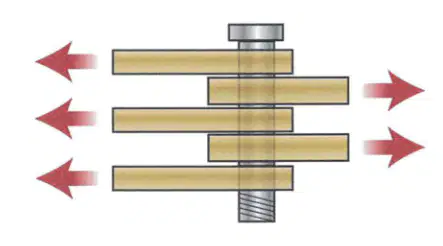
The diagram below shows a steel bolt undergoing a particular shearing stress. What type of shear stress is the bolt experiencing?
Single
Double
Triple
Quadruple
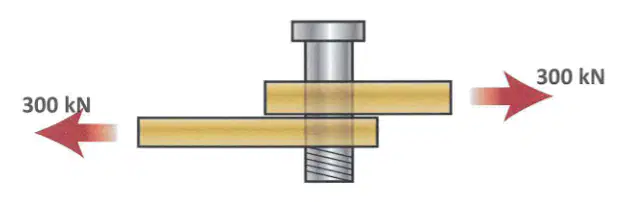
A 300 kN force is applied to the plates as shown below. The shear stress in the ϕ25 mm diameter bolt is closest to:
12 MPa
153 MPa
306 MPa
611 MPa
A Uniformly Distributed Load (UDL):
has the same magnitude along the beam.
has the same SFD and BMD shape when concentrated loads are placed along the length of the beam
changes uniformly in magnitude along the beam
has no effect on calculations on a simple beam

A 5 mm thick metal plate has a hole punched through it. Determine the force required to punch the hole if the ultimate shear stress of the plate is 750 MPa.
674 kN
94 kN
471 kN
4712 kN
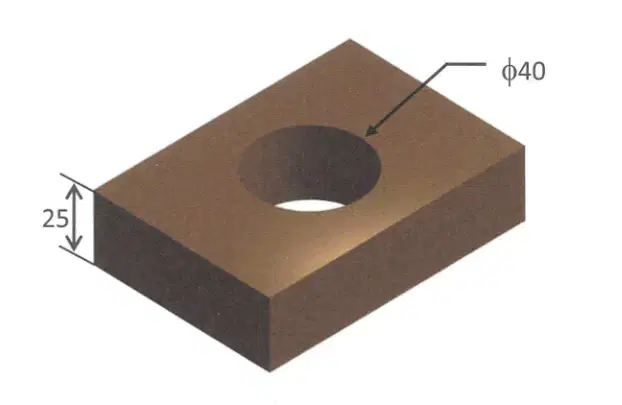
The ultimate shear stress of the metal plate is 250 MPa. Calculate the force that is needed to punch the hole.
785 kN
314 kN
250 kN
7854 kN

A shear force diagram for a loaded beam is drawn below. Which point of the beam will the maximum bending moment occur?
A
B
C
D
E
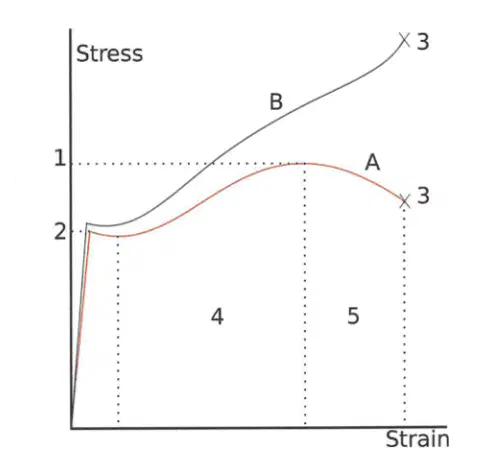
Based on the diagram below, determine which label is correct.
A - True stress-strain curve & 5 - Toughness
A - Engineering stress-strain curve & 5 - Toughness
B - True stress-strain curve & 5 - Necking occurs
B - Engineering stress-strain curve & 5 - Necking occurs

