
Font size
 Worksheets
Bechmark
Total questions: 70
Worksheet time: 41mins
Which scientist is credited with the discovery of the electron, leading to the development of the atomic model?
Niels Bohr
J.J. Thomson
Ernest Rutherford
James Chadwick
Explain how the periodic table is organized to help predict the chemical properties of elements.
By atomic mass
By atomic number and electron configuration
By alphabetical order
By color
Describe the main postulate of the kinetic molecular theory regarding the motion of particles in a gas.
Particles are stationary
Particles move in random, constant motion
Particles move in a fixed pattern
Particles do not interact with each other
How did the discovery of isotopes challenge the original concept of the atomic model?
It showed that atoms are indivisible
It demonstrated that atoms of the same element can have different masses
It proved that electrons orbit in fixed paths
It confirmed that atoms are mostly empty space
Which element is most likely to form a positive ion based on its position in the periodic table?
Neon (Ne)
Sodium (Na)
Chlorine (Cl)
Argon (Ar)
Predict what happens to the pressure of a gas if the temperature is increased while the volume remains constant.
Pressure decreases
Pressure remains the same
Pressure increases
Pressure fluctuates
What was the major contribution of Niels Bohr to the atomic theory?
Discovery of the neutron
Development of the planetary model of the atom
Discovery of the electron
Development of the quantum mechanical model
How can the periodic table be used to determine the reactivity of an element?
By its color
By its position in a group or period
By its atomic mass
By its density
Using the kinetic molecular theory, explain why gases are compressible while solids are not.
Gas particles are far apart, while solid particles are closely packed
Gas particles are stationary, while solid particles move freely
Gas particles are larger than solid particles
Gas particles are heavier than solid particles
Which of the following elements is a noble gas?
Oxygen (O)
Nitrogen (N)
Helium (He)
Hydrogen (H)
How did the gold foil experiment conducted by Ernest Rutherford change the atomic model?
It confirmed the existence of electrons
It led to the discovery of the nucleus
It proved that atoms are indivisible
It showed that electrons are in fixed orbits
What is the relationship between temperature and the kinetic energy of particles in a substance?
As temperature increases, kinetic energy decreases
As temperature increases, kinetic energy remains constant
As temperature increases, kinetic energy increases
As temperature decreases, kinetic energy increases
What is the primary reason for the periodic trends observed in the periodic table?
Changes in density
Changes in atomic mass
Changes in atomic number
Changes in electron configuration
Which of the following best describes the concept of atomic radius?
The distance from the nucleus to the outermost electron
The distance between the nucleus and the first electron shell
The distance between two nuclei in a molecule
The size of the nucleus
How does the kinetic molecular theory explain the increase in pressure of a gas when its volume is decreased at constant temperature?
Particles move at the same speed and collide less frequently
Particles move faster and collide more frequently
Particles move at the same speed but collide more frequently
Particles move slower and collide less frequently
What is the significance of electron configuration in determining the chemical properties of an element?
It changes the element's density
It affects the element's atomic mass
It influences the element's reactivity and bonding behavior
It determines the element's color
Which of the following statements best describes the relationship between atomic number and the periodic table?
Atomic number increases from right to left across a period
Atomic number decreases down a group
Atomic number remains constant across a period
Atomic number increases from left to right across a period
How does the kinetic molecular theory explain the behavior of particles in a liquid compared to a gas?
Particles in a liquid are stationary, while particles in a gas move freely
Particles in a liquid move more freely than in a gas
Particles in a liquid are closely packed but can slide past each other, while particles in a gas are far apart and move freely
Particles in a liquid are more energetic than in a gas
What is the primary factor that determines the state of matter of a substance at a given temperature and pressure?
The atomic number of the substance
The kinetic energy of the particles
The density of the substance
The color of the substance
Which of the following best explains why metals are good conductors of electricity?
Metals have a shiny appearance
Metals have a high atomic mass
Metals have free electrons that can move easily
Metals have a high melting point
How does the kinetic molecular theory describe the behavior of particles in a solid?
Particles in a solid are stationary and do not move
Particles in a solid are closely packed and vibrate in place
Particles in a solid move in random, constant motion
Particles in a solid move freely and are far apart
What is the significance of the periodic law in the organization of the periodic table?
It arranges elements by increasing atomic mass
It arranges elements by increasing atomic number
It arranges elements by alphabetical order
It arranges elements by decreasing atomic number
Which of the following best explains why nonmetals are poor conductors of electricity?
Nonmetals have a shiny appearance
Nonmetals have tightly bound electrons that do not move freely
Nonmetals have a high melting point
Nonmetals have a high atomic mass
How does the concept of electronegativity relate to the periodic table?
Electronegativity remains constant across a period
Electronegativity increases from left to right across a period
Electronegativity increases from top to bottom in a group
Electronegativity decreases from left to right across a period
What is the primary reason gases expand to fill their containers according to the kinetic molecular theory?
Gas particles move in random, constant motion
Gas particles are attracted to the container walls
Gas particles are heavier than air
Gas particles are stationary
How does the kinetic molecular theory explain the effect of temperature on the volume of a gas at constant pressure?
As temperature increases, gas particles move slower, decreasing volume
Temperature has no effect on the volume of a gas
As temperature increases, gas particles move faster, increasing volume
As temperature decreases, gas particles move faster, increasing volume
According to the kinetic molecular theory, what happens to the speed of gas particles as the temperature decreases?
The speed of gas particles becomes unpredictable
The speed of gas particles remains constant
The speed of gas particles decreases
The speed of gas particles increases
According to the kinetic molecular theory, what is the effect of increasing the temperature on the pressure of a gas if the volume is kept constant?
Pressure decreases
Pressure remains constant
Pressure fluctuates randomly
Pressure increases
What does the kinetic molecular theory suggest about the motion of particles in a gas compared to a liquid?
Gas particles move in a fixed pattern, while liquid particles are stationary
Gas particles are stationary, while liquid particles move freely
Gas particles are closely packed and vibrate in place, while liquid particles move freely
Gas particles move freely and are far apart, while liquid particles are closely packed but can slide past each other
How does the kinetic molecular theory explain the compressibility of gases?
Gas particles are closely packed, making them compressible
Gas particles are far apart, allowing them to be compressed
Gas particles are stationary, which makes them compressible
Gas particles are heavier than solid particles, making them compressible
What is the primary reason gases expand to fill their containers?
Gas particles move in random, constant motion
Gas particles are attracted to each other
Gas particles are heavier than liquid particles
Gas particles are stationary
Which of the following best explains why the boiling point of a substance is higher at higher pressures?
Higher pressure decreases the temperature of the substance
Higher pressure increases the attraction between particles
Higher pressure decreases the space between particles
Higher pressure increases the kinetic energy of particles
According to the kinetic molecular theory, what happens to the volume of a gas when the pressure is increased at constant temperature?
Volume fluctuates randomly
Volume decreases
Volume remains constant
Volume increases
What is the primary reason for the periodic trends observed in atomic size across a period?
Increase in nuclear charge
Decrease in nuclear charge
Increase in the number of electron shells
Decrease in the number of electron shells
Which of the following best explains the concept of ionization energy?
The energy released when an electron is removed from a neutral atom
The energy released when an electron is added to a neutral atom
The energy required to remove an electron from a neutral atom
The energy required to add an electron to a neutral atom
How does the kinetic molecular theory explain the diffusion of gases?
Gas particles are attracted to each other, causing them to mix
Gas particles move in fixed paths, leading to diffusion
Gas particles are stationary, allowing them to mix
Gas particles move randomly and spread out to fill available space


How many protons are in Sodium (Na)?
22.99
19
11
3

How many protons are in the element Nitrogen?
7
14.01
21.01
Nitrogen doesn't have protons


For Fluorine, the atomic number is nine. The mass number is 19. How many neutrons in one atom of Fluorine?
9
7
19
10


Atoms are made up of ________________
energy
electrons
subatomic particles
gasses

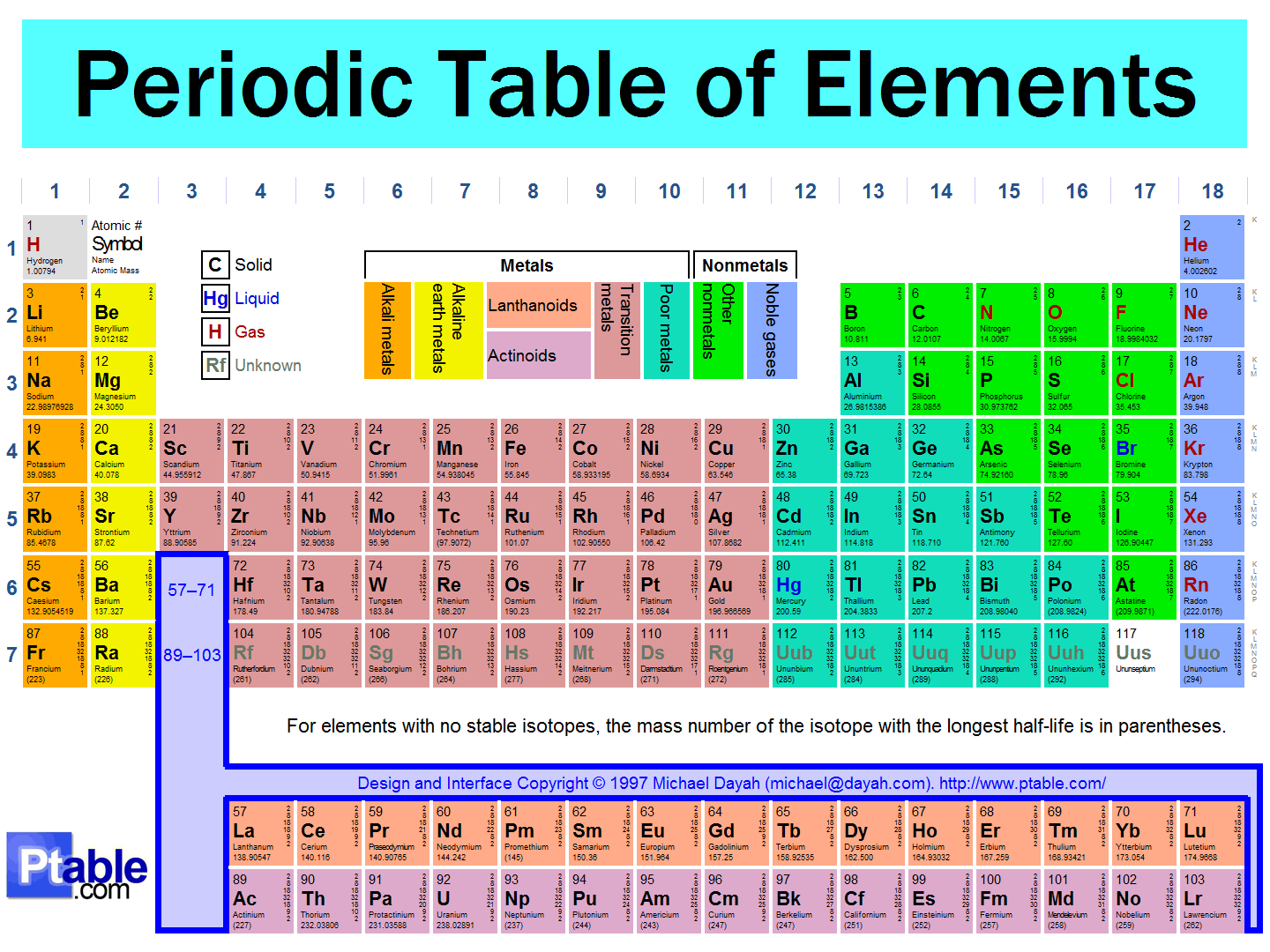
What Period is this element in?
The (a) -molecular (b) of matter is a theory that explains the (c) of particles in (d) based on the idea that particles of matter are always in (e)
The more energy that particles have, the ___ they move.
slower
faster
How do we measure an increase in kinetic energy?
volume
temperature
Liters
none of the above
Match the following
Invisible pieces that make up all matter.
Particles
Made up of protons, neutrons, and electrons.
Atoms
On the left side of the chemical reaction.
Reactants
On the right side of the chemical reaction.
Products
Substance made of one type of atom.
Element
What is a group of atoms joined together in a particular way?
Substance
Atoms
Molecule
Extended structure
two or more different types of atoms combined together
atom
element
electron
compound
Samuel is observing the behavior of particles in different states of matter. Analyze the relationship between the kinetic energy of particles and the state of matter they are in.
Particles in a solid have the highest kinetic energy.
Particles in a gas have the highest kinetic energy.
Particles in a liquid have the highest kinetic energy.
All states of matter have the same kinetic energy.
Matter that is composed of only one kind of atom is
lonely
proton
element
quark
two or more different types of atoms combined together
atom
element
electron
compound
Take in electrons when they form compounds
metal
nonmetal
metalloid
(a) is a liquid non-metal
The most pure substances that can be found, made of only one type of atom
elements
atoms
molecules
compounds
Which of the following is a physical property that can be used to identify a pure substance?
Color change in a chemical reaction
Ability to conduct electricity
Reactivity with acid
Boiling point
What is a chemical property that can help identify a pure substance?
Flammability
Solubility
Melting point
Density
Which of the following statements is true about pure substances?
They can be separated into components by physical means
They have variable composition
They are always mixtures of different elements
They have consistent chemical and physical properties
Which of the following properties is most useful in identifying a pure substance?
Volume
Melting point
Shape
Color
How can the boiling point of a substance help in determining its purity?
A pure substance does not boil
A pure substance has a fixed boiling point
A pure substance has a variable boiling point
A pure substance boils at room temperature
Which of the following is a chemical property that can help identify a pure substance?
Reactivity with acid
Density
Boiling point
Color
What is a physical change that a pure substance can undergo?
Burning
Melting
Decomposing
Rusting
Which of the following is an example of a chemical change in a pure substance?
Boiling water
Freezing water
Iron rusting
Breaking glass
How does a chemical change affect the properties of a pure substance?
The substance becomes a mixture
The substance retains its original properties
The substance changes its state but not its properties
The substance changes into a new substance with different properties
What is a physical change in a pure substance?
A change that involves the breaking of chemical bonds
A change that alters the chemical composition of the substance
A change that results in the formation of a new substance
A change that affects the physical properties without altering the chemical composition
Which of the following is an example of a chemical change in a pure substance?
Melting of ice
Boiling of water
Freezing of water
Rusting of iron
How can a chemical change be identified in a pure substance?
By a change in state from solid to liquid
By a change in color, temperature, or the formation of a gas or precipitate
By a change in shape or size
By a change in mass

