
 Worksheets
7th Grade Review
Total questions: 36
Worksheet time: 36mins
The process in which organisms that are better adapted to their environment tend to survive and produce more offspring
Ecology
Evolution
Natural Selection
Charles Darwin
Although all dogs are descendants of the wolf, the use of _____________ has allowed humans to drastically alter the appearance of dogs.
Artificial Selection
Natural Selection
Evolution
Phylogeny
Any characteristic that helps a plant or animal survive
Adaptation
Mimicry
Niche
Species
Organisms that possess heritable traits that enable them to better adapt to their environment compared with other members of their species will be more likely to __________, reproduce, and pass more of their genes onto the next generation
survive
go extinct
die
evolve
The presence of differences in sequences of genes between individual organisms of a species. It enables natural selection, one of the primary forces driving the evolution of life.
Evolution
Adaptation
Genetic Variation
DNA replication
The changes over time in the inherited traits of a type of organism are __.
growth
biogenesis
spontaneous generation
evolution
When a species cannot adapt to a new environment, the species may become ______.
extinct
evolved
mutated
genetic variant
Which statement is the most accurate:
Organisms develop at similar rates because they share a common ancestor.
Organisms that share certain embryonic structures share a common ancestor.
Organisms that are more closely related develop faster due to sharing a common ancestor.
In which kind of rock do we usually find a fossil?
sedimentary rock
metamorphic rock
igneous rock


What are the oldest fossils and why?
B, C- because they are closest to the top
A, B- because they are closest to the bottom
They are all the same age- because they are all found on layer 2
A, B- because they are found closest to the top

Fossil A is an ancient mollusk, an organism that needs water to survive. Why do you think that the mollusk went extinct in this particular sample of the fossil record?
When the ocean levels rose in layer 4, the mollusk went extinct because they cannot live in water
For some reason, the ocean disappeared causing the mollusk to thrive
For some reason, the ocean disappeared causing the mollusk to go extinct
When the ocean level rose in layer 4, the mollusk thrived because they need water

What do we call structures that no longer perform their original function?
Natural Selection
Analogous Structure
Vestigial Structure
Homologous Structure

Select ALL that show evidence of evolution.
DNA
mutations
fossils
skeletal structures

What do you call different structures with a similar function but NO common ancestor?
Natural Selection
Analogous Structure
Vestigial Structure
Homologous Structure

What do you call similar structures that related species have inherited from a common ancestor?
Natural Selection
Analogous Structure
Vestigial Structure
Homologous Structure
The physical expression of a trait is called the ...
genotype
phenotype

Cross 2 heterozygous tall pea plants. Tall (T) is dominant to short (t). What fraction of the offspring do you predict will be tall?
1/4
2/4
3/4
4/4

In humans, freckles (F) on the skin are dominant to no freckles (f). If a heterozygous parent and a recessive parent conceive, what is the chances of having a child with NO FRECKLES?
0%
50%
100%

A Punnett square is a (a) that allows you to easily determine the expected (b) of different (c) in the (d) of two parents. An example of a Punnett square for pea plants is shown here. In this example, both parents are (e) for flower color (Pp).

An inherited trait that helps those organisms that have it to survive
niche
structure
characteristic
adaptation

The possible cause for the finches on the Galapagos Islands to have beaks that are different from the finches living on the south american mainland?
mainland finches built different nests.
there were different types of food available on the island
all the different types of predators living on the island
some were salt water finches

Which mice are better suited for their environment?
Top 2 mice.
Bottom 2 mice.
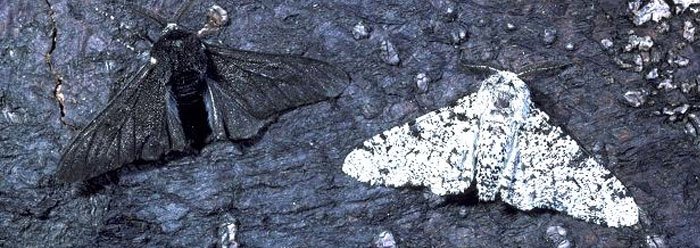
The trees these moths used to live on were white, but have been covered in soot(pollution) from coal factories. Which moth will be more successful in this environment?
Dark moth
Light moth
Both will be equally successful
Neither will be successful
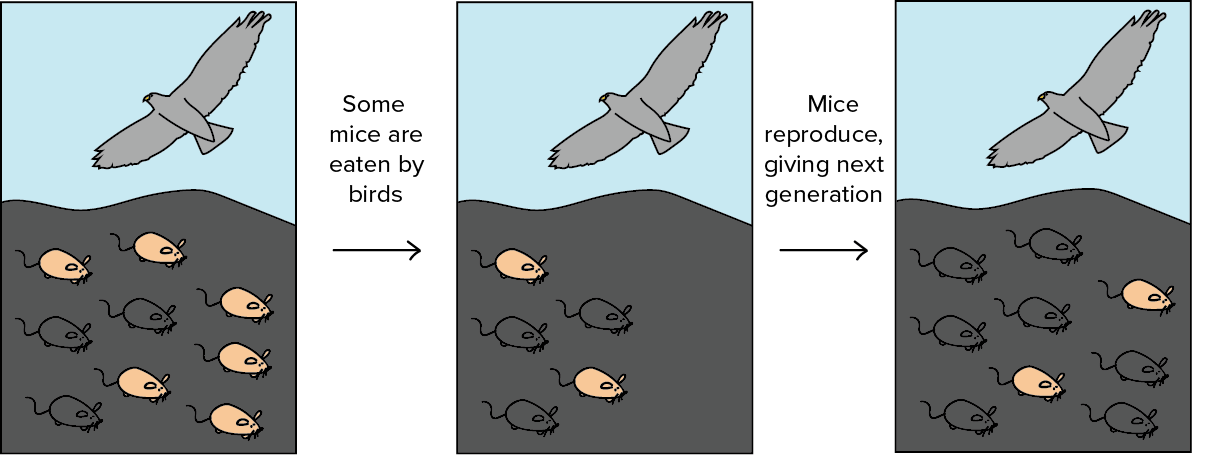
Why is the mouse population changing over time?
The light mice can reproduce more successfully than the dark mice
The hawks eat more dark mice than light mice because the dark mice taste better
The hawks eat more light mice than dark mice because they can see the light mice more easily
The hawks eat more dark mice than light mice because they can see the dark mice more easily

This picture shows how a scientist how a scientist might use this type of data to decide if an animal is closely related or not.
Comparing the anatomy of a living animal to an extinct one
Comparing the DNA of a living animal to another living animal
Comparing the anatomy of a living animal to another living animal
Comparing the development of one living animal to another

The graphs below show the changes in crab color at one beach.
Which of the following is most likely to have caused the change in the distribution?
A new predator arrived that preferred dark-tan crabs.
A new predator arrived that preferred light-tan crabs.
A change in beach color made medium-tan crabs the least visible to predators.
A change in beach color made medium-tan crabs the most visible to predators.

The figure shows how natural selection of a single-trait gene affects lizard survival.
Which of the following most likely causes the changes in allele distribution?
The allele for light gray coloration disappears from the population. This may be because light gray lizards are more visible to predators and therefore they might be less likely to survive and reproduce.
The allele for black coloration decreases fitness and becomes less common. This may be because black coloration keeps the lizards cool during hot summer temperatures.
Medium gray coloration in lizards appears to be a neutral mutant allele that allows the lizards to hide better from predators. This leads to increases in phenotype and allele frequency of gray coloration.
Because black and medium gray lizards are less visible to predators, these alleles are neutral to natural selection and therefore will not disappear from the population of lizards.

What is the most likely explanation of the data shown below?
There has been a drought in the area that is affecting all life forms.
The population of natural predators of the moths has gotten smaller.
The moths are living in an environment with light trees.
The moths are living in an environment with dark trees.

The pair of population graphs below display the results of two different five-year hunting cycles, one on light trees and one on dark trees. The population of light-colored moths is shown by the light gray dots, and the population of dark moths is shown by the dark gray dots. How do these results demonstrate natural selection?
The moth populations shown here demonstrate random fluctuations over time that are not explained by tree color.
On light trees, individual moths tried to become lighter in color to match the tree background. On dark trees, individual moths tried to become darker in color.
The moths that were the same color as their background were more likely to survive and reproduce. Over time, the populations of these well-adapted moths increased.
Small particles of tree bark became embedded in the moth’s wings, causing the moths to become darker on the dark trees and lighter on the light trees. These acquired traits were then passed down to the next generation of moths, causing the populations to change color over time.

