Wayground logo

Free Printable Worksheets

Font size

S
M
L
XL
Worksheets

Unit 3 Motion Exam review

Total questions: 40

Worksheet time: 29mins

Name
Class
Date
1.

is measured along the shortest path connecting them

a)

distance

b)

displacement

c)

unit

d)

variable

2.

has only magnitude

a)
Scalar
b)
Force
c)
Vector
d)
Acceleration
3.

is measured by the complete path it takes to get from one point to another.

a)
Distance
b)
Area
c)
Time
d)
Speed
4.

anything that changes

a)
Constancy
b)

unit

c)
Stability
d)

variable

5.

50 feet up

a)

scalar

b)

vector

c)

unit

6.

Mrs. Vaughn drove west 17 miles to the store. Then, she drove 2 miles east to the gym. what distance did she drive?

a)
19 miles
b)
20 miles
c)
15 miles
d)
25 miles
7.

An object that changes position relative to a reference point is

a)
a reference point
b)

in motion

c)
an object at rest
d)
a stationary object
8.

On a distance vs. time graph of an object’s motion, distance is usually

a)
on the horizontal axis (x-axis)
b)
on the diagonal axis
c)
not represented on the graph
d)
on the vertical axis (y-axis)
9.

Average speed can be represented by the mathematical expression

a)
Average Speed = Total Distance + Total Time
b)
Average Speed = Distance x Time
c)
Average Speed = Total Time / Total Distance
d)

Average Speed = Distance /Time

10.

A baseball is pitched with a speed of 55 m/s. How long does it take the ball to travel 21 m from the pitcher’s mound to home plate?

a)
0.25 seconds
b)
0.38 seconds
c)
0.50 seconds
d)
0.60 seconds
11.

A cross-country runner runs northwest 6.2 km/hr in 1.5 hours. What is his distance

a)
7.5 km
b)
10.2 km
c)
9.3 km
d)
8.0 km
12.

A deer can run a distance of 174 m in 4.65 s at its top speed. What is the deer's top speed?

a)
25.0 m/s
b)
37.4 m/s
c)
45.2 m/s
d)
30.1 m/s
13.

a)

return to start

b)

acceleration or speeding up

c)

deacceleration or slowing down

d)

constant speed

14.

a)

constant speed

b)

acceleration or speeding up

c)

deacceleration or slowing down

d)

at rest or stationary

15.

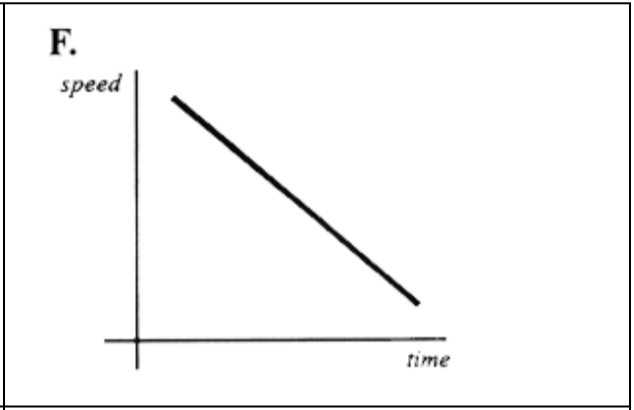
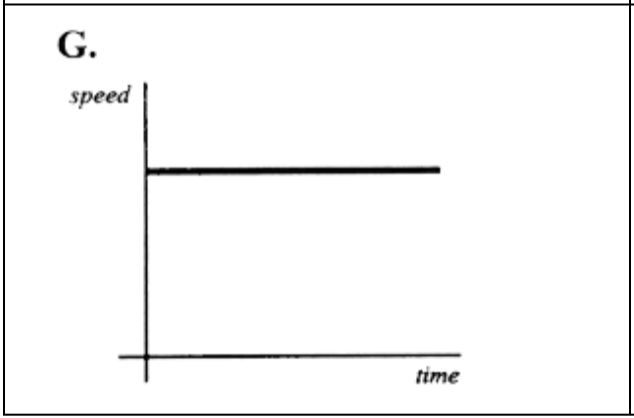
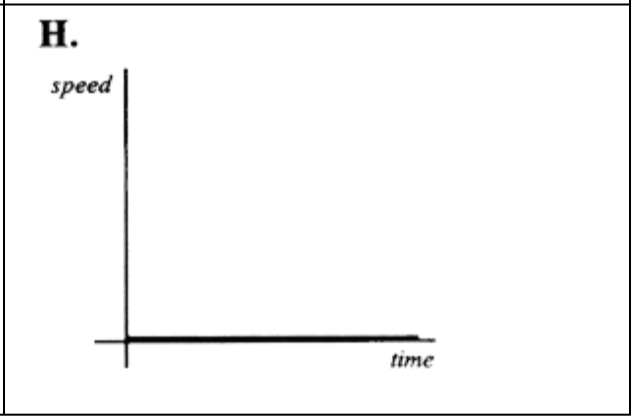
Match the graph to the description:

"The car is traveling at a constant speed."
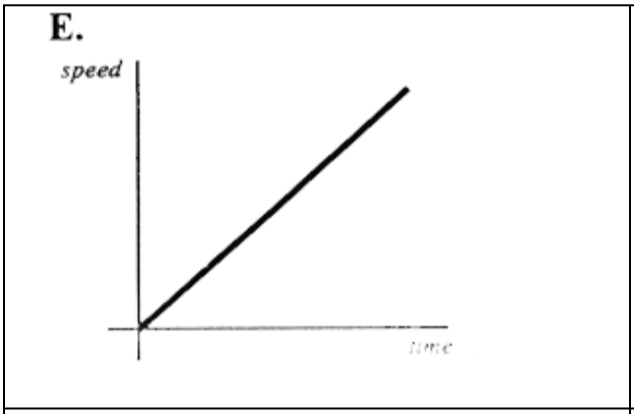
a)
b)
c)
d)
16.

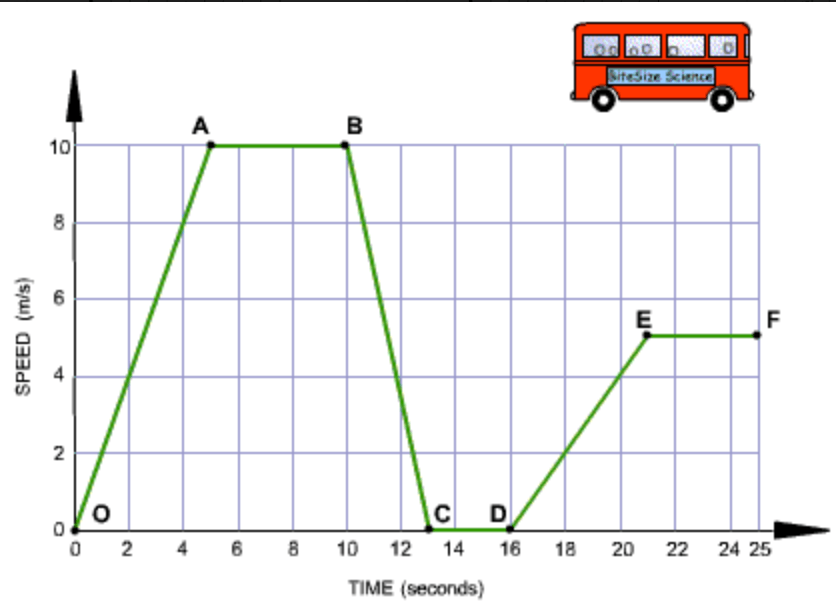
Segment O-A: The bus is _________________. It's speed changes from 0m/s to 10 m/s in 5 seconds.

a)

accelerating

b)

decelerating

c)

constant speed

d)

at rest

17.

The equation for finding average acceleration for straight-line motion is

a)

average acceleration = (vf - vi) / t

b)

average acceleration = vf / t

c)

average acceleration = (vi + vf) * t

d)

average acceleration = vf + vi

18.

What happens when a car slows down and velocity changes?

a)
The car's velocity increases, resulting in positive acceleration.
b)
The car comes to a complete stop without any change in velocity.
c)
The car's velocity remains constant throughout the process.
d)
The car's velocity decreases, resulting in negative acceleration.
19.

The difference between speed and velocity is that velocity includes

a)
time
b)
direction
c)
distance
d)
acceleration
20.

When centripetal acceleration occurs, an object

a)
is moving in a straight line.
b)
is experiencing gravitational pull.
c)
is at rest and not moving.
d)

is changing directions

21.


A 71 kg skater pushed by a friend accelerates 3.5 m/sec2.  How much force did the friend apply? 

a)
248.5 N
b)
200 N
c)
150 N
d)
300 N
22.

What is the mass of a ball that has a force of 17 N and an acceleration of 5.5 m/s(squared)? 

a)
3.09 kg
b)
2.5 kg
c)
4.1 kg
d)
5.0 kg
23.

What is the momentum of a 15,000 kg box car at rest? 
a)
30,000 kg·m/s
b)
15,000 kg·m/s
c)
7,500 kg·m/s
d)
0 kg·m/s
24.

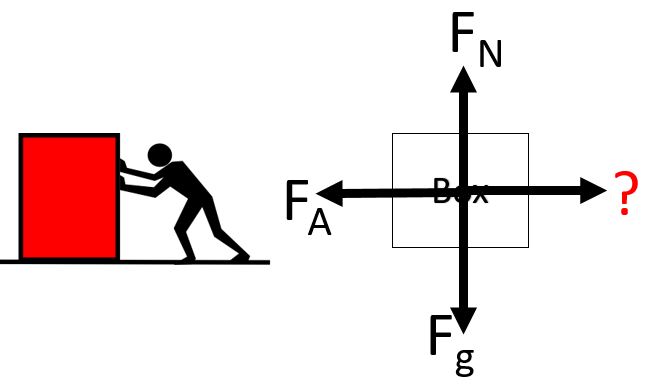
Name the missing force.

a)

Weight force

b)

Normal force

c)

Frictional force

d)

Tension force

25.
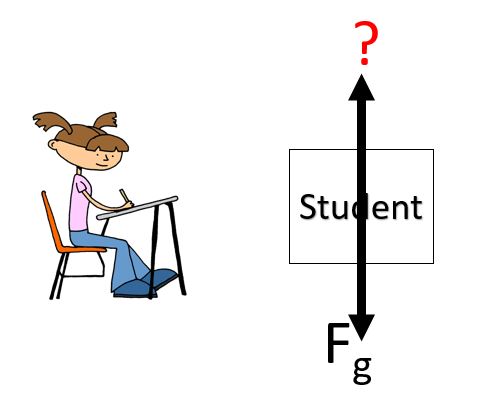
Name the missing force...
a)
frictional force
b)
weight force
c)
thrust
d)
buoyant force
26.

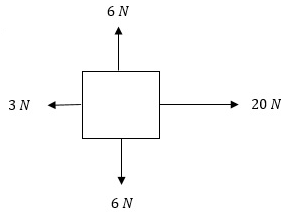
What is the NET FORCE of this diagram?

a)

17 N, right

b)

17 N, left

c)

23 N, right

d)

12 N, up

27.

If the net force is zero then the object has

a)

not moving

b)
accelerating in a circle
c)
decreasing speed
d)
increasing speed
28.

Which one of Newton's laws is shown

a)

3rd law

b)

2nd law

c)

1st law

29.

Which of Newton's laws is shown

a)

1st law

b)

3rd law

c)

2nd law

30.

When there is a change in motion?

a)

When forces are balanced

b)

When the forces are unbalanced

c)

Whe forces are equal

d)

Never

31.

You are carrying a lunch tray when you bump into the edge of a table. Although the tray did not tip, your milk falls off the front of the tray.

a)

Newton's 1st Law of Motion

b)

Newton's 2nd Law of Motion

c)

Newton's 3rd Law of Motion

32.
Why is it harder to push a van filled with bowling balls than it is to push a van with basketballs?
a)
The mass of the car is greater than the mass of the basketballs
b)
The mass of the bowling balls is greater than the mass of the basketballs
c)
The van with the basketballs is bigger than the van with the bowling balls
d)
It should be equally as hard to push the two vans
33.
the tendency of an object to resist a change in its motion
a)
acceleration
b)
inertia
c)
mass
d)
frame of reference
34.
A box sliding down an inclined plane attains a velocity of 27 m/s in 3 seconds from rest.  Find the acceleration.
a)
30 m/s
b)
24 m/s2
c)
9 m/s2
d)
81 km/hr
35.

a push or pull that changes the objects velocity

a)
Acceleration
b)
Force
c)
Momentum
d)
Friction
36.

what force attracts a body toward the center of the earth

a)
Magnetism
b)
Friction
c)
Centrifugal force
d)
Gravity
37.

the combination of all forces acting on an object

a)
Resultant force
b)
Applied force
c)
Net force
d)
Total force
38.

objects momentum is determined by the

a)
energy and time
b)
force and distance
c)
acceleration and friction
d)
mass and velocity
39.

how does total momentum before and after a collision compare

a)
Total momentum is only conserved in elastic collisions.
b)
Total momentum decreases after a collision.
c)
Total momentum before and after a collision is equal.
d)
Total momentum increases after a collision.
40.

the law that states unbalanced forces acting on an object equals the objects mass times its acceleration

a)
Newton's second law of motion
b)
Newton's first law of motion
c)
Newton's third law of motion
d)
Law of universal gravitation