
Font size
 Worksheets
Q3 Benchmark Practice 2
Total questions: 25
Worksheet time: 37mins
Areas along coastlines, such as Florida, often do not experience winters as severe as areas inland,
even though some of these coastal areas lie further north. Why do coastal areas tend to have more
mild winter weather patterns?
Cold ocean currents only flow east to west and cannot reach inland areas.
Warm ocean currents only flow east to west and cannot reach inland areas.
Cold ocean waters cool the air above them, the cool air flows over coastal areas, but cannot reach the areas inland.
Warm ocean waters heat the air above them, the warm air flows over coastal areas, but cannot reach areas inland.
El Niño is a weather event that causes great changes in weather worldwide. During an El Niño
event, the pacific jet stream shifts southward. Which change will an El Niño event most likely
cause?
colder temperatures in the southern United States
warmer than usual temperatures in the northern United States
more rain than usual weather in the northern United States
drier than usual weather in the southern United States
Airplane flight paths often take advantage of the jet stream. Which of the following statements accurately describes the jet stream? (6.E.7.3)
steady, warm breeze
large air mass that flows over Earth’s surface
narrow band of strong winds high in the atmosphere
cold, moist air sinking in the atmosphere
What causes the Coriolis effect?
atmospheric pressure changes
Earth’s rotation on its axis
Earth’s gravitational pull
seasonal changes in ocean temperatures
What effect does the Gulf Stream have on towns along the east coast of the United States and the western European coastline?
It makes temperatures along both coasts more mild/moderate year round.
It makes the coastline towns hotter than inland towns in summer.
It makes the weather much colder in towns along both coasts.
It makes temperatures dip lower at night and soar higher each day.
Amy and Scott are preparing a presentation on climate in Florida. Which of the following statements would best support the idea that Florida has a subtropical climate? (6.E.7.6)
Florida had record high temperatures this past summer.
Florida received 35 inches of rain this past year.
Florida’s location near the equator makes it cooler than most of the United States.
Florida has a long pattern of experiencing hot, humid summers and mild to cool winters.
On any given day, the weather forecast might say that rain, snow, and sleet are expected. Which of the following statements describes this area’s climate? (6.E.7.6)
Sleet is a combination of rain and snow.
Last January it snowed for 17 days in a row.
Rain, snow and sleet are common during the month of December.
The rain turned to sleet and snow later that afternoon.
A current report on the internet is predicting that it will be sunny in Tampa, Florida, tomorrow. What is this report predicting? (6.E.7.6)
climate
season
temperature
weather
Which of the following statements accurately describes the term climate? (6.E.7.6)
The high today will be 89* F (32 *C).
Between October and December there is an average of 2 cm of rain per month.
It rained 2 cm this morning.
On December 13, it was cool and cloudy with a total of 2 cm of rain falling.
Which of the following statements best describes climate?
the conditions of the atmosphere over long periods of time in a given place
the conditions of the atmosphere during the winter time
the conditions of the atmosphere at a given time and place
The conditions of the atmosphere in the northern hemisphere
Humid weather occurs most often during warm, summer months. Why are the summer months more humid? (6.E.7.2)
Cold air rises quickly into the atmosphere.
Air holds ice in the winter and water vapor in the summer.
Warm air holds more water vapor than cold air.
Water is only present in the air during the summer.
Air masses that form over large bodies of water are characterized by high humidity. What process
directly determines the amount of moisture in an air mass?
condensation
evaporation
precipitation
transpiration
Which of the following statements best describes how the Sun causes wind? (6.E.7.3)
The Sun heats the Earth unevenly, causing warm air to rise and cool air to sink, which causes differences in air pressure.
The Sun heats the Earth evenly, which causes all air to rise.
The Sun heats the Earth unevenly, causing warm air to sink and cool air to rise, which causes differences in air pressure.
The Sun heats the Earth evenly, which causes all air to sink.

Based on the ocean currents shown, which statement best explains the difference in humidity?
The air mass in the Atlantic Ocean is warmer than the air mass in the Pacific Ocean is, and a warmer air mass holds more water vapor than a colder air mass does.
The air mass in the Pacific Ocean is colder than the air mass in the Atlantic Ocean is, and a colder air mass causes more evaporation than a warmer air mass causes.
The cold ocean current in the Pacific Ocean causes stronger winds than the warm ocean current in the Atlantic Ocean causes, and moisture evaporates from the Pacific ocean air mass.
The warm ocean current in the Atlantic Ocean produces denser air masses than the cold ocean current in the Pacific Ocean produces, and the dense air mass in the Atlantic Ocean cannot release precipitation.
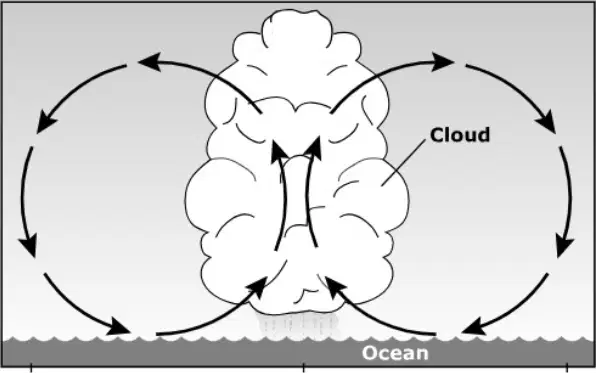
What causes the movement shown in the diagram? (6.E.7.2)
movement of ocean currents
decrease in relative humidity
heating by energy from the Sun
warming in the upper atmosphere
Evaporation drives the water cycle. Without evaporation, the water cycle would not be possible.
What is Earth's main source of evaporation
a. oceans
b. rivers
c. groundwater
d. clouds
The Gulf Stream is a warm ocean current that originates at the southern tip of Florida, travels
north along the east coast of the United States, and then crosses the Atlantic Ocean to the British Isles. What would Great Britain’s climate be like without the influence of the Gulf Stream?
Colder and more rain
Colder and drier
Warmer and drier
Warmer and more rain
What type of weather is most commonly associated with a high-pressure system? (6.E.7.3)
Clear and dry
Cloudy and wet
Stormy and windy
Hot and humid
Based on the direction of the jet stream, in which direction would you expect most weather systems to travel in the United States? (6.E.7.3)
North to south
East to west
West to east
South to north
Which of the following statements accurately describes the relationship between air masses and ocean currents? (6.E.7.3)
Warm ocean currents cool the air masses above them.
Cold ocean currents warm the air masses above them.
Warm ocean currents warm the air masses above them.
Air masses do not affect ocean currents.
What makes scientific knowledge hold up so well over time?
As new evidence is presented, scientific knowledge is open to revision.
Scientific knowledge is published in well-respected journals, so it is easy to locate.
Scientific knowledge is well researched and permanent.
Once established, scientific laws cannot be broken or revised.
As new information is discovered, scientific theories are changed. Sometimes, old theories are thrown out. Why is this a necessary condition for good science? (6.N.2.2)
It ensures that the newest ideas are the ones used to develop medicines and important safety equipment.
New scientists need to get credit for their ideas or no one will go into science.
Old theories are dependent on primitive technology that was flawed, so new technology must be used.
The process allows for an increasingly accurate understanding of the world.
With new knowledge comes new technology. For example, since science has analyzed how light
works, we have been able to use new technology such as high-powered telescopes.
The high-powered telescopes have allowed us to discover more galaxies. Which statement best
describes what scientists do with information obtained through the use of new technology?
If new information is discovered that conflicts with previous knowledge, scientists simply discard it.
When new information is discovered, scientists accept and incorporate the new knowledge if it is determined to be factual.
As new knowledge is discovered, scientists take note of it but do not change any previously established ideas.
Scientists do not seek new knowledge if there is a chance it may conflict with current ideas and understanding.
Why is scientific knowledge considered to be dependable? (6.N.2.2)
It can change if new evidence is discovered.
It is published in trustworthy sources.
It has many different areas that can be studied.
It shows the reasons why the natural world works in certain ways.
Which of the following examples is most likely to cause scientific knowledge to change? (6.N.2.2)
One scientist decides that current knowledge on a specific topic is incorrect.
A scientist tested a plant experiment and did not get the exact same results as the current scientific knowledge suggests.
New evidence and technology allow scientists to get a more in-depth look and understanding of cancer cell growth.
Scientists up north have experienced a shorter fall season this year and conclude that scientific knowledge on seasons needs to change.

