
 Worksheets
Exam II Practice Chemical Kinetics and Equilibrium
Total questions: 89
Worksheet time: 2hrs 9mins
The catalyst alters the rate of a chemical reaction by,
providing an alternative pathway with a lower Ea
changing the products formed in the direction of the reaction
providing a surface on which the molecules react
increasing the frequencies of collisions between molecules
Which of the following are true of reaction rates?
I. The overall rate law is determined by the fastest step of a reaction
II. The presence of a catalyst will increase the number of molecules entering the transition state
III. An increase in temperature will increase the rate of a reaction
IV. Decreasing the concentration of reactants will increase the rate at which products yield
II+III+IV
I+IV
II + III
I+II+III
Which factors increase the rate of a reaction?
increasing temperature
increasing concentration
increasing surface area
all of the above
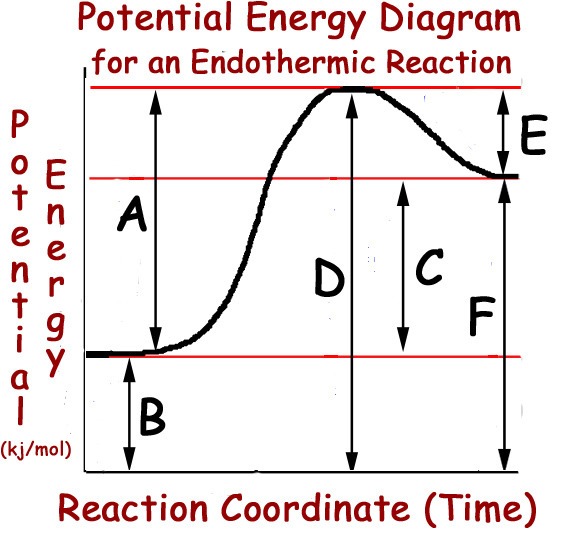
What letter represents the activation energy?
A
B
C
D
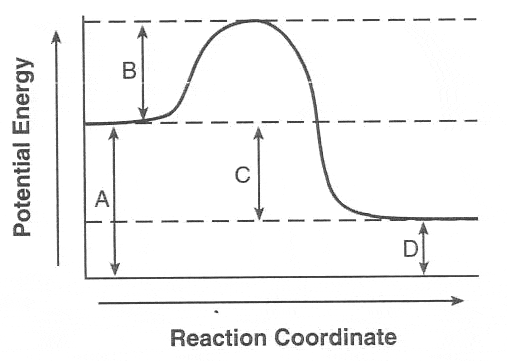
Based on the collision model, the atoms in the top of potential energy ‘’hill’’ are called
Top of hill
Activation energy
Transition state
Steric factor
Which of the following best describes why increasing temperature increase reaction rate?
Activation energy is reduced.
Collisions become more frequent.
Collisions become more energetic.
Collisions become more frequent and more energetic.
Which of the following statements about the catalyst is true?
A catalyst accelerates the rate of reaction by bringing down the activation energy.
A catalyst does not participate in reaction mechanism.
A catalyst makes the reaction feasible by making ∆G more negative.
A catalyst makes equilibrium constant more favorable for forward reaction.

An endothermic reaction with high activation energy for the forward reaction is given by the diagram.
A
B
C
D
4 factors that affects reaction rate.
temperature
surface area
presence of catalyst
Chemical nature of reactant
In solid form


An addition of a catalyst to the following reaction would have what effect?
A would be increased
B would be increased
C would be decreased
No change
What are the two factors to look for when determining if the reaction is at equilibrium?
Forward reaction rate is faster than the reverse reaction rate and amounts of reactants are greater than the products
Forward and reverse reaction rates are equal and amounts of reactants and products are constant
Forward reaction rate is slower than the reverse reaction rate and amounts of reactants are greater than the products
Forward reaction rate is faster than the reverse reaction rate and amounts of products are greater than the reactants


At what time does the reaction reach equilibrium?
It is a chemical reaction where the reactants form products and the products form reactants.
reversible reaction
nonreversible reaction
decomposition reaction
standard reaction

Identify the labels (a) and (b) on the graph.
a is the amount (concentration) of reactants and b is the concentration of products
a is the amount (concentration) of products and b is the concentration of reactants
a is the volume of reactants and b is the volume of products
a is the mass of reactants and b is the mass of products


Which of the following is NOT true at equilibrium?
The forward and reverse reactions proceed at the same rate.
The amount (concentration) of reactants and products do not change.
The amount (concentration) of the reactants is equal to the concentration of the products.
The forward and reverse reactions continue to occur.
During equilibrium, the rates of the forward and the reverse reaction are ________
equal
unequal
unequal for exothermic reactions
unequal for endothermic reactions

Around what time does the reaction reach equilibrium?
25 min
70 min
45 min
80 min
During equilibrium, the amount of the products and the amount of the reactants are __________.
equal
constant (unchanging)
constantly increasing
constantly decreasing
An equilibrium mixture is prepared in a container of fixed volume.
CO(g) + Cl2(g) ⇌ COCl2(g)
ΔH = −108 kJ mol−1
The temperature of this mixture is decreased and the mixture is allowed to reach a new equilibrium.
Which is greater for the new equilibrium than for the original equilibrium?
The mole fraction of carbon monoxide
The partial pressure of chlorine
The total pressure of the mixture
The value of the equilibrium constant, Kp
Which change would alter the value of the equilibrium constant (Kp) for this reaction?
2SO2(g) + O2(g) ⇌ 2SO3(g)
Increasing the total pressure of the system.
Increasing the concentration of sulfur trioxide.
Increasing the concentration of sulfur dioxide.
Increasing the temperature
Which statement about Kp is correct for this reaction in the gas phase?
W + X + Y2 ⇌ WXY + Y
ΔH = −46 kJ mol−1
The value of Kp is independent of pressure.
The value of Kp increases as pressure increases.
The value of Kp increases as temperature increases.
The value of Kp is independent of temperature.
The reaction between carbon monoxide and hydrogen reaches a dynamic equilibrium.
CO(g) + 2H2(g) <=> CH3OH(g)
Which of these statements about a dynamic equilibrium is not true?
The forward rate of reaction is equal to the backward rate of reaction.
The forward rate of reaction is equal to the backward rate of reaction.
The concentrations of the products and reactants are equal.
The concentrations of the products and reactants are equal.
Carbon monoxide and chlorine react together and reach equilibrium:
CO(g) + Cl2(g) <=> COCl2(g)
If the pressure of the system is then increased at constant temperature, which of the following statements is correct?
The equilibrium moves to the left and Kp decreases.
The equilibrium moves to the right and Kp increases.
The equilibrium moves to the right, then back to the left and Kp remains the same.
The equilibrium moves to the right and Kp remains the same.
Hydrogen can be produced by this reaction.
CO(g) + H2O(g) ⇌ CO2(g) + H2(g)
In an experiment 4.20 mol of carbon monoxide were mixed with 2.00 mol of steam. When the reaction reached equilibrium, 1.60 mol of hydrogen had been formed. (If you are not given a volume, assume it is 1dm3)
What is the value of the equilibrium constant, Kc, for this reaction?
0.30
0.41
1.54
2.46
Hydrogen is produced by the reaction of methane with steam. The reaction mixture reaches a state of dynamic equilibrium.
CH4(g) + H2O(g) ⇌ CO(g) + 3H2(g) ∆H = +206 kJ mol−1
Which of the following shows how the equilibrium yield of hydrogen and the value of the equilibrium constant are affected by the changes shown?
Change: Increase pressure
Effect on equilibrium yield of H2(g): decrease
Effect on value of Kc: decrease
Change: Add a catalyst
Effect on equilibrium yield of H2(g): increase
Effect on value of Kc: no effect
Change: Increase temperature
Effect on equilibrium yield of H2(g): increase
Effect on value of Kc: increase
Change: Remove CO(g) as formed
Effect on equilibrium yield of H2(g): increase
Effect on value of Kc: increase
Which is the correct exam technique when explaining equilibrium shifts in terms of Kc when more molecules of X is added to this system.
X <--> Y ΔH = -250kJmol -1


Which is the correct exam technique when explaining equilibrium shifts in terms of Kc when the pressure in the system is decreased?
X(g) + Y(g) <--> Z(g)


Look at the equilibrium involving hydrogen, iodine and hydrogen iodide:
H2 (g) + I2(g) ⟺ 2HI (g) ∆H = -10.4 kJmol-1
Kp will stay the same
Kp will increase
Kp will decrease
Which factors affect the rate of a reaction?
polarity
temperature
presence of a catalyst
concentration
physical state
When the species in a reaction have a coefficient, how do you adjust the reaction rate equation?
multiply the rate by the coefficient
add the coefficient to the rate
divide the rate by the coefficient
subtract the coefficient to the rate
For the reaction A→B the reaction rate is
−ΔtΔ[A]
Δ[A]Δt
ΔtΔ[B]
Δ[B]Δt
k[A]x[B]y... is called the
rate equation
rate law equation
rate constant
kinetic equation
What is the reaction order?
the order in which the reactants change to products
the speed of the reaction
the relationship between the concentrations of species and the rate of a reaction
the number of moles of a species in a reaction
If the rate doubles when [A] doubles, the rate depends on __ and the reaction is __
[A]1 , second order
[A]1 , zero order
[A]2 , second order
[A]1 , first order
If the rate quadruples when [A] doubles, the rate depends on __ and the reaction is __
[A]1 , second order
[A]0 , zero-order
[A]2 , second order
[A]1 , first order
If the rate does not change when [A] doubles, the rate depends on __ and the reaction is __
[A]1 , second order
[A]0 , zero-order
[A]2 , second order
[A]1 , first order
The integrated rate law for a first order reaction is
ln[A]t=−kt+ln[A]0
−[A]t1=kt+[A]01
[A]t1=kt+[A]01
[A]t=−kt+[A]0
The integrated rate law for a second order reaction is
ln[A]t=−kt+ln[A]0
−[A]t1=kt+[A]01
[A]t1=kt+[A]01
[A]t=−kt+[A]0
The integrated rate law for a zero order reaction is
ln[A]t=−kt+ln[A]0
−[A]t1=kt+[A]01
[A]t1=kt+[A]01
[A]t=−kt+[A]0
In the rate law equation, k represents the ____________.
kelvin
kinetic constant
rate constant
reaction order
The units for k in a first-order reaction are
L⋅smol
mol L−1⋅s−1
s−1
mol⋅sL
s1
The units for k in a zero-order reaction are
L⋅smol
mol L−1⋅s−1
s−1
mol⋅sL
s1
The units for k in a second-order reaction are
L mol−1s−1
mol L−1⋅s−1
s−1
mol⋅sL
s1
The units for k in a third-order reaction are
L2 mol−2s−1
mol L−1⋅s−1
s−1
mol2⋅sL2
s1
What is reaction half-life?
the time required for a product concentration to reach one half of its initial value
the time required for a reactant concentration to reach one half of its initial value
the minimum amount of energy molucule must have for a reaction to take place
the amount of reactant left when half of the allotted time for a reaction to take place has passed
What is the Arrhenius Equation?
k=AeRTEa
k=Ae−RTEa
k=−RTEa
k=(RTEa)Ae

Why does a higher concentration increase the rate of reaction?
it increases the amount of reactants
it lowers the activation energy
it increases the energy of particle collisions
it increases the frequency of particle collisions
Why does a higher temperature increase the rate of a reaction?
it increases both the frequency and energy of particle collisions
it only increases the frequency of particle collisions
it only increases the energy of particle collisions
it reduces the activation energy of the reaction
The minimum amount of energy needed for colliding particles to react is called
Chemical Energy
Kinetic Energy
Activation Energy
Potential Energy
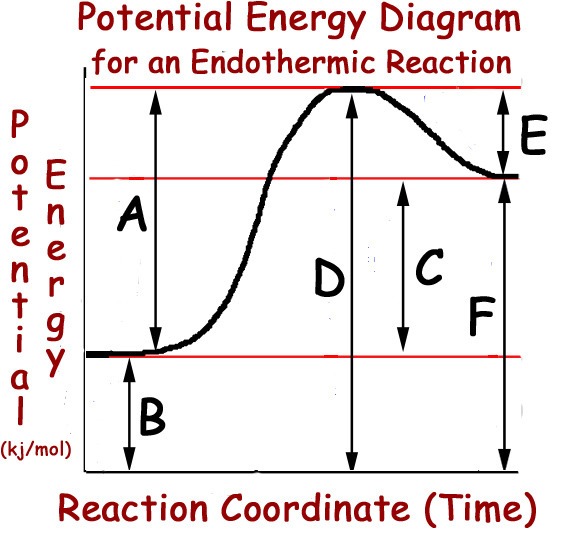
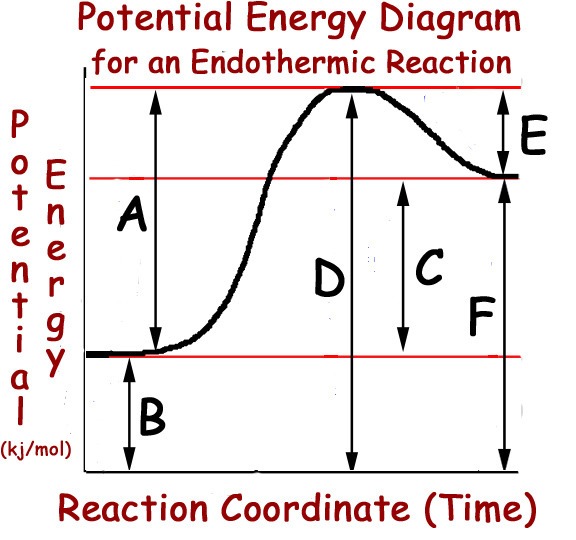
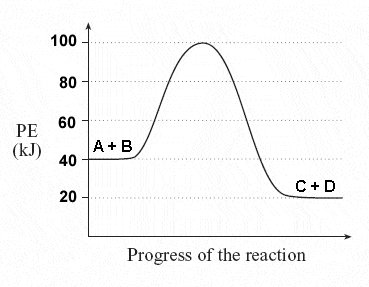
What is the change of the heat of the reaction (ΔH)?
-40 kJ
-20 kJ
100 kJ
60 kJ

What are the two factors to look for when determining if the reaction is at equilibrium?
Forward reaction rate is faster than the reverse and concentrations are equal
Forward and reverse reaction rates are equal and concentration is constant
Forward and revers reaction rates are equal and concentration is equal
Forward reaction rate is faster than the reverse and concentration is equal
Identify the incorrect statement about achieving equilibrium.
achieved when product and reactant concentrations are equal
achieved when forward and reverse reaction rates are same
achieved when concentration of reactants is stable/constant
achieved when concentration ratio of reactants to products becomes stable, thus fixing the equilibrium constant (equilibrium position)
Which of the following are true? Assume this reaction: A is reactant concentration and B is product concentration.
At t3, there are more reactants than products
The equilibrium constant lies to the right
At t3; the amount of reactants and products are equal
At t2; the forward and reverse reaction rates are equal
at t1, the the concentration of the reactants is decreasing and the concentration of the products is increasing

What is the keq for this reaction?
Greater than 1
Less than 1
Exactly 1
Impossible to determine

