
 Worksheets
Unit 4 Practice Exam
Total questions: 40
Worksheet time: 20mins
Name
Class
Date
1.

Find the density of a rectangular prism with a mass of 140.67 grams. The sides of the prism are 6cm, 12cm, and 3 cm.
a)
0.65 g/cm3
b)
1.54 g/cm3
c)
1.27 g/cm3
d)
0.98 g/cm3
2.
Which characteristics describe all organic compounds? Choose TWO correct answers.
a)
The compound must contain a metal.
b)
Electrons are shared by the atoms.
c)
The compound must contain carbon.
d)
Electrons are transferred between atoms.
e)
They are found in nonliving things only.
3.

The diagram shows a model of an atom. Atoms contain three different subatomic particles. Which statement best describes the outermost particle?
a)
Particle A exists outside the nucleus.
b)
Particle A has a negative charge.
c)
Particle A does not contribute to an atom’s mass.
d)
All of the above are correct.
4.
Which subatomic particles have no electrical charge and may not always be the same in number as the protons?
a)
electrons
b)
neutrons
c)
atoms
d)
nucleus
5.
If an oxygen atom has a mass number of 16, how many neutrons are in the atom?
a)
5
b)
6
c)
7
d)
8
6.
In a neutral atom, the number of protons and electrons are as follows:
a)
more protons than electrons
b)
equal
c)
more electrons than protons
d)
need more information
7.

What is the number of protons?
a)
10
b)
11
c)
12
d)
13
8.
Which of the following is an example of a compound?
a)
helium (He)
b)
sodium (Na)
c)
carbon dioxide (CO2)
d)
iron (Fe)
9.

What is the name of this atom?
a)
Cesium
b)
Carbon
c)
Calcium
d)
Chlorine
10.
Which statement about molecules is true?
a)
Molecules are always composed of only one type of atom.
b)
Molecules are the smallest unit of an element that keeps its chemical properties.
c)
Molecules are formed by atoms bonding together.
d)
Molecules cannot be represented by chemical formulas.
11.

What is the atomic mass of this atom?
a)
1.008
b)
6.938
c)
15.999
d)
91.224
12.
What is the smallest unit of a compound that keeps the same chemical properties?
a)
molecule
b)
atom
c)
element
d)
compound
13.
Hydrogen, carbon, oxygen, nitrogen, phosphorous, and sulfur will be found in...
a)
carbohydrates
b)
proteins
c)
lipids
d)
nucleic acids
14.

Is this compound organic or inorganic?
a)
Organic
b)
Inorganic
15.
A liquid that is safe to drink tastes sour. What is the most likely pH?
a)
1
b)
5
c)
7
d)
12
16.
Which property of water makes molecules of different substances, like water and a spider web, stick together?
a)
adhesion
b)
cohesion
c)
surface tension
d)
evaporation
17.
Which property of water allows water to resist outside forces?
a)
adhesion
b)
cohesion
c)
surface tension
d)
evaporation
18.
What two properties of water cause a small crater shape to form when rain falls onto a pond? Select ALL that apply.
a)
adhesion
b)
cohesion
c)
surface tension
d)
evaporation
19.
What does the pH scale tell us?
a)
how acidic or basic a solution is
b)
the kinetic energy of the molecules in a solution
c)
how quickly a solute can dissolve in a solution
d)
the freezing points of different liquids
20.
Which does NOT describe how the properties of vinegar compare to water?
a)
The pH of vinegar is less than water.
b)
Water is neutral and vinegar is acidic.
c)
Vinegar will taste bitter compared to water.
d)
Vinegar will turn cabbage juice indicators red.
21.
What are the characteristics of an acidic solution? Select TWO that apply.
a)
sour taste
b)
bitter taste
c)
feels slippery
d)
turns blue litmus paper red
e)
has a pH above 7
22.
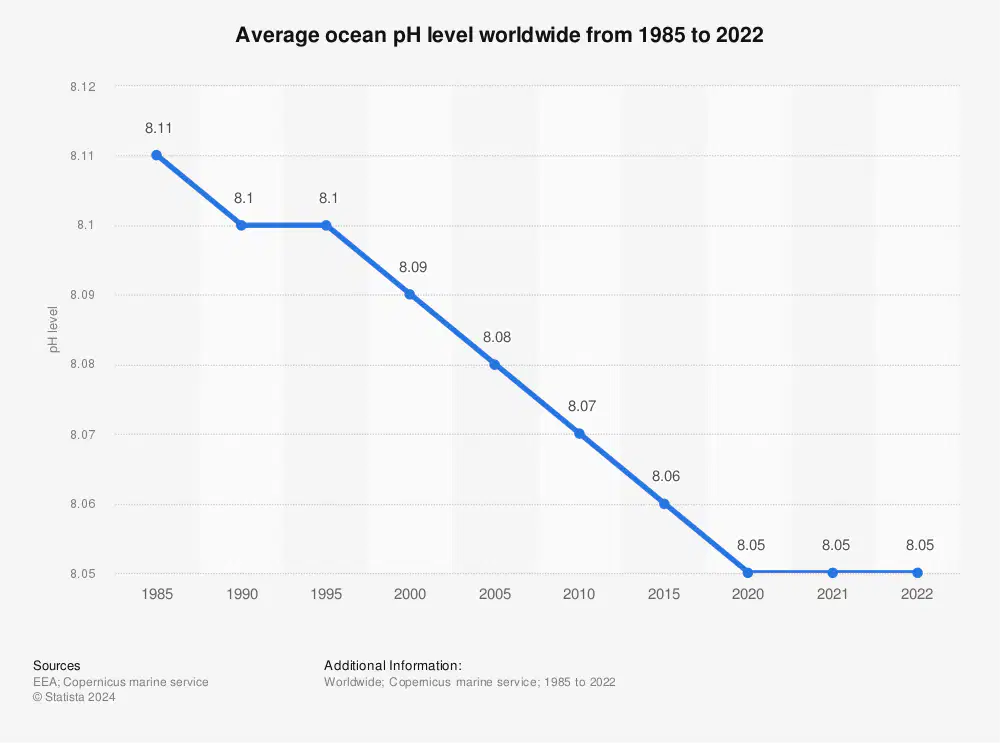
Two students are looking at a graph showing the change in ocean pH over time.
The students have two different opinions on how natural ocean ecosystems are impacted.
Mariah: The ocean water is becoming more acidic. This will harm organisms that live in the water.
Jaafar: The ocean is becoming more basic. This will harm organisms that live in the water.
Which student is most accurate?
a)
Mariah
b)
Jaafar
c)
Both are correct
d)
Neither are correct
23.
How is cohesion related to surface tension?
a)
The water molecules are attracted to objects on the surface of the water.
b)
It invites lightweight insects to “walk” across to continue the water cycle through living organisms.
c)
The water molecules stick extra tight to the molecules around and below them creating an elastic “skin.”
d)
Although both are properties of water, they are not related to each other.
24.
A paper clip can float on the surface of water due to surface tension. What would happen if you added soap to the water?
a)
The paper clip would float because it would balance on the bubbles.
b)
The paper clip would sink because soap decreases the surface tension of the water.
c)
The paper clip would sink because the soap would make it slippery.
d)
The paper clip would float because soap increases the surface tension of water.
25.
Water is an inorganic compound (since it does not contain carbon), why do you think it is so important for living things?
a)
Water is important for living things because it helps with chemical reactions, moves nutrients, keeps temperatures steady, and helps cells stay healthy and balanced.
b)
Water is an organic compound.
c)
Water is not important for living things.
d)
Water is important for living things because it has a lot of oxygen atoms.
26.

Where are most metals located on the periodic table?
a)
The left side
b)
The top
c)
The middle
27.
Who is the scientist credited with the Periodic Table?
a)
George Meyer
b)
Dmitri Mendeleev
c)
Albert Einstein
d)
Marie Curie
28.
Why do the noble gases tend not to react with other elements?
a)
All of the noble gases have exactly the number of electrons that they need
b)
The noble gases are all polar
c)
All of the noble gases are highly reactive
d)
The noble gases all have a low atomic mass
29.

Which side of the periodic table is MORE reactive?
a)
Left
b)
Top
c)
Middle
30.
What two elements are liquid at room temperature?
a)
Gold (Au)
b)
Hydrogen (H)
c)
Mercury (Hg)
d)
Copper (Cu)
e)
Bromine (Br)
31.
What are groups on the periodic table sometimes called?
a)
Elements in the same vertical column (group) are sometimes called a "row"
b)
Elements in the same vertical column (group) are sometimes called a "period"
c)
Elements in the same vertical column (group) are sometimes called a “family”
32.
Density is...
a)
An object's volume divided by its mass
b)
The ratio of an object's mass to its volume
c)
Often measured in cubic centimeters (cm3)
d)
The amount of matter in an object
33.

Which of the following is NOT a balanced chemical equation?
a)
A
b)
B
c)
C
d)
D
e)
E
34.
Is this reaction balanced or unbalanced?
Na + Cl → NaCl
a)
Balanced
b)
Unbalanced
35.
Which element is in the same period as magnesium?
a)
Beryllium
b)
Sodium
c)
Calcium
d)
Copper
36.
What element is found at Period 3, Group 17 on the periodic table?
a)
Sulfur
b)
Fluorine
c)
Chlorine
d)
Bromine
37.
Sodium and lithium have similar chemical properties. Which description best explains why they are chemically similar?
a)
They both have the same number of atoms.
b)
They both have the same atomic mass.
c)
They are both in the same group.
d)
They are both in the same period.
38.
Which statement best represents the Law of Conservation of Mass?
a)
Atoms can be created or destroyed, but not rearranged.
b)
Matter can neither be created nor destroyed.
c)
When atoms are rearranged, new matter is created.
d)
Matter can neither be created nor rearranged.
39.

How many atoms of oxygen are present in the reactants of the following equation?
a)
12
b)
18
c)
36
d)
6
40.
How can you tell if a reaction is balanced?
a)
The atoms for all types of elements must be equal
b)
The atoms of the products must be equal
c)
The atoms of the reactants must be equal
d)
The atoms of the same type of element must be equal for products and reactants
100 %

