
 Worksheets
Cellular Processes and Functions Assessment Review
Total questions: 20
Worksheet time: 12mins
Rabbits’ intestines help in the digestion of cellulose, which is a time-consuming and complex process. To digest cellulose, rabbits require enzymes produced by bacteria living in their intestines. These bacteria break down the cellulose into simple sugars that rabbits can digest.
Which of the following is an accurate statement about the survival needs of both rabbits and the bacteria that live in the rabbits’ intestines?
Both the bacteria and rabbits get energy from sugars, and both must eliminate wastes.
Both the bacteria and rabbits get energy from sugars, but only rabbits need to eliminate wastes.
Both the bacteria and rabbits need nutrients, but only rabbits need water.
Only rabbits need nutrients and water; the bacteria do not need nutrients or water.
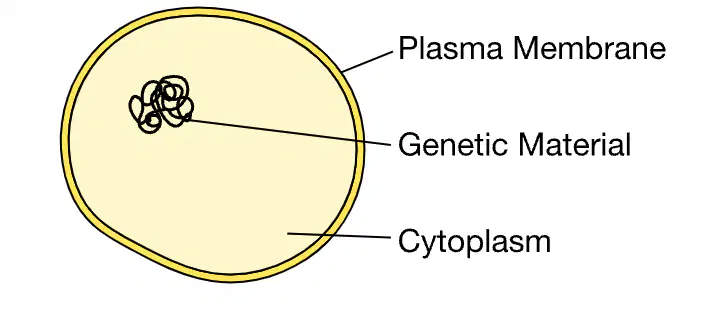
A student created a model of a typical cell to show the characteristics that all living cells share. Which of the following additions will improve the accuracy of the model?
Adding a cell wall, because all cells have both a plasma membrane and a cell wall
Adding ribosomes, because all cells carry out protein synthesis
Adding a membrane around the genetic material, because all cells have a nucleus
Adding chloroplasts, because all cells must produce oxygen to use in aerobic respiration
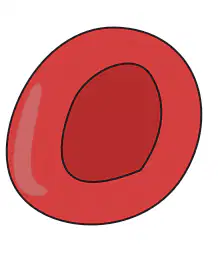
Question 3
Cystic fibrosis is an inherited disorder that causes affected individuals to excrete greater amounts of sodium and chloride than individuals without cystic fibrosis do. As a result, in some individuals the fluid surrounding the blood cells (blood plasma) has a lower concentration of sodium and chloride than the inside of the red blood cells. The image to the left shows the blood in normal conditions


A team of scientists are developing a method to measure ATP levels in the cell instantaneously. This would allow scientists to take immediate measurements of ATP and determine where ATP is localized in the cell.
Which of the following statements best explains the benefit of measuring ATP in a cell instantaneously?
Measuring the levels of ATP will allow scientists to locate mutations within the nucleus.
Measuring the levels of ATP will allow scientists to locate where energy is used for cellular activities.
Measuring the levels of ATP will allow scientists to determine if the cell is undergoing meiosis.
Measuring the levels of ATP will allow scientists to deter
Plant cells have a large central vacuole that holds water, which results in other cell organelles being located against the cell membrane. Which of the following best explains how being close to the cell membrane could benefit a cellular process?
Nucleotides would have more access to space in the cytosol and become more concentrated, benefiting DNA replication.
Mitochondria would have more access to glucose to convert into ATP, benefiting cellular respiration.
Ribosomes would have more access to space in the cytosol and make more proteins, benefiting protein synthesis.
Chloroplasts would have more access to light energy to convert carbon dioxide and water into glucose, benefiting photosynthesis.
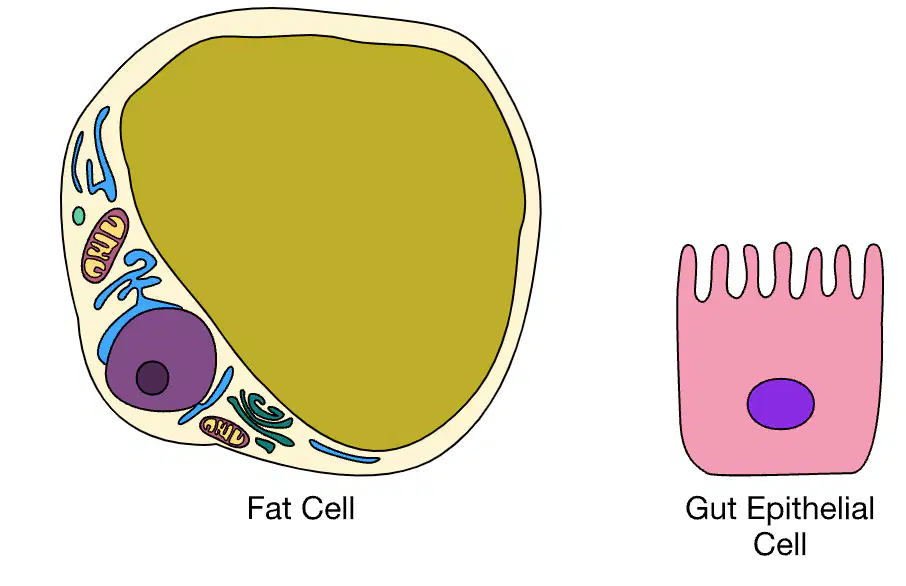
Animals have cells of various sizes and shapes. Fat cells are roughly spherical and can be quite large. The cells lining the intestine, on the other hand, are much smaller and have highly folded plasma membranes on one side, as represented in the figure.
Which of the following describes how the shape of the cell relates to the cell’s ability to function?
Responses
The folding of the epithelial cell increases the surface area-to-volume ratio, allowing it to absorb nutrients efficiently from digested food.
The large size of the fat cell increases the surface area-to-volume ratio, allowing it excrete large quantities of lipid molecules into the blood
The small size of the epithelial cell decreases the surface-to-volume ratio, allowing it to move digested food through the intestine more efficiently.
The smooth shape of the fat cell decreases the surface-to-volume ratio, allowing it to absorb glucose more efficiently from digested food.
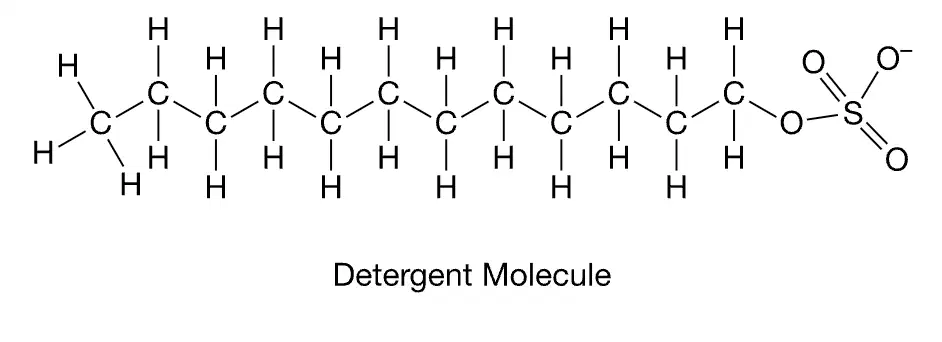
In a lab, students were extracting DNA from the nucleus of strawberry cells. The strawberries were mashed with a mixture of detergent, salt, meat tenderizer, and water. The detergent consists of a long hydrocarbon chain with a charged sulfate head, as shown in the figure. The detergent helps to disrupt and separate fats and other lipids.
Which of the following best explains the function of the detergent in the DNA extraction?
The detergent helps to break open cell membranes, allowing the DNA to come out of the cell.
The detergent helps to dissolve the DNA into the extraction mixture.
The detergent binds to proteins and causes them to precipitate from the extraction mixture.
The detergent helps to remove the cell wall, allowing the DNA to come out of the nucleus.

In order to model osmosis, students created an artificial cell using dialysis tubing (a thin membrane that water can pass through but that sucrose cannot) and a solution made of sucrose (a type of sugar) dissolved in water. The students filled the dialysis tubing with the sucrose solution, tied the open ends of the tube, and placed the artificial cell in a beaker containing distilled water as shown in the figure.


Students in a lab were working with a strain of bacteria that expressed a gene allowing the cells to break down the sugar galactose. The students isolated the component of the cell with the activity and performed chemical analysis to determine its composition. Which of the following would provide evidence that the isolated component was a protein?
The component was made of nucleotides.
The component was made of sugars.
The component was made of amino acids.
The component was made of fatty acids.
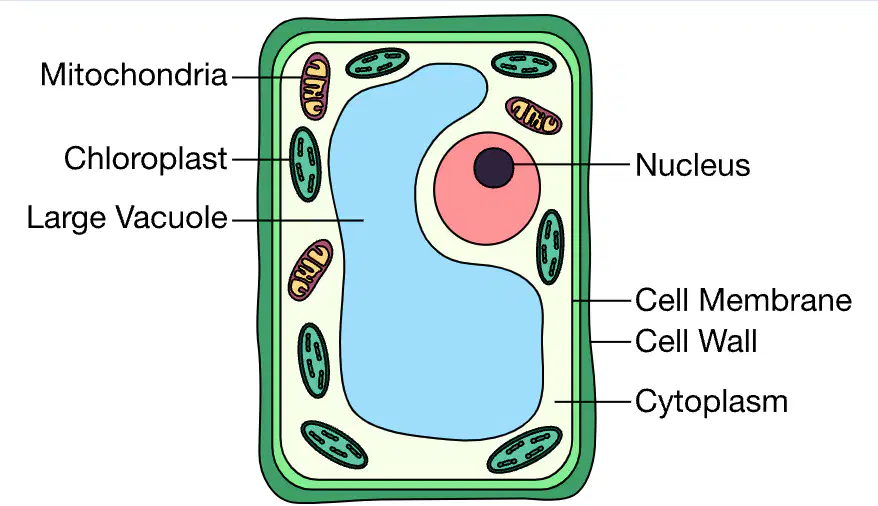
A class is creating a model of a plant cell that shows some of the structures that are likely to be observed in a typical plant cell. Students in the class have proposed revisions to make it a more accurate model of a plant cell. Which TWO of the following proposed changes will make the model more accurate?
Adding ribosomes because plant cells perform protein synthesis
Adding cilia or a flagellum because plant cells need a structure to help them move
Adding Golgi apparatus because plant cells package and export proteins from the cell
Removing the large vacuole because plant cells do not need to store water
Removing the mitochondria because plant cells use chloroplasts for ATP production
Used to move the stage up and down to focus specimen on low power.
Stage
Stage clips
Diaphragm
Coarse adjustment

Which of the following membrane activities requires energy from ATP?
Facilitated diffusion of chloride ions through a chloride channel.
Movement of Na+ ions from lower concentration in a mammalian cell to a higher concentration in the extracellular fluid.
Movement of glucose molecules into a bacteria cell from a medium containing a higher concentration of glucose than inside the cell.
Movement of carbon dioxide out of a paramecium.

Some cells move large particles out of the cell through the process of:
Protein Synthesis
Endocytosis
Exocytosis
Cytoplasmic Streaming
What is the movement of particles with the concentration gradient using protein "helpers"?
diffusion
facilitated diffusion
active transport
enzymatic reactions
If the body can no longer make ATP, which type of transport would be impacted?
Facilitated Diffusion
Osmosis
Active Transport
Simple Diffusion

Is the cell prokaryotic or eukaryotic, and why?
Eukaryotic because it has a nucleus
Eukaryotic because it has ribosomes
Prokaryotic because it has a nucleus
Prokaryotic because it has ribosomes
How is the cell wall different from the cell membrane in plants?
None of these are correct
The cell membrane is composed of cellulose, which makes it thicker and more rigid than the cell wall.
The cell wall is composed of lipids, which makes it thicker and more rigid than the cell membrane.
The cell wall is composed of cellulose, which makes it thicker and more rigid than the cell membrane.

