
Font size
 Worksheets
Social Studies Benchmark Practice
Total questions: 102
Worksheet time: 3hrs 31mins
What was Sui dynasty known for?
Separating Northern and Southern China
Reunifying China
Buddhism became popular during the Tang Dynasty becuase
Missionaries brought Buddhism from India
Buddhism taught that taught how people could escape suffering
It was spread along trade routes such as the Silk Road
all of the above
Complete the cause & effect relationship below:
Cause: Farmers import new types of rice.
Effect: ?
Many people converted to Buddhism out of thanks for the new rice.
Farmers were now able to grow rice along the Yellow River.
Rice grows very efficiently, resulting in conflict because of the competition.
Rice grows more efficiently, increasing the population.
Which Song advancement likely helped the spread of ideas through books and writing?
paper money
canals
moveable type
gunpowder
Around 1200 CE, this person unified the Mongol Empire
Kublai Khan
Genghis Khan
Confucius
Marco Polo

Kublai Khan etablished a new dyansty when he ruled over China. He called this dyansty the _____________
Shang
Yuan
Song
Tang
________________ was allegedly the most famous European to viists China during years of Mongolian rule.
Columbus
Marco Polo
John Wayne
Tom Brady
the traditional religion of Japan based on the worship and respect for nature and ancestors
Shinto
meditation
haiku
novel
a ruler who brought elements of Chinese culture to Japan
Prince Shotoku
Wendi
Lady Murasaki Shikibu
Buddha
a large landowner in medieval Japan
emperor
daimyo
samurai
shogun
Under Sui emperor Yangdi, China was able to build the ___________. This allowed for the Chinese to ship goods from North to South China, greatly increasing China's overall economy.
Grand Rapids
Grand Canal
Great Wall of China
Great Wall of Panda Express
a military leader who ruled on the emperor's behalf
emperor
daimyo
samurai
shogun

Who was the military general that ruled in Japan in the Emperor's name?
Emperor
Shogun
Daimyo
Samurai
Peasants
How did the Heian Period impact Japanese culture?
the Bubonic Plague destroyed the population
industrialization strengthened the economy
Christianity became the most popular religion
Japanese art and literature became more unique
Byzantine Empire
Ancient Greek city; renamed Constantinople and would be the capital city of the Byzantine Empire
The Eastern Roman Empire, which survived after fall of Western Roman Empire; capital city was Constantinople
Warlike people who migrated from Asia into territory controlled by Germanic tribes, forcing them to move into areas controlled by Rome
The city of _____________ was the capital of the Eastern Byzantine Empire.
Alexandria
Rome
Istanbul
Constantinople
Emperor Justinian revised the Roman laws which then became known as?
Justinian's Code
Hammurani's Code
The Da Vinci Code
Chaussard's Code
Which statement is true about the city of Constantinople?
It sat at the location of many trade system
It was able to prosper despite having no harbor
It cut all cultural ties with Rome
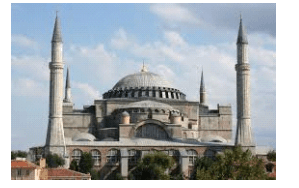
Cultural diffusion means?
sharing of secrets
sharing and spreading of culture
practice of one religion such as Christianity

In what city was the prophet Muhammad born?
Jerusalem
Antioch
Mecca
Medina

The fundamental beliefs of Islam are called the:
The Five Pillars
The Ten Commandments
The Four Noble Truths
The Beatitudes

What is the language of Islam?
Greek
Hebrew
Arabic
Latin

What does the diagram show?
The Silk Road
The Hajj
The way to Disneyland
Baja 1000 race course

Where do Muslim's worship?
Church
Synagogue
Mosque
Temple
In 1453, the Ottomans ended the Byzantine Empire by capturing what city?
Cordoba
Mecca
Balkans
Constantinople
One of the reasons for the wealth of the Ottoman Empire was
its control over the Eastern Mediterranean
because they found the Americas first
strong diplomatic ties with the Genghis Khan

He was a king of the Mali empire and was considered the richest man to ever live.
Mansa Musa
Askia Muhammad
Suni Ali
Pumba
This was traded for gold and was considered to have the same worth pound for pound.
millet
salt
books
textiles
These are the two valuable trade goods that made West Africa rich
gold and salt
silk and jade
spices and tea
silk and gold
Mansa Musa became famous during the Hajj he took to...
Mecca
Medina
Cairo
Timbuktu

A caravan is
a group of people or animals traveling together on a long journey especially through the desert
a car that is large and shaped like a van
giving money or goods to a ruler or country for protection

A pilgrimage is a
a journey to a holy place
person who attended the first Thanksgiving
a group of people or animals traveling on a long journey


While he was king of the Franks, Charlemagne was also crowned the...
King of Germany
King of England
Eastern Roman Emperor
Holy Roman Emperor

Why did Pope Leo III crown Charlemagne the Holy Roman Emperor?
Charlemagne invaded and destroyed Rome.
Charlemagne stopped a Muslim invasion.
Charlemagne became the pope.
Charlemagne helped protect the pope.
With the crowning of Charlemagne –
a greater division within the Roman Empire occurred
the Ottoman Empire gained control of most of Europe.
the political influence of the Church increased.
the Vikings were expelled from Europe.

The Magna Carta accomplished which of the following?
Limited powers of the king, allowed for trial by jury
No false imprisonment (can't be arrested/jailed for no reason) and a right to a trial by jury
Taxes can't be raised without approval of nobles, all free men protected equally by law
All of these are true
What major change did William the Conqueror introduce to England's government?
The establishment of a modified feudal system
The abolition of monarchy
The creation of a democratic parliament
The separation of church and state

What were the changes after the Battle of Hastings?
French became the language of English Royalty.
The king became the supreme ruler over the land.
Many castles & churches were built.
English became the language of French rulers.

Why do many scholars consider the Battle of Hastings to be the biggest event in English history?
It paved the wave for a spree of castle- and church-building.
It destroyed the English aristocracy & put people from Normandy in charge.
It ended the rule of Edward the Confessor.
It led to the establishment of feudalism in England.

What was one main source of conflict between the European monarchs and the pope during the Middle Ages?
The pope wanted the power to crown an emperor who would support him.
They both wanted the power to appoint bishops who were loyal to them.
They both wanted the power to tax nobles without their consent.
The monarchs wanted the power to choose a pope by a secret ballot.
Why did people join in the Crusades?
They thought it would help them gain land
They thought it would help them get rich.
They thought it would help them get into heaven.
All of these answers
What was the result of the First Crusade?
The crusaders captured and gained control of Jerusalem.
The crusaders were defeated and returned home.
The crusaders never made it to Jerusalem.
What religious leader from the Catholic Church helped to organize the First Crusade?
Stephen Harding
Pope Urban II
Saint Benedict

Which Muslim leader helped retake Jerusalem in 1186 CE?
Saladin
Hugh Capet
Richard I
Frederick I
What two countries fought in the Hundred Years War?
Germany and Italy
England and France
France and the Holy Roman Empire
Spain and Africa
What became more important as a result of the Hundred Years War?
Knights
Castles
Longbows
Latin
Which of the following was NOT a result of the Hundred Years War?
Feudalism became more powerful
The borders of England and France were set
It increased the forces of nationalism
Joan of Arc became a martyr
Which of the following BEST explains how Joan of Arc impacted the Hundred Years War?
She inspired French troops and rallied them to victory
She allied with the English and conspired against the French
She worked with the Pope and helped end the war peacefully
She created new laws and helped women get fair treatment
What was the main GOAL of the Reconquista?
To eliminate foreign trade on the Iberian Peninsula and make it self-sufficient
To push the Muslims out of the Iberian Peninsula and make it all Catholic
To make a truce with the Jews and develop the banking industry
To work with the Pope and force all Muslims and Jews to become Catholic
How did the Black Death spread?
Bacteria carried by fleas
Jews poisoning drinking water
Lepers open wounds
Position of planets
How did the Bubonic Plague contibute to the decline of Feudalism?
Killed off everyone in the Feudal system
Gave more power to the clergy allowing them to gain more land and taxes
Desperate need for workers and now workers could demand more rights
Stopped all legal reforms which gave power back to its original owners
About how many people died of the disease?
40 million
10 million
1.2 billion
25 million
True or False: The Black Death had a negative impact on the feudal system of Europe
True
False

• Venetian explorer who visited the court of Kublai Khan
• One of the first Westerners to travel the Silk Road to China
• Travels increased the interest of Europeans in the lands of the East
Who is described above?
Marco Polo
Ferdinand Magellan
Vasco da Gama
Christopher Columbus
Which of these men of the Renaissance was known equally for his art as well as inventions?
Rueben
Leonardo da Vinci
Michelangelo
Aristotle
Which of these statements reflects an influence of the Renaissance?
dominance of the church
constant feudal warfare
lack of any governance
increased interest in the arts

Which of these famous structures did Michelangelo paint?
the Louvre
the Coliseum
the Sistine Chapel
the Eiffel Tower
Which of these events influenced the changing role of religion during the Renaissance?
the humanist movement
the removal of the pope
the burning of bibles
the invention of movable type
Which of Henry VIII's daughters became a successful English queen, allowing religious toleration?

What helped the rapid spread of new ideas during the Protestant Reformation?
Improved personal hygiene and greater access to healthcare
Invention of the printing press and increased literacy
Support of the Pope as the head of the Roman Catholic Church
Vast road system crossing Europe and linking urban centers
This Spanish conquistador conquered the Inca civilization.
Francisco de Gama
Ferdinand Magellan
Franz Ferdinand
Francisco Pizarro
This famous Spanish conquistador conquered the Aztec civilization.
Francisco Pizarro
Hernan Cortez
Amerigo Vespucci
Christopher Columbus
Terraced the hills to create farmland
Maya
Aztec
Inca
Built 10,000 miles of roads & bridges
Maya
Aztec
Inca
Had a 365 day calendar & concept of zero
Maya
Aztec
Inca
Designed chinampas or floating gardens
Maya
Aztec
Inca

