
 Worksheets
e-mag
Total questions: 68
Worksheet time: 2hrs 33mins
A current flowing through a wire produces a _______ ______.
(a)
which one is the strongest eletromagnet?
50 turns on the coil, low current,
copper core
100 turns on the coil,
high current,
iron core
50 turns on the coil, low current,
iron core
100 turns on the coil,
low current,
iron core

Looking at the field lines in this picture, these two magnets are ________.
Attracting
Repelling
Attracting and Repelling
Doing nothing

Are the magnetic field lines in the picture correct?
Yes, because they point from north to south.
No, because the North pole is on the left in all pictures (it's supposed to be on the right).
No, because they point from north to south (they're supposed to go the other way).
Yes, because the North pole is on the left in all pictures.
An electromagnet can be strengthened if _______________.
a nickel or cobalt iron core is used.
less coils are added to the iron core
the iron core is removed
more current runs through the wire
What causes the magnetic field to form in an electromagnet?
The magnetic field is absorbed from another magnet
Electromagnets are only called magnets because electricity is involved.
The domains of the magnet become aligned
Electric current flowing in a wire

The area of magnetic force around a magnet is known as its _____________.
magnetic field
magnetic fan
magnetic force
How can the strength of an electromagnet be increased? (mark all that apply)
increase the current flowing through the coil
increase the number of coils
add an amplifier to it
put iron core inside the coil
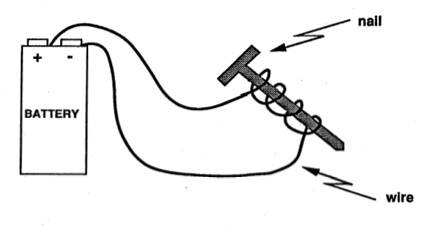
It is a kind of magnet that works only when there is a flow of electricity.
Electromagnet
Bar Magnet
Horse Shoe Magnet
Magnetite
Which of these forces can be used in a motor?
magnetism
wind
friction
gravity
Electromagnets are ___________________.
permanent
instant
temporary
stable
Which makes an electromagnet work?
needle
electricity
pin
thumbtacks

Most cores are made of _______.
Iron
Copper
Aluminum
Wood


The strongest parts of the magnet are ...
fronts
backs
poles
middle

The area around a magnet is called the .....
attraction zone
work area
magnetic field
hot zone

Why does the compass needle move at different locations?
Because the needle is attracted to the magnetic field produced by the magnet
Because north is up
Because it is being attracted to the Magnetic North Pole
Because north is down
Every magnet has a:
East and West pole
North and South pole
East and South pole
North and West pole
Chicago and Saint pole


When running a current through a wire, what do the blue lines represent?
The wire spinning
A magnetic field that was created
Electrons leaving
Electricity

What must the student do in the picture, in order to induce electricity and move the the galvonometer
nothing
move the magnet
add more loops of wire
unplug the galvnonmeter
To decrease the strength of a magnetic field around an electromagnet, we must
increase the number of coils
increase the size of the iron core
decrease the size of the iron core
decrease the number of coils
Describe the relationship between the number of coils and the strength of an electromagnet represented in the data table.
The greater the number of coils, the weaker the electromagnet.
There is no direct relationship between the number of coils and the strength.
The fewer the coils, the stronger the electromagnet.
The greater the number of coils, the stronger the electromagnet.
Describe the relationship between the amount of electric current and the strength of an electromagnet.
There is no direct relationship between current and electromagnetic strength.
The stronger the electric current is the weaker the electromagnet will be.
A stronger current will reverse the polarity of any electromagnet.
The stronger the electric current, the stronger the electromagnet.

Magnetic field near to the wire is stronger.
True
False

Direction of current in the wire is
Upwards
Downwards

Thumb shows the direction of
Magnetic field
Current

Pole of X and Y is
X : South
Y : North
X : North
Y : South

Diagram shows magnetic field around
Straight wire
Coil
Solenoid

What is pole X and Y?
X : North
Y : South
X : South
Y : North

Diagram shows meyhod to determine magnetic pole around a
Straight wire
Coil
Solenoid
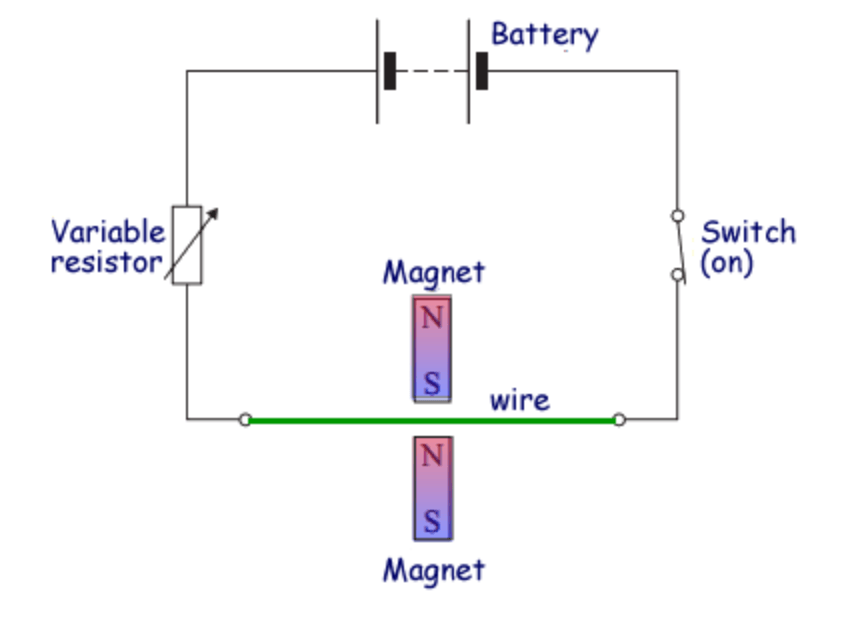
When a wire carrying an electric current is placed in a ________________, it may experience a force. The field from the fixed magnet ___________ with the field due to the current. This can cause the wire to be attracted or repelled from the fixed magnet you will see the effect of the attraction/repulsion in the ___________of the wire.

Thumb and first finger represent .......
magnetic field, force
force, current
force, magnetic field
current, force

The diagram show the direction of magnetic field,B and current, I.
By using Fleming left hand rules, determine the direction of Magnetic force, F.
left
downward
into the page
out from the page

The diagram show the direction of magnetic field,B and current, I.
By using Fleming left hand rules, determine the direction of Magnetic force, F.
no force produced
downward
into the page
out from the page
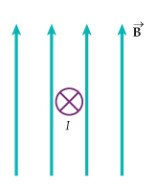
The diagram show the direction of magnetic field,B and current, I.
By using Fleming left hand rules, determine the direction of Magnetic force, F.
no force produced
right
into the page
out from the page

The diagram show the direction of magnetic field,B and current, I.
By using Fleming left hand rules, determine the direction of Magnetic force, F.
no force produced
right
downward
out from the page
Which part (s) of the DC motor connect the power supply to the split-ring and coil?
Carbon brushes
Magnets
Commutator
Slip rings

Use Flemming's left-hand rule to work out which way coil AB will turn.
Downward
Upward
Into the paper
Out of the paper
Which rule is used to find the direction of magnetic field around a straight conductor
Flemming left hand rule
Lenz law
Flemmings right hand rule
Right hand thumb rule

In the picture shown, can you decide the direction of the current on wire MN?
Upward
Downward
Into the paper
Out of the paper

Which among the following is not an example of electric motor
Fan
Blender
Nuclear power plant
Car

An example of electric generator
Windmill
Car
Refrigerator
Mixer
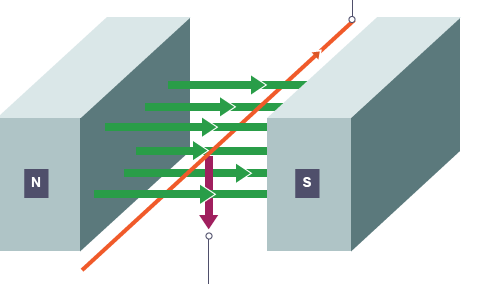
What direction is the force/motion in the following diagram?
Perpendicular to the magnets
Downwards
Parallel and through the magnets

Main difference between the motor effect and EM induction
Motor effect: current + magnetic field = motion
Induction: motion + magnetic field = current
Motor effect: current + motion = magnetic field
Induction: motion + magnetic field = current
Motor effect: current + motion = magnetic field
Induction: motion + magnetic field = no effect


Diagram above shows the apparatus used to study the effect of an electromagnet. Which change will increase the number of paper clips attracted to the iron rod?
Use a thinner wire to form the coils
Use a non-insulated wire to form the coils
Reduce the number of coils
Increase the magnitude of current
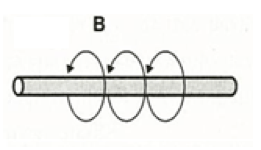
1) A wire carries a current, creating a magnetic field around itself as shown. The current in the wire is:
A. Directed to the right
A. Directed to the left
A. Equal to the magnetic field
In the same direction as the magnetic field

