
 Worksheets
Heat Math Review
Total questions: 70
Worksheet time: 2hrs 20mins
What is the formula to calculate heat energy required to raise the temperature of any substance?
Q = m C ∆T
Q = m C
Q = ½ m v
m = Tfinal - Tinitial


Heat transfers from ______ objects to cold objects.
Cold
Hot
larger
smaller
1. For the formula:
Q= m c ∆T
The units for specific heat are:
g /J °C
°C/g J
kJ/g
J/g°C
If the specific heat of water is 4.18 J/g∙°C, how much heat is required to increase the temperature of 1.2 g of water from 23 °C to 39 °C?
-80.256 J
80.256 J
80.256 J/g∙°C
-80.256 J/g∙°C
Which water molecules have the greatest kinetic energy?
Ice at 0 °C.
Water at 373 K.
Water at 98 °C
Steam at 150 °C.
Which of the following describes Convection?
The transfer of heat through liquids and gases
The transfer of heat through electromagnetic waves (rays)
The transfer of heat between two objects in direct contact with one another
Which of the following describes Radiation?
The transfer of heat through liquids and gases
The transfer of heat through electromagnetic waves (rays)
The transfer of heat between two objects in direct contact with one another
Which of the following examples represents Conduction?
A person holding a hot cup of coffee
The sun heating the sidewalk
A person warming their hands above a fire
Which of the following examples represents Convection?
A person holding a hot cup of coffee
A pot of boiling water
A person warming their hands above a fire
Which of the following examples represents Radiation?
A person holding a hot cup of coffee
A pot of boiling water
A person warming their hands above a fire
Fill-in the blank: A person gets sunburned due to ______________ from the sun.
Conduction
Convection
Radiation

Boiling Water
Conduction
Convection
Radiation

Curling Iron
Conduction
Convection
Radiation

Sun Bathing
Conduction
Convection
Radiation
Cooking pizza in the microwave is an example of...
conduction
convection
radiation
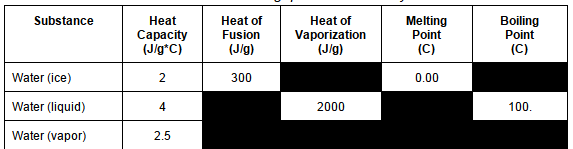
The specific heat of platinum is 0.133 J/g°C. How much heat(Q) is released when a 10 g piece of platinum cools from 100°C to 50°C?
66.5 J
665 J
0.0266 J
0.665 J
You hold a bowl of hot soup that warms your hands; this is
A. Radiation
B. Conduction
C. Convection
D. Conviction
Heat transfer is also called...
Thermal Energy
Conduction
Convection
Radiation

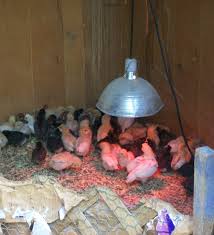
This picture is an example of...
Conduction
Convection
Radiation
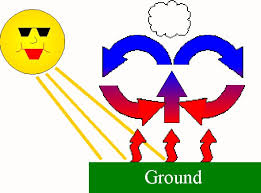
When heat energy moves in a liquids or gases it is called...
Conduction
Convection
Radiation
What is the formula to calculate heat energy required to raise the temperature of any substance?
Q=mc∆t
Q=mc
Q= ½mv
m=QC
What is Specific Heat?
The amount of thermal energy required to increase the temperature of 1 g of a material by 1 degree Celsius.
The amount of radiant energy required to increase the temperature of 1 g of a material by 1 degree Fahrenheit.
The amount of energy required to increase the temperature of 1 kg of a material by 1 degree Kelvin.
The amount of friction required to increase the temperature of 1 kg of a material by 1 degree.
Using the heat equation, what would the formula look like if we were solving for change in temperature?
Q m=∆T c
Q/mc= ∆T
Qm/c=∆T
mcQ=∆T
The unit(s) for specific heat is/are
J
g
℃
J/g℃
Using the heat equation, what would the formula look like if we were solving for specific heat?
q=mcΔT
q=c/mΔT
c=qmΔT
c=q/mΔT
How do you calculate ΔT?
Tinitial -Tfinal
Tfinal -Tinitial
Tinitial - Tstart
Tfinal- T end

If two objects have different temperatures when they come in contact, heat will flow from the warmer object to the cooler one UNTIL ____________
one reaches a temperature of zero
they both have an equal temperature
one runs out of energy
What does "ΔT" mean?
A change in health
A change in heat
A change in height
A change in temperature
The total amount of energy of all the particles in a substance is called________________.
temperature
thermal energy or heat
degrees
mass
The standard unit of heat and energy is the __________.
grams
heat
joule
watts
milliliters
The specific heat of water is 4.18 J/g°C.
If 980. J of energy is added to 6.20 g of water at 18.0 °C, what is the final temperature of the water?
37.8 °C
-19.8 °C
19.8 °C
55.8 °C

A metal cube at temperature of 70°C is immersed in water at temperature of 20°C. The metal _______ heat while the water __________ heat.
gains, loses
loses, gains
What causes your skin to feel warm when it is in the sun on a summer day?
Particles in the atmosphere reflect energy from the Sun downward
The Sun radiates energy that passes through space & the atmosphere to your skin.
Hot particles from the Sun still carry some heat when they reach your skin.
The solar wind carries heated air from the Sun’s atmosphere to Earth’s surface.
Which best describes the flow of heat?
A. From a larger object to a smaller object
From a cooler object to a warmer object
From a warmer object to a cooler object
From a warmer object to a warmer object
You hold a bowl of hot soup that warms your hands; this is
A. Radiation
B. Conduction
C. Convection
D. Conviction
Steam from a hot bowl of soup warms your face as you lean over it; this is
A. Radiation
B. Conduction
C. Convection
D. Conviction
Jim wakes up early in the morning and walks from his carpeted bedroom to the tiled kitchen. Which BEST describes why, despite being the same temperature, the tile floor feels cooler to his feet than the carpet?
A. Tile is a better conductor of heat and transfers heat away from his skin.
B. Carpet is a bad conductor of heat and transfers heat to his skin.
C. Tile is a poor conductor of heat and transfers heat to his skin.
D. The tile and carpet are the same temperature

This picture is an example of...
Conduction
Convection
Radiation

This picture is an example of...
Conduction
Convection
Radiation
A type of heat transfer that does not rely on physical contact of substances is called...
Conduction
Convection
Radiation

This picture is an example of...
Conduction
Convection
Radiation

This picture is an example of...
Conduction
Convection
Radiation
The higher the temperature the higher the...
Kinetic Energy
Potential Energy
Sound Energy
Chemical Energy
The more heat the more the particles...
Stay in a fixed psoition
Vibrate

