
Font size
 Worksheets
TCAP Review
Total questions: 16
Worksheet time: 13mins
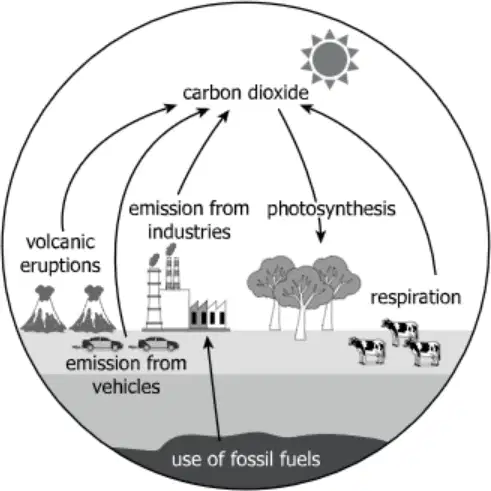
Using fossil fuels in industries can harm groups of living things. What is the best way to protect the biodiversity of an ecosystem from industrial development?
operate industries without using fossil fuels
use more vehicles to increase visitors
burn more fossil fuels to improve the economy
set up more homes for people to live in
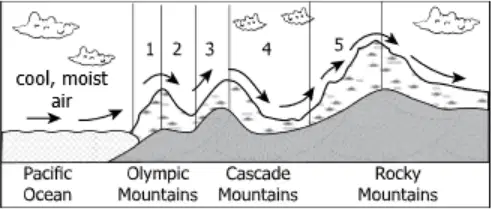
The diagram shows five regions around the Olympic, Cascade, and Rocky Mountains, along with the prevailing wind direction. Which three regions are most likely to receive rainfall as the cool, moist air passes over them?
1
2
3
4
5
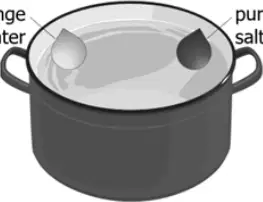
A student creates a model of a global ocean current by filling a pot with water. The student adds orange-colored fresh water to one side and purple-colored salt water to the other side. What is the expected movement of the colored water and how does the experiment demonstrate the ocean current?
The fresh water and salt water mix evenly showing the temperature differences in ocean water.
The salt water and fresh water remain on separate sides of the baking dish showing the temperature differences in ocean water.
The fresh water is more dense and sinks under the salt water showing the salinity differences in global water movement.
The salt water is more dense and sinks under the fresh water showing the salinity differences in global water movement.
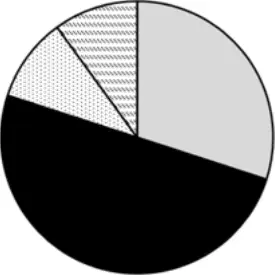
The town's main sources of electricity include both fossil fuels and renewable energy.
Fossil fuels
Renewable energy
Both fossil fuels and renewable energy
None of these

The percentage of the town's water that has come from the river in the past 10 years is:
10%
25%
50%
75%
Which energy source is not renewable?
The town is concerned about the depletion of nonrenewable resources.
Depletion
Cost
Pollution
Waste
How has the town's population changed in the past 10 years?
Which statement best describes the resources used by the town shown in Graph 1?
The town uses only nonrenewable resources.
The town uses only renewable resources.
The town uses more renewable than nonrenewable resources.
The town uses more nonrenewable than renewable resources.
How can the town use the available money to increase the electricity supply and keep the long-term costs down?
Increase the use of hydroelectric and wind power.
Increase the use of coal and wind power.
Increase the use of natural gas and hydroelectric power.
Increase the use of coal and natural gas.
Which correctly compares the consequences of the possible heating sources for new buildings?
Heating new buildings using only natural gas will decrease the town’s total demand for resources.
Heating new buildings with natural gas will produce less pollution than heating buildings with electricity that is supplied by hydroelectricity and wind turbines.
Heating new buildings using both natural gas and electricity from all the town’s electricity sources will decrease the town’s total demand for resources.
Heating new buildings with electricity that is supplied by hydroelectricity and wind turbines will produce less pollution than heating buildings with natural gas.
Which argument about the town’s water use can be made from the data in Graph 2?
The town can continue its current pattern of water resource management because the water use is less than the water supply.
The town can continue its current pattern of water resource management because river water is easier to access than groundwater.
The town needs to change its current pattern of water resource management because its use of river water is almost equal to the river water supply.
The town needs to change its current pattern of water resource management because it uses far less groundwater than is available.
The town currently uses the river for both hydroelectric power and as a water supply. Which is the best way for the town to meet its electricity and water needs while minimizing its impact on the river?
The town should continue to use the river as a water source until the water use is equal to the water supply.
The town should stop using the river for hydroelectric power and use it only as a water source.
The town should decrease the use of the river as a water source and rely more on groundwater.
The town should increase the use of the river for both hydroelectric power and water source and monitor when animals stop living around the river.

Which climate description is most likely correct for the mountain?
A. The mountain is colder at 3,000 m than at 1,000 m.
B. The mountain is less humid at 1,000 m than at 3,000 m.
C. The mountain has less precipitation at 3,000 m than at 1,000 m.
D. The mountain has more severe weather at 1,000 m than at 3,000 m.
A student reads a passage about animals that eat honey. The honey badger and honeyguide are two animals that live in the grasslands of Africa. Both animals eat honey as part of their diets. The honeyguide is a bird that can find beehives that contain honey but cannot access the honey. The honey badger is a mammal that is low to the ground, so while it can break apart beehives, it cannot locate them very well. The honey badger follows the honeyguide to beehives and then breaks them apart. Both animals eat the honey inside the beehives. The student claims that the honeyguide and honey badger are competitors. Which statement evaluates the student’s claim?
The student is incorrect because both animals have a predatory relationship as they can attack beehives and eat the honey they contain.
The student is incorrect because the two animals have a mutualistic relationship that results in both having food to eat.
The student is correct because both animals are trying to get the same food source.
The student is correct because the honey badger eats more honey than the honeyguide.
How can alternating crops prevent nutrient depletion from the soil?
It maintains healthy conditions for plant growth.
It limits the amount of water needed each year.
It reduces the need for the soil to contain nutrients.
It increases the need for watering.

