
Font size
 Worksheets
Electricity AS
Total questions: 22
Worksheet time: 15mins

Kirchoff's First Law states
the sum of the currents entering any junction in an electric circuit must equal the sum of the currents leaving that junction
the sum of the charges entering any junction in an electric circuit must equal the sum of the charges leaving that junction
the sum of the emfs entering any junction in an electric circuit must equal the sum of the pds leaving that junction
none of these
Select all true statements
Kirchoff's second law depends on the conservation of energy principle
Kirchoff's first law depends upon the conservation of charge
Kirchoff's second law depends on the conservation of charge principle
Kirchoff's first law depends upon the conservation of energy

i1 + i5 +i4 = i2 + i3
i1 + i5 +i3 = i2 + i4
i5 + i2 +i4 = i1 + i3
i1 + i5 = i2 + i3 + i4

Which equations are correct?
ε1 - i1R1 - i2R2 = 0
ε1 + ε2 + i3R3 - i2R2 = 0
ε1 - i2R1 - i2R2 = 0
ε1 - ε2 - i3R3 + i2R2 = 0
If three 1.5 V cells are connected in series
the combined emf is 4.5 V and it will last as long as a single 1.5 V cell
the combined emf is 1.5 V and it will last as long as a single 1.5 V cell
the combined emf is 4.5 V and it will last longer than a single 1.5 V cell
none of these
If three 1.5 V cells are connected in parallel
the combined emf is 4.5 V and it will last as long as a single 1.5 V cell
the combined emf is 1.5 V and it will last longer than a single 1.5 V cell
the combined emf is 4.5 V and it will last as long as a single 1.5 V cell
none of these
Two 4000 Ω are connected in parallel, and then these are connected in series to another pair of parallel wired resistors to give a total circuit resistance of 6000 Ω. What are the possible values of the other pair?
both 8000 Ω
both 4000 Ω
one 5500 Ω and the other 8000 Ω
one 6000 Ω and the other 12000 Ω
Which statement about parallel circuits is correct?
The current flowing through each loop is always the same
The potential difference across each loop is always the same
The resistance of each loop is always the same
25 C of charge transfers 50 J of energy between two points. What is the potential difference between those points?

Lydia is comparing series and parallel circuits in a class practical. Lydia switches on both circuits. Which one is correct?
The reading on A1 is less than the reading on A2.
The total resistance in circuit B is 6 Ω.
The p.d. across the 8 Ω is the same in both circuits.
The p.d. across A2 is very large

Which component does this I–V graph represent?
diode
filament bulb
wire
resistor
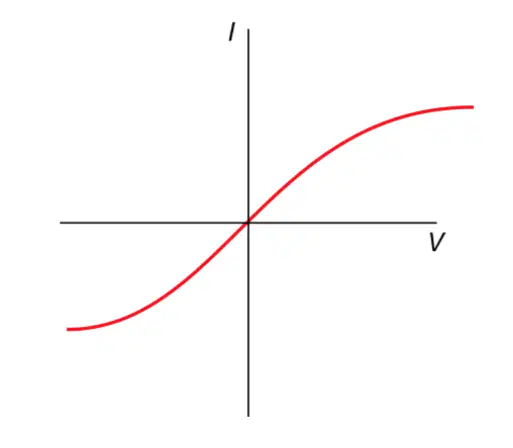
Which component does this I–V graph represent?
diode
wire
filament bulb
resistor
Which statement is correct about a fixed resistor?
Their resistance can be varied.
They are used to control the size of the current through a circuit.
Resistors cause filament lamps to ‘blow’.
Resistors are a safety device in a circuit.
Which of the following statements is true about a thermistor?
As the current increases the voltage across the thermistor remains constant.
Their resistance remains constant despite the temperature.
As the light intensity increases their resistance decreases.
As the temperature increases their resistance decreases.
The resistance of a light dependent resistor changes as the light intensity changes. Which of the following statements is correct?
As the light intensity increases the resistance in the wire decreases.
They are used in photosensitive equipment, such as cameras.
The greater the light intensity the greater the current flow.
All of the above.
A student investigates the I–V characteristics of a wire. Which of the following would help the student maintain accurate readings?
using a different piece of wire each time
turning the switch off when not taking a reading
adding insulation around the wire
none of the above
A student placed a diode into a circuit to record its I–V characteristics. The ammeter registered a reading of 0. What should the student do to get a reading from the diode?
replace the cell
reverse the position of the diode
add in a bulb
add in a fixed resistor
Why does the resistance in a wire increase with temperature?
The atoms in the wire gain energy as the temperature increases.
The electrons in the wire lose energy as the temperature increases.
The atoms in the wire get larger as temperature increases.
None of the above.
Which of the following is a practical application of a thermistor?
in street lighting
in a thermostat in a freezer
to control the current in a radio
in a doorbell
For n resistors, each of the same resistance, the equivalent resistance, R, when connected in parallel is:
R
nR
R/n
n/R
Scarlett, Avery, and Harper are working on a science project. They are trying to understand the concept of resistance. In this context, resistance is
Measured using an ammeter by Scarlett
Units are 'volts', as Avery suggested
How difficult it is for electrons to move through an object, as Harper explained
The continuous movement of electrons in a wire, as Scarlett observed
The work done per unit positive charge is known as...
Emf
Voltage
Current
Resisitor

