
 Worksheets
IOT_SARS
Total questions: 40
Worksheet time: 11mins

1. IoT stands for:
Inside of Things
Internet of Things
Internet of Time
Who is inventor of IoT ?
Mark Zukerberg
Kevin Ashton
Jan Koum
Brian Acton
My watch displays the current weather downloaded from the internet. My watch is an IOT device.
True
False
A car is example of an object that can be part of the Internet of Things. True or False?
True
False

IoT is defined as a network of internet-connected things with _________ and are able to talk to each other and collect or exchange data.
Security
Senses
Sensors
The devices in the IoT are connected...
to the server.
to the Internet.
directly to one another.
When IoT devices are communicating together, these form...
an intelligent system.
a big device.
an android.
a robot.

Select the two advantages of the IoT:
Cutting down waste
Wastes time and money
The ability to access information from anywhere at anytime
Slows down communication between devices
Guess the out of following c program
#include <stdio.h>
int main() {
int x = 10;
printf("%d", ++x);
return 0;
}
10
11
0
Compilation error
#include <stdio.h>
int main() {
int x = 5;
printf("%d %d", x, x += 10);
return 0;
}
5 5
5 15
15 5
15 15

One use of IoT is:
Computer
Laptop
Smart Home

Smartphones, Smartwatches, Cars, Refrigerators are
all components of IoT
True
False

Bank ATMs are considered some of the first IoT objects.
True
False
Internet of Things is the evolution of _______________ connected to the Internet.
cars, mobiles, and desktop computers
mobiles, homes and embedded applications
mobiles, streets, applications
#include <stdio.h>
int main() {
int a = 3, b = 4;
printf("%d", a > b ? a : b);
return 0;
}
3
4
0
Compilation error
#include <stdio.h>
int main() {
int a = 5, b = 10;
printf("%d", (a < b) && (b > 5));
return 0;
}
0
1
5
10

Chips and sensors are integrated into devices around us to
Transmit data
Decrypt messages
Add features
Which network technology support by IoT device?
Wi-Fi
Bluetooth
LoRa
All
Arduino IDE is written in which programming language?
Java
c/c++
Java Script
Python
What is Arduino UNO?
Software
Hardware Device
Network
Protocol
Which of the following operations is not supported by a stack?
Push
Pop
Peek
Dequeue
In a stack, which of the following is the correct order of operations?
FIFO
LIFO
FILO
LILO
Which of the following is not a sensor in IoT?
BMP280
DHT11
Photoresistor
LED
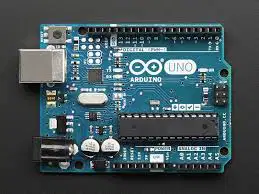
There are _____
14 digital pins, 6 analog pins and power pins are 3
12 digital pins, 6 analog pins and power pins are 3
16 digital pins, 8 analog pins and power pins are 5
20 digital pins, 8 analog pins and power pins are 5
Name a benefit of using IoT in agriculture.
Improved resource management and crop yields
Higher labor costs
Increased water usage
Decreased pest resistance

Digital pins starts from ______________
pin 0 to 13
pin 9 to 13
pin 0 to 7
pin A0 to A5
In a queue, which of the following pointers is typically used to keep track of the front of the queue?
Rear
Head
Tail
Front
Which of the following data structures can be used to implement a queue?
Array
Linked List
Stack
All of the above
Which of the following layers provides end-to-end communication in IoT?
Logical layer
Data link layer
Transport layer
Session layer

This object is
an Actuator
a Sensor
a Connected Object
a Communicating Object

This object is
a Sensor
an Actuator
Connected Object
Communicating Object

This smart Watch is called
Communicating Object
Connected Object

IoT components use a wired or wireless computer network to connect and communicate.
True
False
Which of the following operations is NOT typically supported by a linked list?
Insertion
Deletion
Traversal
Random access
Which of the following is a key characteristic of IoT?
Limited data processing
High interconnectivity between devices
No real-time monitoring
Lack of automation
Which technology enables IoT devices to communicate over short distances?
Bluetooth
Satellite Communication
Fiber Optics
Dial-up Connection
What does OLED stand for?
What is the purpose of sensors in IoT devices
To collect environmental data.
What does DHT stand for in the context of sensors?
What is the operating voltage of the Arduino UNO?

