
 Worksheets
1st Quiz on Systems and Devices of Applied AI
Total questions: 19
Worksheet time: 10mins
What is the primary function of a sensor?
To convert energy from one domain to another
To detect physical inputs and convert them into electrical signals
To store data for processing
To amplify electrical signals
Which of the following is a characteristic of a transducer?
It can only function as a sensor
It transforms energy from one domain into another
It is always reversible
It does not require any power source
What type of sensor uses resistance changes to measure physical quantities?
Physical sensor
Radioactive sensor
Biological sensor
Chemical sensor
What is the difference between active and passive sensors?
Passive sensors can only measure pressure
Passive sensors are more accurate than active sensors
Active sensors can only measure temperature
Active sensors require an external power source, while passive sensors do not
Which of the following is an example of a digital sensor?
Pressure gauge
Encoder
Thermocouple
Accelerometer
What does the term 'sensitivity' refer to in the context of sensors?
The ability to detect small changes in input
The time it takes for a sensor to respond
The range of input values a sensor can measure
The accuracy of the sensor's output
What is the purpose of signal conditioning?
To convert analog signals to digital signals
To amplify the output of a sensor
To store data for future use
To manipulate an analog signal to meet processing requirements
Which type of filter allows all frequencies below a certain cutoff frequency to pass?
Band-stop filter
Low-pass filter
Band-pass filter
High-pass filter
What is the primary function of a Wheatstone bridge?
To convert analog signals to digital
To filter noise from signals
To measure unknown resistances
To amplify signals
What is the main advantage of digital signal processing over analog?
Lower power consumption
Higher noise immunity
Simpler implementation
Less expensive
Which of the following is a disadvantage of analog signals?
Higher noise immunity
More accurate representation of changes
Prone to distortion and noise
Easier to process
What does PWM stand for in signal processing?
Phase Width Modulation
Pulse Wave Modulation
Pulse Width Modulation
Pulse Waveform Modulation
Which of the following is NOT a characteristic of a microcontroller?
It has a CPU
It can perform multiple functions
It requires an external power source
It has built-in memory
What is the role of an ADC?
To filter noise from signals
To amplify analog signals
To convert digital signals to analog
To convert analog signals to digital
What is the primary use of a PLC?
To control industrial processes
To amplify signals
To measure temperature
To store data
Which of the following describes a digital signal?
Continuous in nature
Prone to noise
Discrete values
Analog in form
What is the main function of a DAC?
To filter noise from signals
To measure temperature
To convert digital signals to analog
To amplify analog signals

When a relay is better to a transistor when we want to control devices?
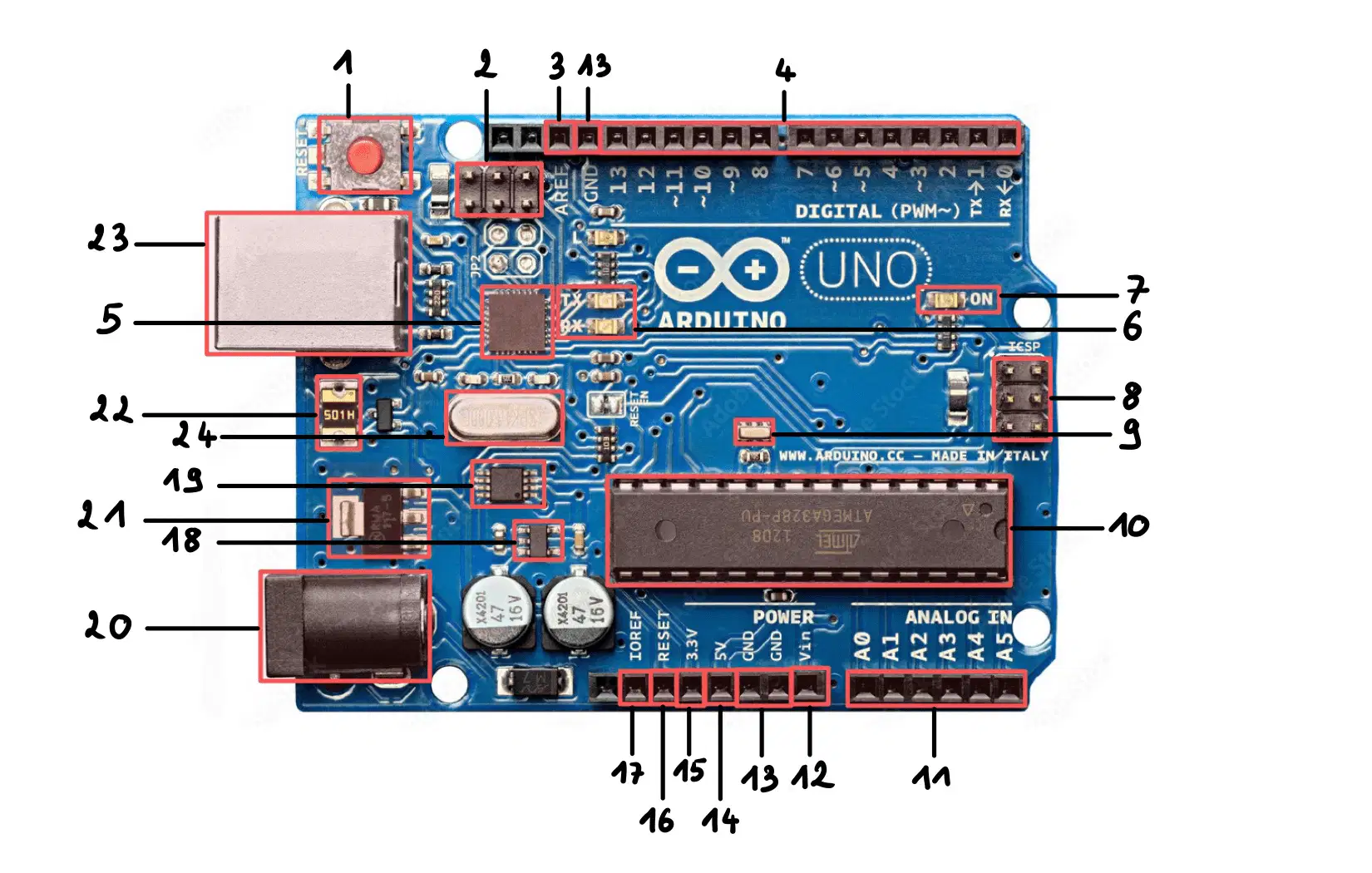
What kind of elements are marked with No. 4 in the microcontroller?

