
 Worksheets
Business in Society
Total questions: 60
Worksheet time: 30mins
What is the main difference between 'needs' and 'wants'?
Needs are things you would like to have but do not need to survive, while wants are essential for survival.
Needs are essential for survival, while wants are things you would like to have but do not need to survive.
Needs and wants are both essential for survival.
Wants are more important than needs.
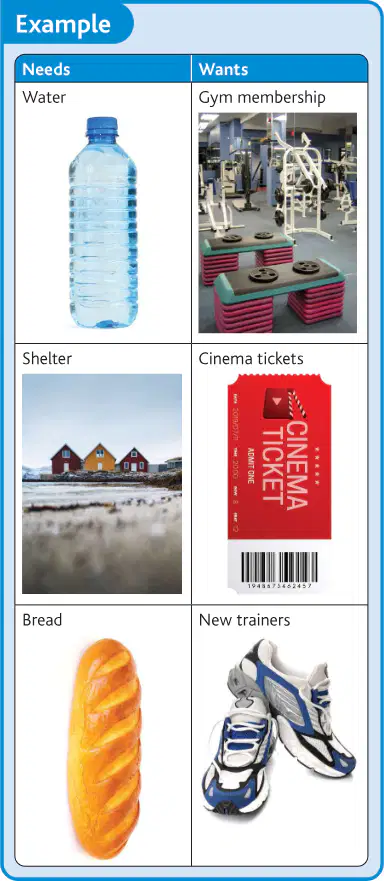
Which of the following is an example of a 'need'?
Gym membership
Cinema tickets
Water
New trainers
Why do businesses supply products and services?
To meet only the wants of societies
To meet both the needs and wants of societies
To meet only the needs of societies
To make a loss
In economically developed countries, why do some people work?
To earn an income to buy things they want rather than need
To earn an income to buy only essential items
To avoid buying any non-essential items
To earn an income to buy only luxury items
What is the difference between needs and wants?
Needs are things we require to survive; wants are products or services we would like to make our life more enjoyable.
Needs are things we want for fun; wants are things we require to survive.
Needs and wants are the same and can be used interchangeably.
Needs are always more expensive than wants.
Which of the following is an example of a need?
Designer jacket
Sports car
Water
Holiday in Spain
Which of the following is an example of a want?
Basic food such as bread and potatoes
Weatherproof house
Strawberry milkshake
Water
What are 'tangible' goods?
Goods that cannot be seen or touched
Services provided by businesses
Products we can see and touch
Items that are only used once
Which of the following is an example of a durable good?
Food
Can of soft drink
Fridge
Petrol
What is a characteristic of non-durable goods?
Used many times and have a long lifespan
Consumed almost immediately
Difficult to understand
Provided by local councils
Which industry is part of the service sector in the UK?
Manufacturing
Education
Agriculture
Mining
What are goods?
Products we can see and touch when we purchase them.
Services performed for us.
Items that are always free.
Things that cannot be bought.
What are services?
Products we can see and touch when we purchase them.
Services performed for us.
Items that are always free.
Things that cannot be bought.
Which of the following is an example of a durable good?
A loaf of bread
A haircut
A computer
A taxi ride
Which of the following is an example of a service?
A loaf of bread
A computer
Hairdressing
A car
Which factor of production includes natural resources like coal and water?
Labour
Land
Capital
Enterprise
What does the factor of production 'Labour' refer to?
Natural resources
Machinery and equipment
Staff within a business
Business ideas
Which factor of production involves machinery, equipment, and finance?
Land
Labour
Capital
Enterprise
What is the role of 'Enterprise' in the factors of production?
Providing natural resources
Supplying machinery and tools
Generating business ideas and taking risks
Hiring employees
What are the four factors of production?
Land, Labour, Capital, Enterprise
Land, Water, Air, Fire
Money, Machines, Buildings, Vehicles
Workers, Managers, Owners, Investors
What is the business idea that the owner has when bringing the other three factors of production together?
Land
Labour
Capital
Enterprise
Which factor of production involves raw materials taken from the land?
Land
Labour
Capital
Enterprise
What is an entrepreneur?
Someone who manages a team
Someone who combines factors of production to provide a service
Someone who works for a company
Someone who invests in stocks
Which of the following is a decision an entrepreneur must make when starting a business?
What color to paint the office
Where to locate the business
What to have for lunch
How to decorate the office
What is a key characteristic of entrepreneurs?
They avoid taking risks
They have a strong belief in their ability to succeed
They prefer to work alone
They dislike planning
Why do entrepreneurs work very long hours?
To avoid spending time with family
To ensure their business idea works and is successful
To impress their friends
To avoid boredom
What is one of the key characteristics an entrepreneur must have according to the text?
Ability to avoid risks
Show initiative and make things happen
Depend on others for ideas
Avoid new ventures
Identify three personal qualities an entrepreneur could have.
Laziness, fearfulness, indecision
Motivation, determination, risk-taking
Carelessness, impatience, doubt
Timidity, passivity, hesitation
Identify three skills a successful entrepreneur could have.
Procrastination, avoidance, denial
Communication, problem-solving, leadership
Disorganization, forgetfulness, distraction
Complaining, blaming, quitting
Outline reasons why a person would want to become an entrepreneur and own their own business.
To avoid responsibility and work less
To have control over their work and pursue their passion
To ensure they never have to make decisions
To avoid learning new skills
Who typically offers advice on starting up a business and helps prepare a business plan?
Venture capitalist
Local enterprise councils
Banks
The Prince’s Trust
What is a venture capitalist?
A person/business that invests in businesses considered too risky by banks
An organization offering grants and training
A government loan scheme
A small business advisor
What age group does The Prince’s Trust’s Enterprise Programme target?
10-20 years
18-30 years
25-40 years
30-50 years
Which type of finance involves borrowing a specific sum of money for a specific purpose?
Bank loan
Savings
Hire purchase
Grant
What is the purpose of a grant from local or central government?
To buy a property
To borrow money from family
To meet certain criteria, such as setting up in an area of high unemployment
To purchase equipment over time
What does hire purchase (HP) involve?
Buying assets over a period of time and owning them at the end
Borrowing money from a bank for a specific purpose
Reducing the amount to be borrowed by investing savings
Receiving money as an incentive to meet criteria
Which term allows you to withdraw more money than you have from your bank account?
Mortgage
Overdraft
Loan
Credit card
Which term refers to someone who will invest in more risky business ventures?
Venture capitalist
Business angel
Stockbroker
Financial advisor
What are the three main sectors of the economy?
Private sector, Public sector, Third sector
Private sector, Government sector, Industrial sector
Public sector, Industrial sector, Agricultural sector
Third sector, Agricultural sector, Government sector
Which of the following is a characteristic of the private sector?
Owned by the government
Driven mainly by profit
Provides free services
Funded by taxpayers
Which organization is part of the public sector?
Sole traders
Franchises
National Health Service (NHS)
Private limited companies
How are services in the public sector funded?
By private investors
Through bank loans
By taxpayers
By shareholders
What is the main purpose of organisations in the third sector?
To make a profit
To help a community or specific cause
To compete with other businesses
To sell products
How do third sector organisations typically receive their funding?
By selling products
Through donations and membership fees
By charging high service fees
Through government grants only
Which of the following is an example of a third sector organisation?
A multinational corporation
A local rugby club
A private bank
A fast-food chain
What type of organisation is the Red Cross?
A for-profit business
A government agency
A charity
A private club
What is the main purpose of public sector organizations?
To make a profit and be funded by owners
To be owned and run by the government, and funded by taxes
To set up a group or to raise awareness for a cause
To provide entertainment services
Which sector is set up to make a profit and funded by the owners?
Private sector
Public sector
Third sector
Charity sector
What is the primary goal of the third sector?
To be owned by the government
To make a profit
To set up a group or to raise awareness for a cause
To provide educational services
What are the four main sectors of industry?
Primary, secondary, tertiary, quaternary
Primary, secondary, tertiary, quinary
Primary, secondary, quaternary, quinary
Primary, tertiary, quaternary, quinary
Which sector is involved in the extraction of Earth's natural resources?
Primary sector
Secondary sector
Tertiary sector
Quaternary sector
Which of the following is NOT typically part of the primary sector?
Farming
Oil and gas industry
Banking
Mining
What is the primary function of organisations in the secondary sector?
Selling raw materials
Providing services
Manufacturing finished products
Distributing goods
Which sector is mainly concerned with selling goods or providing a service?
Primary sector
Secondary sector
Tertiary sector
Quaternary sector
What type of services does the quaternary sector mainly provide?
Manufacturing-based services
Knowledge-based services
Agricultural services
Retail services
Which of the following is a typical job role in the quaternary sector?
Farmer
Factory worker
Computer programmer
Retail manager
What is the main focus of the primary sector?
Providing services
Extracting raw materials
Manufacturing products
Knowledge-based services
Which sector of industry is concerned with using raw materials to manufacture products?
Primary
Secondary
Tertiary
Quaternary
Which sector is involved in manufacturing and construction?
Primary sector
Secondary sector
Tertiary sector
Quaternary sector
What does the tertiary sector focus on?
Agriculture
Manufacturing
Services
Information technology

