
 Worksheets
Protein Synthesis - TRANSCRIPTION
Total questions: 20
Worksheet time: 16mins
The nitrogenous bases of DNA code for...
carbs
proteins
lipids
sandwiches
Which process is used to make mRNA from the DNA in the nucleus?
replication
transcription
translation
reverse transcription
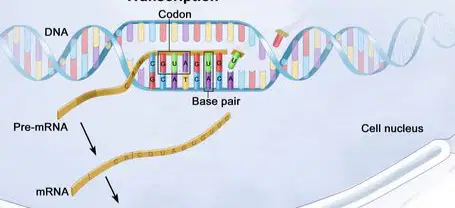
Which process is occurring in this figure?
translocation
transcription
replication
translation
The first step in transcription is ...
RNA polymerase binds to DNA and unwinds the double helix
RNA polymerase builds a complementary mRNA strand from DNA template
mRNA leaves the nucleus to find a ribosome
the mRNA is "read" by the ribosome
The second step in transcription is ...
RNA polymerase binds to DNA and unwinds the double helix
RNA polymerase builds a complementary mRNA strand from DNA template
mRNA leaves the nucleus to find a ribosome
the mRNA is "read" by the ribosome
The third step in transcription is ...
RNA polymerase binds to DNA and unwinds the double helix
RNA polymerase builds a complementary mRNA strand from DNA template
mRNA leaves the nucleus to find a ribosome
the mRNA is "read" by the ribosome
How does the RNA "base pairing" rule differ from DNA?
in RNA, C pairs with A instead of G
in RNA, U pairs with A instead of T
in RNA, U pairs with G instead of C
in RNA, U pairs with T instead of A
What would the mRNA sequence be if the original DNA template strand sequence was: TAC GCT ACT GAA
AUG CGA UGA CUU
ATG CGA TGA CTT
GUA TAG UAG TUU
Protein is a polymer made from what monomer?
nucleic acids
carbohydrates
amino acids
fatty acids
The central dogma of biology states that the "flow" of genetic information
DNA --> proteins --> RNA
DNA --> RNA --> proteins
RNA --> DNA --> proteins
proteins --> RNA --> DNA
During transcription, this type of ribonucleic acid is responsible for copying the DNA and brining it out of the nucleus.
tRNA
mRNA
rRNA
dRNA
In what process is mRNA synthesized?
Transcription
Translation
DNA Replication
Mitosis
Why must transcription occur in the nucleus?
because DNA can't leave the nucleus
because ribosomes are in the nucleus
because DNA polymerase is found there
because helicase unzips the DNA

How are DNA and RNA different? (CHECK ALL THAT APPLY)
Only DNA can leave the nucleus
RNA contains Thymine; DNA contains Uracil
DNA is double stranded, RNA is a single stranded
DNA contains Thymine, RNA contains Uracil
Choose the sequence of the mRNA strand that would match up with to the following DNA strand:
GTA CAT
CAT GTA
GAU CUA
CAU GUA
CUT GTU
Which is the mRNA molecule that would be transcribed from this DNA template:
TGG CAA GTA CGT
ACC GTT CAT GCA
UGG CAA GUA CGU
UCC GUU CUU GCU
ACC GUU CAU GCA
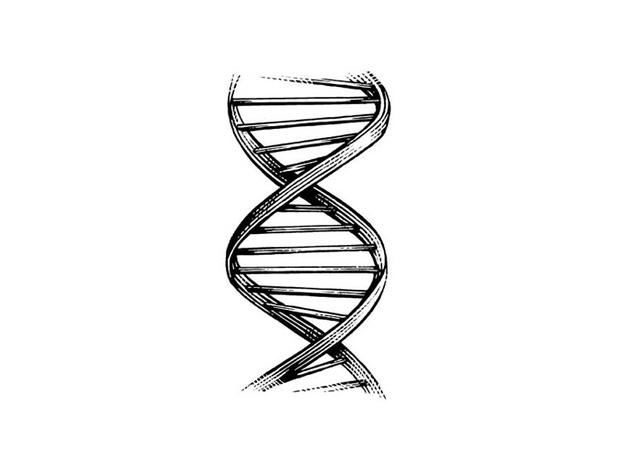
What is the product of transcription?
mRNA molecule
double stranded DNA
amino acids
protein

What is the correct order to make a protein?
Protein, DNA, RNA
RNA, DNA, Protein
DNA, RNA, Protein
Protein, RNA, DNA
What is the primary function of mRNA in the cell?
To bring amino acids to the ribosome
To carry genetic information from DNA to the ribosome
To form the structure of ribosomes
To catalyze the formation of peptide bonds
![[Practice Test] Skeletal & Muscular Systems](https://cf.quizizz.com/image/image-loader.svg)
